



Drinking Water Crisis in Mayotte: Enhanced Measures in Response to the Exceptional Situation
In light of the drought and the water restrictions implemented in Mayotte, the population of Mayotte is potentially exposed to increased health risks. Santé publique France provides an update on the strengthening of the monitoring and alert system that has been put in place, as well as the mobilization of the Pharmaceutical Agency and the Health Reserve, which have been on the ground for several months.
The health reserve
Coordinated by Santé publique France, the Health Reserve is a community of healthcare professionals who volunteer their services and can be called upon by the government. Capable of...
The department of Mayotte is currently facing an unprecedented drought, with the largest rainfall deficit since 1997. By the end of January 2023, rainfall in Dzoumogné and Combani—the locations of the department’s two hillside reservoirs, which account for approximately 80% of the department’s water supply—was 40% below normal levels. The exceptionally low levels of water reserves led the water resource monitoring committee, chaired by the Prefect, to decide to implement water cuts starting in early 2023—much earlier than in previous years.
The disruption in water supply may expose the population to significant health risks and lead to potential epidemics. In this context, Santé publique France has implemented enhanced surveillance measures and established a crisis management structure, including significant mobilization of the Health Reserve. Regular updates are produced and published on the website to monitor and assess the epidemiological situation in Mayotte.
What are the health risks to the population?
These water shortages expose the population to increased health risks, especially since a large portion of the residents live in precarious conditions (77% of the population lives below the national poverty line). The lack of water supply can lead to:
the use of water unfit for consumption;
insufficient hydration;
an inability to practice basic hygiene, including handwashing;
a lack of sanitation and the inability to dispose of waste;
the storage of water unfit for consumption or likely to serve as breeding grounds (for mosquitoes).
To date, Mayotte has entered the post-epidemic phase for the seasonal outbreak of acute rotavirus gastroenteritis. However, a significant proportion of the pathogens identified in gastrointestinal samples over the past five weeks are Escherichia coli-type enterobacteria, indicating a decline in basic hygiene practices resulting from stricter water cutoff measures across the territory.
At the same time, typhoid fever and hepatitis A, two diseases endemic to Mayotte, could be on the verge of an epidemic outbreak. Indeed, the water shortage could reduce people’s ability to practice even the most basic hygiene practices, thereby facilitating the spread of these two diseases through direct person-to-person contact (fecal-oral transmission) or through the ingestion of contaminated water or food. At this stage, however, no resurgence of these diseases has been observed.
What monitoring system has been put in place?
The enhanced surveillance and alert system in place relies on surveillance systems and networks that are already operational or have been tested during previous crises, such as:
monitoring of emergency room visits (Oscour®) at the Mamoudzou Hospital and deaths from all causes;
surveillance via the network of sentinel pharmacists and physicians;
molecular surveillance in collaboration with the laboratory at the Mamoudzou Hospital Center;
surveillance of severe cases admitted to intensive care;
surveillance of reportable diseases;
surveillance in middle and high school infirmaries.
The system is supplemented by community-based surveillance (CBS) targeting populations with low healthcare utilization and limited access to water. CBS is being rolled out across the territory through the network of health and social service associations, in collaboration with the ARS and Samu-Centre 15.
In addition, wastewater surveillance is being implemented at two water treatment plants by the ARS Mayotte with support from the DGS and Eau de Paris.
Enhanced mobilization of the Health Reserve
To address this exceptional situation in Mayotte, which could lead to a major public health crisis, Santé publique France has increased the presence of public health reservists on the ground, notably:
14 sanitation technicians and engineers have already been deployed since July 4 to reinforce the ARS teams for water analysis and management;
1 epidemiologist and 1 state-certified public health nurse (IDE) have been mobilized for an expert assessment mission to support the Santé publique France Mayotte unit;
28 professionals (registered nurses, logisticians, general practitioners, and coordinators) were mobilized between late July and late August for a typhoid vaccination support mission.
More generally, the health reserve has also provided support to the CHM:
in the perinatal unit: 230 health reservists have been mobilized since March, including healthcare managers, registered nurses (RNs)/assistant registered nurses (ARNs), neonatal RNs, pediatricians, midwives, logisticians, and mission coordinators;
in the emergency department: 57 emergency registered nurses, emergency physicians, and general practitioners have been mobilized since May.
Support and expertise from the Pharmaceutical Agency
At the request of the Ministry of Health, the Pharmaceutical Agency is providing its expertise on supplementary supplies of hydroalcoholic solution, on the shipment of freezers to boost vaccine storage capacity, and on the logistics of supplying vaccines that may be required in large quantities to combat feared epidemics (typhoid, hepatitis A, cholera, and polio).
What are the health recommendations for the people of Mayotte?
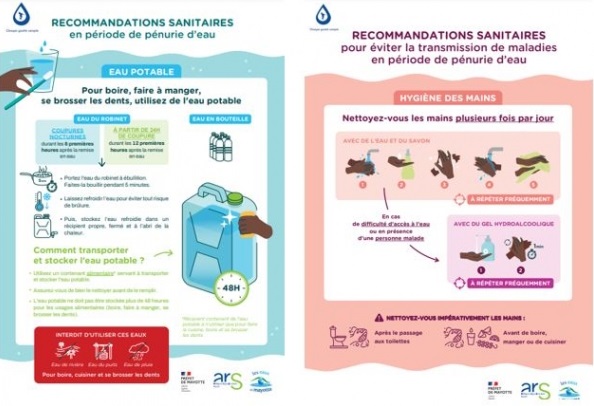
At the local level, the Mayotte Regional Health Agency (ARS) informs the public (through radio and TV spots, social media posts, and its website) and regularly updates the available information to allow people to track changes in health recommendations in response to the 2023 water shortage.
View the epidemiological updates
Find the latest data on the epidemiological situation in Mayotte.












