




The disease
Leptospirosis: A Disease That Should Not Be Overlooked
Leptospirosis is caused by Leptospira bacteria. Leptospira belong to the phylum Spirochaeta. The genus Leptospira comprises 22 species, 10 of which are pathogenic, and more than 300 serovars grouped into at least 24 serogroups. Pathogenic leptospires are responsible for a globally distributed zoonosis, leptospirosis, in which humans serve as occasional hosts in a cycle involving wild and domestic animals.
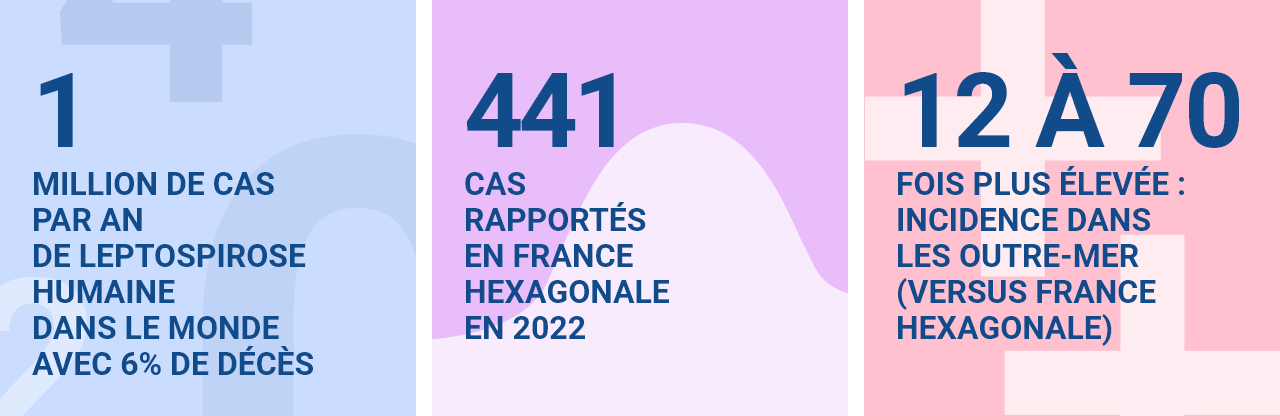
The annual number of human leptospirosis cases worldwide is estimated at over one million, with a case-fatality rate of approximately 6%.
While the disease remains relatively rare in mainland France, an increase in the number of leptospirosis cases has recently been observed, rising from 300 cases per year to 600 cases since 2014. The annual incidence is approximately 1 case per 100,000 inhabitants.
Furthermore, leptospirosis has incidence rates 12 to 70 times higher in France’s overseas territories than in mainland France. This makes it a significant public health issue.
Key statistics on leptospirosis
Direct or indirect transmission by animals
Humans are occasional hosts of pathogenic Leptospira species, which cause leptospirosis, in a cycle involving wild and domestic animals. The animal reservoir is highly diverse and, in addition to rodents (rats, coypu, mice, field mice), includes certain carnivores (mongooses, foxes), livestock (cattle, goats, sheep, horses, pigs), and pets (dogs). All these animals, often asymptomatic carriers, excrete leptospires in their urine. Leptospires survive quite easily in the external environment (freshwater, muddy soil), which facilitates transmission. In humans, direct transmission (animal contact) is rare compared to indirect transmission (contact with contaminated soil or water).
Contributing factors
Behavioral factors that promote transmission of the disease to humans include: occupational or recreational activities involving skin-to-mucous membrane contact:
either with environments that may be contaminated by urine from infected animals (hunting, freshwater fishing, freshwater water sports, gardening, extreme sports, etc.);
or with the animals themselves: agriculture, horticulture, construction work, road maintenance, animal husbandry, animal slaughter, hunting, freshwater fishing.
These outdoor activities are naturally more common throughout the year due to the warmer climate of the overseas departments compared to mainland France, and for the same reason, are more often carried out without protective gear (boots, gloves).
Leptospirosis Prevention Measures
Prevention measures rely on collective control measures, including rodent control, management of animal populations in rural areas, control of effluents from industrial livestock operations, drainage of flooded areas, and general waste management.
Leptospirosis prevention also relies on individual protective measures against contamination from animal urine.
These include:
Wearing protective gear when:
high-risk occupational activities (livestock farming, sewer workers, garbage collectors, farmers, working the land, etc.), including boots, gloves, thigh-high boots, protective clothing, and even splash-proof goggles if there is a risk of splashes;
participating in whitewater sports such as canyoning and kayaking, including a protective wetsuit, boots, and gloves.
Avoid swimming in murky or muddy water
Avoid walking barefoot or in open-toed sandals on muddy ground, in puddles, stagnant water, or ravines (especially in overseas departments)
Protect wounds from contact with water using waterproof bandages
After exposure to risk, you should:
Wash with potable water and disinfect wounds
If you develop a fever, see a doctor and mention the high-risk activity you engaged in
In France, a vaccine is available and effective against L. icterohaemorrhagiae (30% of reported leptospirosis cases). This vaccine requires three initial injections followed by a booster every two years. The vaccine is reserved for certain high-risk occupational groups (sewer workers, garbage collectors) or individuals who regularly engage in high-risk recreational activities, following an individualized assessment by a doctor. Vaccination of high-risk groups does not in any way exempt individuals from implementing systematic preventive measures.
A Wide Range of Symptoms
The clinical presentation of leptospirosis is extremely varied, ranging from a mild flu-like syndrome in most cases to a potentially fatal condition of multi-organ failure (hepatorenal). In its typical form, leptospirosis begins after an incubation period of 4 to 19 days with the sudden onset of a high fever (generally >39°C), accompanied by muscle, joint, and abdominal pain, as well as severe headaches. The disease may worsen 4 to 5 days after the first signs appear and spread to the liver (jaundice), kidneys, lungs, and meninges.
Diagnosis
The diagnosis of leptospirosis is based on a combination of clinical, laboratory, and epidemiological findings. Clinical polymorphism can lead to a harmful delay in treatment due to confusion with differential diagnoses such as influenza virus, chikungunya virus, or dengue virus. Differential diagnosis with other infectious diseases, particularly in tropical regions, is essential for the rapid initiation of antibiotic therapy.
Biological confirmation of leptospirosis relies on bacterial isolation, the presence of DNA in biological samples, or positive serology in a clinically and epidemiologically suggestive context.
Only molecular biology techniques—i.e., detection of leptospiral DNA in clinical samples (blood, cerebrospinal fluid, or, later on, urine)—allow for early diagnosis of the disease (as soon as clinical signs appear) and rapid results (within 24 hours). Direct diagnosis within the first 10 days after the onset of the disease relies on PCR (in blood, CSF, or urine), which allows for rapid diagnosis (within 24 hours), or culture (slow and difficult); after 10 days, diagnosis relies solely on PCR in urine or CSF.
Serology can also be used starting on the 6th day. A negative initial serological result does not rule out the diagnosis, and the test must be repeated 8 days to 3 weeks later. The microagglutination test (MAT) can be performed in cases of positive serology and allows for a reliable diagnosis and determination of the serogroup (epidemiological interest). In France, only the National Reference Center (CNR) performs the MAT test on the full range of potentially pathogenic antigens (24). The MAT test remains the gold standard but has not been covered by insurance since September 2014. Only PCR and IgM ELISA are listed in the reimbursement directory.
Prompt antibiotic treatment
Treatment is based on antibiotic therapy. When administered early, antibiotic therapy reduces the risk of complications, alleviates symptoms, and shortens the duration of renal carriage.
Regional Variations
The incidence of leptospirosis varies greatly by geographic region, due to differences in climate, the diversity of potential reservoir species, and varying activities and lifestyles. Thus, a distinction must be made between the epidemiological contexts of mainland France and those of the overseas territories, where incidence rates are 12 to 70 times higher.
Reference materials:
Recommendations from the French High Council for Public Health (CHSPF):
In relation to

Vaccination
thematic dossier
Contagious diseases most often affect children at a very young age. Because children are particularly vulnerable, they are a priority target for vaccination programs.











