


Summary of Legionnaires' disease cases reported in France in 2019
Number of reported cases and incidence
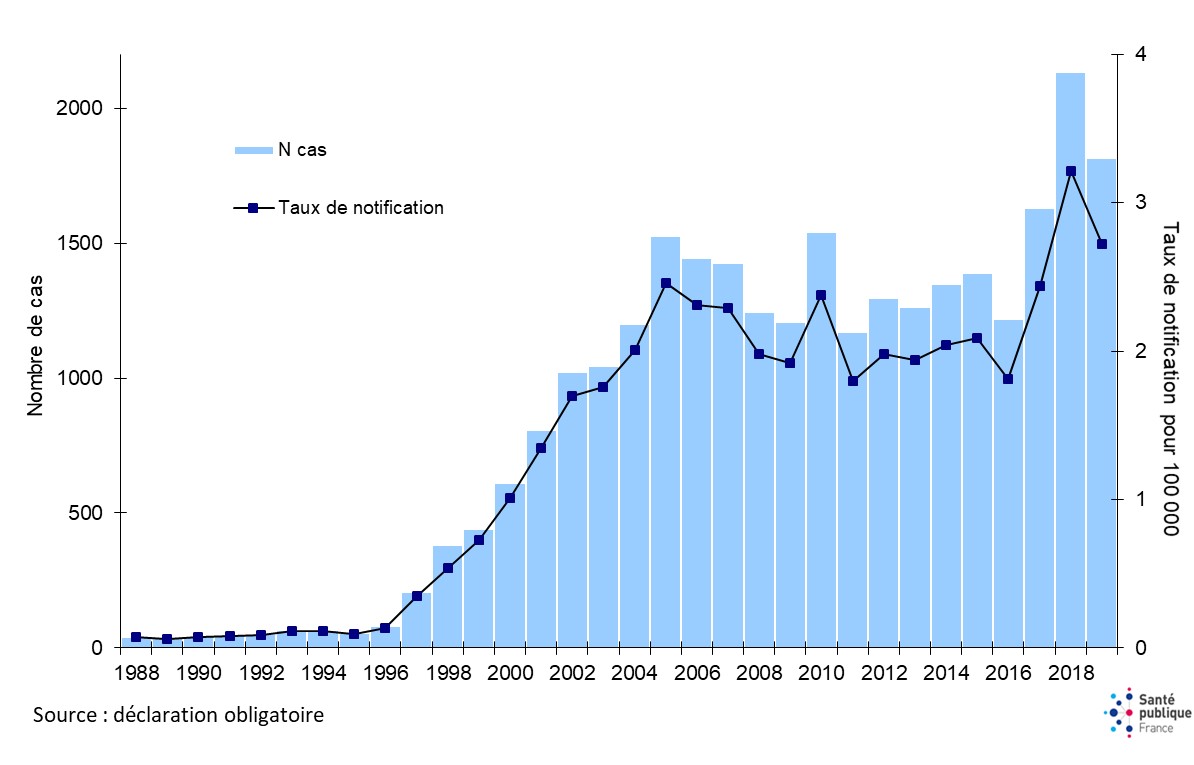
In 2019, 1,816 cases of Legionnaires’ disease were reported in France through the mandatory reporting system. Of these, 16 cases were residents of the French overseas departments and regions (9 in Réunion, 3 in Guadeloupe, 3 in Martinique, and 1 in French Guiana), and 37 were foreign nationals diagnosed in France. The incidence rate of reported cases of Legionnaires’ disease in mainland France was 2.7 per 100,000 inhabitants.
The number of reported cases of legionellosis in 2019 was significantly lower than in 2018 (-15%), a year in which a record number of 2,133 cases were reported (incidence of 3.2 per 100,000 inhabitants) (Figure 1). Although the number of cases in 2019 was lower than the number reported in 2018, it remains significant, and the upward trend has continued over the past three years.
Figure 1. Trends in the annual number and incidence rate of reported cases of Legionnaires' disease in France, 1988–2019
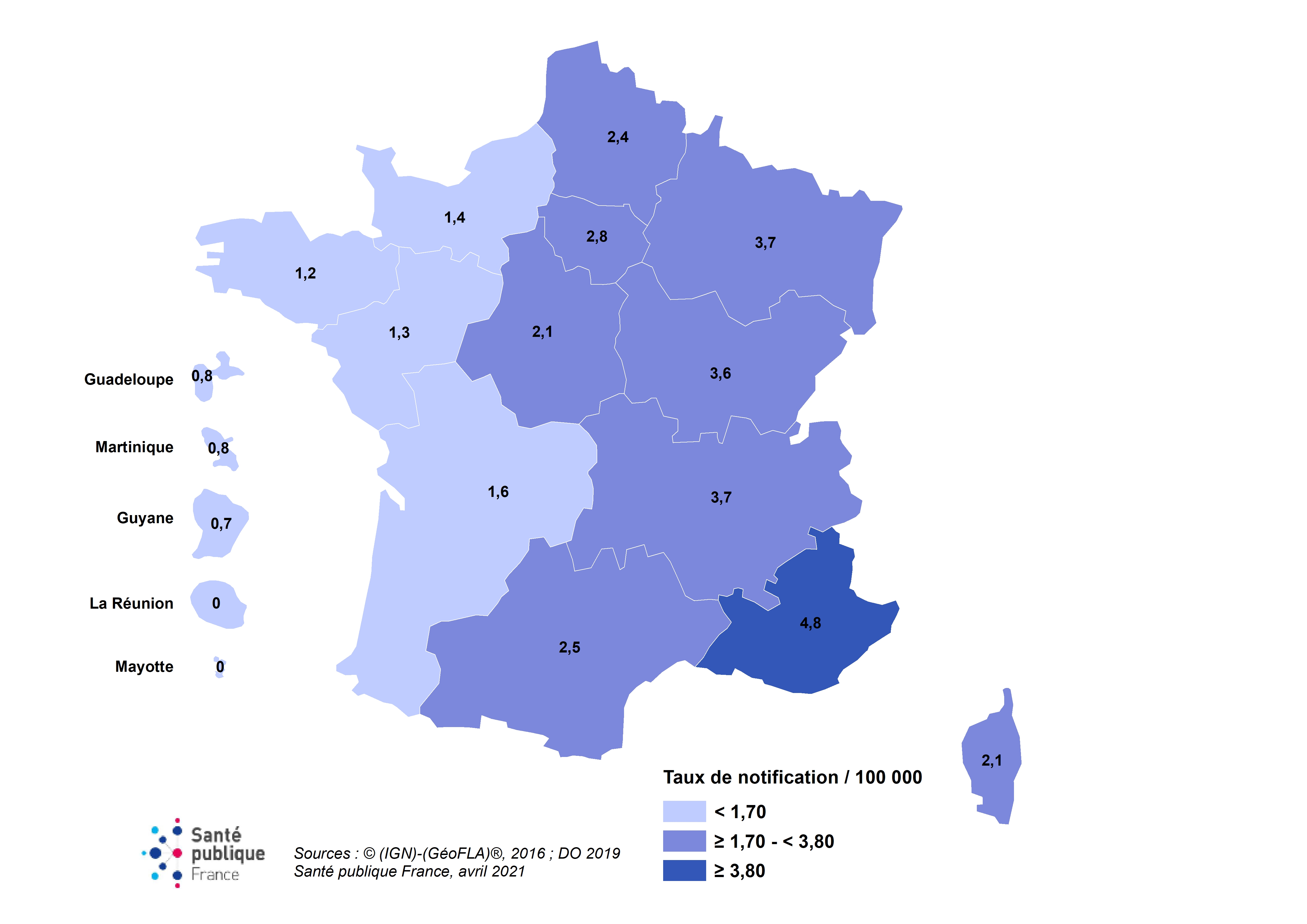
The west-to-east geographical gradient in the incidence rate of reported cases of legionellosis was pronounced, as observed in previous years. The incidence ranged from 1.2 per 100,000 inhabitants in Brittany to 4.8 per 100,000 inhabitants in Provence-Alpes-Côte d’Azur (Figure 2). The incidence rate of reported cases in French Guiana was 1.4 per 100,000 inhabitants, 1.2 in Réunion, 0.8 in Guadeloupe, and 0.7 in Martinique.
Figure 2. Distribution of the age-standardized incidence rate* of Legionnaires’ disease by region of residence in France, 2019
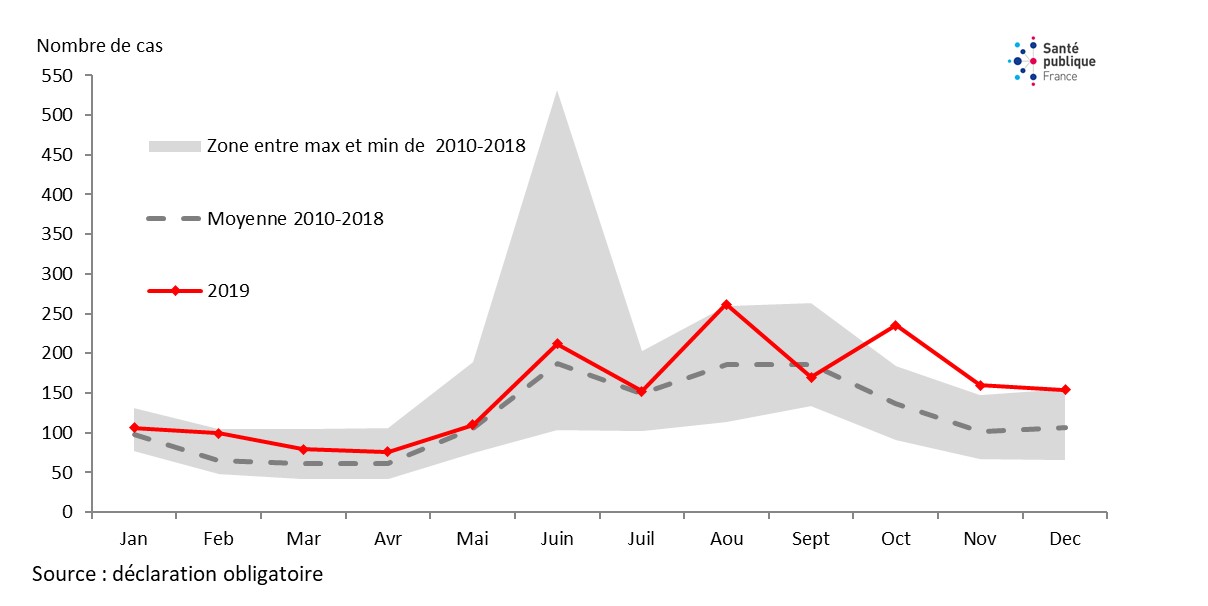
The monthly number of cases was generally above the monthly average of reported cases from 2010 to 2018, with peaks in June, August, and October. The number of cases during the last quarter was above the highest level observed from 2010 to 2018 (Figure 3).
Figure 3. Monthly number of reported cases of Legionnaires' disease in France by onset date, 2010–2019.
Case characteristics
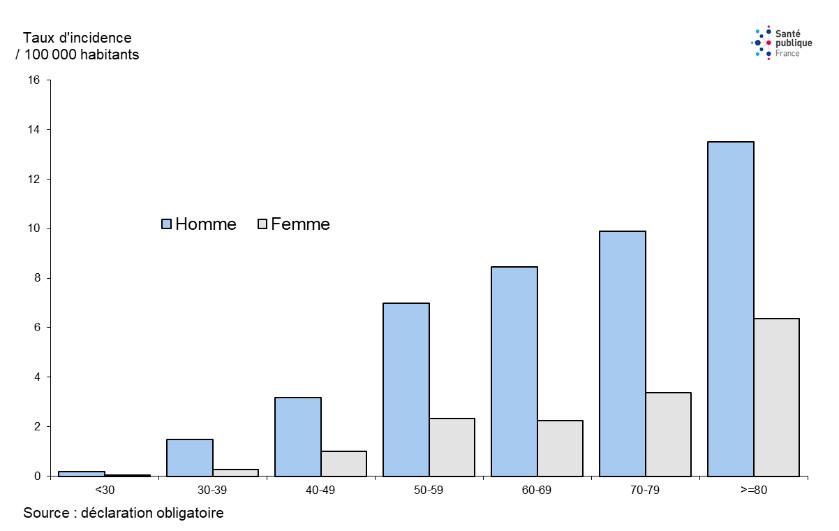
The median age of cases was 65 years [range: 7–104 years], and the male-to-female ratio was 2.4 (1,281 men and 535 women). Incidence increased with age, and the highest incidence rate was observed among people over 80 years of age (8.4 per 100,000) (Figure 4). Only 38 cases (out of 1,816 cases, 2.1%) were not hospitalized.
Figure 4. Incidence rates by age group and sex for cases of Legionnaires' disease reported in France in 2019.
Of the 1,816 cases, 74% had at least one risk factor (Table 1). In 30% of cases, smoking was the only risk factor identified (10% had an additional risk factor).
Table 1. Frequency of risk factors in cases of Legionnaires’ disease reported in France, 2016–2019
| 2017 (1,630) |
2018 (2,133) |
2019 (1,816) |
||||
|---|---|---|---|---|---|---|
| Risk factors* | N | % | N | % | N | % |
| Cancer / blood disorder | 171 | 10 | 225 | 11 | 230 | 13 |
| Corticosteroid therapy / immunosuppressants | 168 | 10 | 195 | 9 | 200 | 11 |
| Diabetes | 303 | 19 | 391 | 18 | 348 | 19 |
| Smoking | 640 | 39 | 943 | 44 | 724 | 40 |
| Others | 300 | 18 | 376 | 18 | 324 | 18 |
| At least one factor | 1,191 | 73 | 1,561 | 73 | 1,335 | 74 |
*not mutually exclusive / Source: mandatory reporting
The disease progression was known for 89% of cases (1,611/1,816), and the case fatality rate (160 deaths) was higher than that observed in 2018 (10% versus 8%, p<0.005).
The median time between the onset of initial clinical signs and the date of notification to the Regional Health Agency (ARS) was 6 days (interquartile range [4–9]); 83% of cases were reported within 10 days of the onset of the first clinical signs, and 95% within 20 days. These annual indicators have remained stable since 2010.
Microbiological Information
Of the 1,816 cases, 1,769 (97%) were confirmed cases: detection of soluble urinary antigens was the primary diagnostic method used (1,716 cases, 94%). Genomic amplification (via Polymerase Chain Reaction - PCR) on respiratory specimens was positive in 249 cases (14%), a proportion that has increased compared to 2018 (14% versus 8%, p<10⁻⁶). For 46 (2.5%) cases, PCR was the sole biological diagnostic method (39 cases, 1.8% in 2018). A few cases were diagnosed solely by culture (13 cases) or serology (2 cases) (Figure 6).
The vast majority of Legionnaires’ disease cases were caused by Legionella pneumophila serogroup 1 (Lp1) (1,732/1,816, 95.4%).
Figure 5. Distribution of diagnostic methods* for cases of Legionnaires' disease, France, 1988–2019
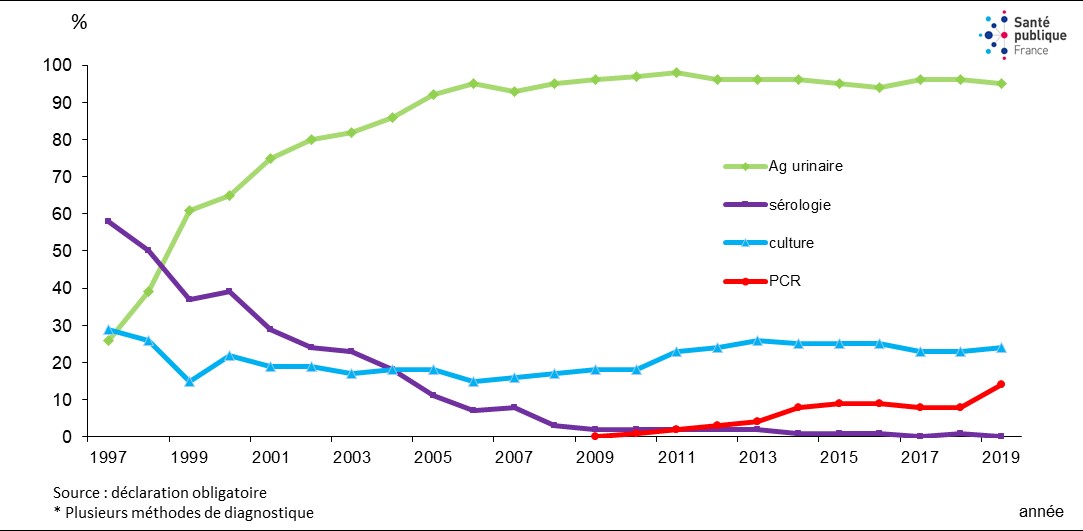
In 24.3% of cases (n=441), a strain was isolated from respiratory specimens; this percentage was comparable to that of 2018 (22.9%). The majority (433/441, 98%) of the isolated strains were of the species Legionella pneumophila, including 398 from serogroup Lp1 and 35 from other serogroups. The 8 non-pneumophila L. strains were L. longbeachae (5), L. bozemanii (2), and L. jordanis (1).
All L. pneumophila strains were analyzed using various molecular methods depending on the context (Sequence-Based Typing or whole-genome sequencing (WGS)) at the National Reference Center (NRC) for Legionella. Among the 440 cases for which a sequence type (ST) was available, 53% were associated with 10 STs: ST1, ST9, ST20, ST23, ST40, ST47, ST62, ST259, ST224, and ST701; the most prevalent were ST23 (79 cases, or 18%), ST1 (33 cases, or 8%), ST62 (27 cases, or 6%), and ST259 (21 cases, or 5%). It should be noted that, in the absence of strain isolation, a complete ST was obtained directly from respiratory specimens in 7 cases (4 cases in 2018).
For 56 cases (13%), the clinical strain could be compared to environmental strains isolated from one or more locations frequented by the patient, and for 45 of the 58 (78%) comparisons (2 cases involving comparisons for two separate locations), the STs of the clinical and environmental strains were found to be identical. Among these cases, environmental and microbiological investigations determined that the potable water systems were the most likely source of contamination in 8 out of 9 healthcare facilities, 12 out of 15 homes, 10 out of 10 tourism facilities, 6 out of 6 senior care facilities, and 9 out of 16 other facilities (swimming pools, stadiums, etc.). It should be noted that the results of the two comparisons involving cooling towers revealed different STs for clinical and environmental strains.
Risk Exposures
Risk exposure during the incubation period (2–10 days) was reported for 39% of cases (706 cases), a proportion consistent with what is typically observed except in 2018 (34%) (Table 2). Among cases who stayed in a hospital during the incubation period, half (55/107) were classified as definitely linked to the hospital stay (stay throughout the presumed exposure period). The most frequently reported exposure was travel (334 cases, or 18%). Among these cases, 248 cases, meeting the reporting criteria of the European Legionnaires’ Disease Surveillance Network (ELDSNet), were reported to this network: the majority (77%) of them had stayed in hotels or campgrounds, while 23% had stayed in vacation rentals, guesthouses, or accommodations booked online. Of the 334 cases for which travel history was reported, most had traveled within France (194/334, or 58%) and 21% within Europe. In the “other exposures” category, 24 patients were using a continuous positive airway pressure (CPAP) device for sleep apnea (10 cases in 2018).
Table 2. Risk exposures among cases of Legionnaires’ disease in France, 2016–2018
| Exposures* | 2017 (1,630) |
2018 (2,133) |
2019 |
|||
|---|---|---|---|---|---|---|
| n | % | n | % | n | % | |
| Hospital | 118 | 7 | 111 | 5 | 106 | 6 |
| Nursing home | 87 | 5 | 75 | 4 | 92 | 5 |
| Spa | 13 | 1 | 6 | <1 | 22 | 1 |
| Travel | 299 | 18 | 387 | 18 | 334 | 18 |
| Campground hotel | 189 | 11 | 234 | 11 | 179 | 10 |
| Temporary residence a | 83 | 5 | 86 | 4 | 99 | 6 |
| Other types of travel b* | 27 | 2 | 67 | 3 | 56 | 3 |
| Other c | 116 | 8 | 145 | 7 | 152 | 9 |
| Total cases with at least one exposure | 633 | 39 | 724 | 34 | 706 | 39 |
* Relative to the total number of cases
a Rental property, bed-and-breakfast, vacation rental, second home, staying with friends or family,
b Location and type of housing not specified
c Public facilities (swimming pool, stadium, etc.), occupational exposure, sleep apnea device, etc.
In 2019, the ELDSNet network reported 53 additional cases to Santé publique France compared to those reported through mandatory reporting. These were cases occurring among foreign nationals who had stayed at a tourist establishment in France within 10 days prior to the onset of symptoms and were diagnosed in a foreign country.
In total, based on notifications of French and foreign cases, 252 French tourist establishments were reported by ELDSNet (248 in 2018), 227 for isolated cases and 24 for clustered cases of Legionnaires’ disease (defined by ELDSNet as at least two cases having stayed in the same establishment over a two-year period). In these 24 establishments, an investigation involving sampling of the potable water system revealed the presence of Legionella above the regulatory threshold in 57% (12/21) of them.
In 2019, several investigations into clusters of cases occurring over time and in the same geographic area were conducted by the ARS in collaboration with the regional units of Santé publique France. Among these investigations, four were reported to national health authorities; they involved:
4 cases in a nursing home for the elderly in the Provence-Alpes-Côte d’Azur region, with no identification of the source of contamination
3 cases who had visited a spa complex in Nouvelle-Aquitaine, with no identification of the source of infection
12 cases linked to a stay at a campground in Occitanie, for which epidemiological, environmental, and microbiological investigations determined that the campground’s water—via the hot tubs in the bungalows and the sanitary facilities—was the most likely source of infection. Management measures were implemented at the campground, and no further cases were identified thereafter. Preventive and control measures were recommended for the campground’s reopening in 2020.
28 cases residing in or having visited the same area in Lingolsheim in the Bas-Rhin department. The results of epidemiological, environmental, and microbiological investigations indicated that water from a chimney in a communal boiler room was the most likely source of contamination (Press release from the Bas-Rhin Prefecture).
Discussion - Conclusion
In 2019, the number of Legionnaires’ disease cases reported to Santé publique France was lower than in 2018—an exceptional year in which 21% of cases occurred over a three-week period in June—but remains high and confirms the upward trend observed over the past three years. In 2019, the monthly number of cases was generally above the monthly average of reported cases from 2010 to 2018, particularly during the last quarter. Moderate peaks were observed sporadically without being linked to the identification of clustered cases. The incidence rate of reported cases in metropolitan France (2.7/100,000) was higher than in previous years, except for 2018. This upward trend is also observed at the European level (European notification rate of 2.2/100,000 in 2018; 2019 data not yet available as of June 25, 2020) [2]. One hypothesis to explain this increase is the influence of meteorological factors on the occurrence of Legionnaires’ disease cases, particularly temperature, precipitation, and humidity, which, according to various studies conducted in recent years, appear to be key variables in the survival and dispersal of Legionella in the environment [3]. The study conducted by Santé publique France on French data from 2008 to 2015, which incorporated meteorological factors, showed that humidity and temperature are linked to the occurrence of Legionnaires’ disease cases but do not, on their own, explain the west-to-east gradient in the notification rate observed for many years in France [4].
The characteristics of Legionnaires’ disease cases occurring in 2019 are comparable to those of previous years: the majority of cases present predisposing factors. The proportion of cases for which risk exposure was documented is similar to that of previous years, except for 2018, when it was lower than usual.
The proportion of strains isolated since 2011 has remained stable, and the proportion of diagnoses made solely by PCR on respiratory specimens increased slightly in 2019. It is important to promote PCR-based diagnosis, which allows for the identification of Legionnaires’ disease cases caused by species and serogroups other than Lp1—cases that are therefore not detected by urine tests, which are currently the most widely used method for diagnosing Legionnaires’ disease. Comparative results between clinical and environmental strains showed that the sources of contamination for the investigated cases were water systems in public establishments and residential water systems.
Among the numerous investigations conducted for the clustered cases, two identified the source of contamination through the results of epidemiological, environmental, and microbiological investigations. The water system responsible for the contamination in one of these investigations highlighted the importance of prevention measures, surveillance, and control of Legionella risk in tourism establishments, particularly the use of hot tubs in private facilities. The other investigation, thanks to the work of all local partners, identified a new source of contamination: water from a chimney in a communal boiler room.
These findings demonstrate the importance of the prompt and systematic reporting and investigation of all suspected clusters of cases by all local partners. It is also necessary to continue promoting the routine collection of respiratory samples in order to obtain strains that can document clusters of cases and, through comparison with environmental strains, identify probable sources of contamination.
[1] Campèse C, Descours G, Bernard-Stoecklin S, Beraud L, Maine C, Ranc AG, et al. Legionellosis in France: a significant increase in the number of cases in 2018. Weekly Epidemiological Bulletin. 2019;(4):89-95.
[2] European Centre for Disease Prevention and Control. Surveillance atlas of infectious diseases–Legionnaires’ disease. [Internet]. Stockholm: ECDC; 2018
[3] Beaute J, Sandin S, Uldum SA, Rota MC, Brandsema P, Giesecke J, et al. Short-term effects of atmospheric pressure, temperature, and rainfall on notification rate of community-acquired Legionnaires’ disease in four European countries. Epidemiol Infect. 2016;144(16):3483-93.
[4] Pelat C, Campese C, Lévy-Bruhl D, Che D. Spatiotemporal disparities in Legionnaires’ disease incidence in France: what role does climate play? ESCMID Study Group for Legionella Infections (ESGLI) 2018 Conference, August 28–30, Lyon, France
Surveillance protocols and all epidemiological data are available on the Santé publique France website












