



The disease
Legionellosis is a lung infection caused by the Legionella bacterium. It is a notifiable disease monitored by Santé publique France.
Legionellosis, a bacterial infection
Legionellosis is a lung infection caused by a bacterium called Legionella.
This bacterium was discovered in 1976 following an outbreak of pneumonia that affected several participants at a convention of American Legion veterans gathered at a hotel in Philadelphia. It was consequently named Legionella.
Legionella bacteria are present in the natural environment and can proliferate in artificial water systems when conditions are favorable for their growth, particularly between 25 and 45°C:
hot water systems
cooling towers
other facilities (hot tubs, humidifiers, decorative fountains, aerosols, respiratory therapy devices, etc.).
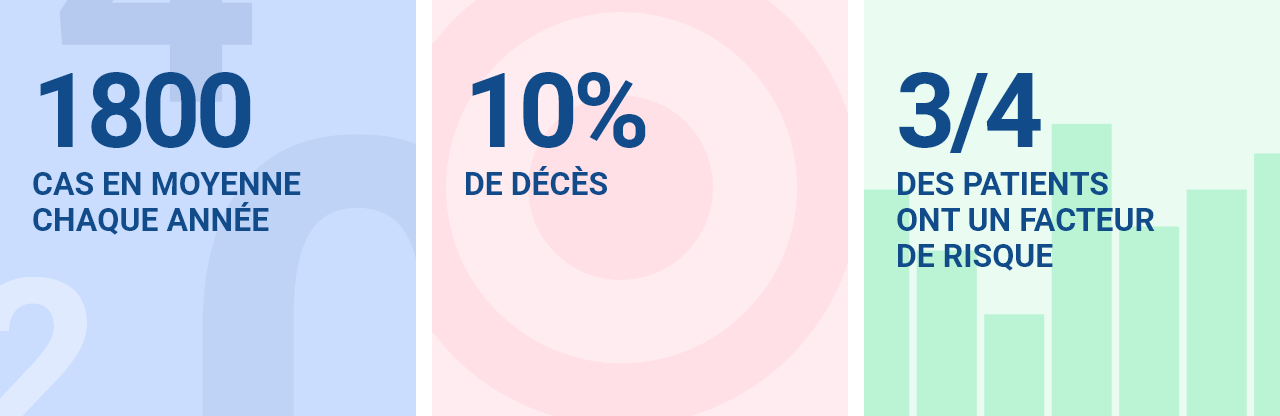
In France, since 2017, an average of 1,800 cases of Legionnaires’ disease have been reported each year. Legionnaires’ disease is fatal in approximately 10% of cases.
Key statistics on Legionnaires' disease
Transmission occurs primarily through the respiratory tract
Transmission occurs primarily via the respiratory route, through inhalation of contaminated water dispersed as an aerosol. Human-to-human transmission is rare. Only one case has been reported to date.
The incubation period is generally 2 to 10 days. However, for a limited number of patients, results from outbreak investigations suggest longer incubation periods (2–19 days) and a median incubation period of 6 days.
Risk Factors
Legionellosis primarily affects adults and particularly impacts individuals with risk factors: advanced age, smoking, chronic respiratory diseases, diabetes, immune disorders, and immunosuppressive treatments.
Flu-like symptoms followed by severe pneumonia
Legionellosis presents as a febrile flu-like illness and a cough that is initially non-productive. Some patients may experience muscle pain, loss of appetite, and occasionally digestive issues (diarrhea) and/or confusion. The flu-like illness rapidly worsens and progresses to severe pneumonia requiring hospitalization.
The clinical diagnosis must be confirmed by one of the following laboratory tests:
isolation of the bacterium from a lower respiratory tract specimen
presence of soluble antigens in urine
a fourfold increase in antibody titers between two consecutive blood samples, with a minimum of 128
positive PCR.
Prompt antibiotic treatment
Treatment for Legionnaires’ disease is all the more effective when initiated promptly. It is therefore important to consider a clinical diagnosis of Legionnaires’ disease in the presence of compatible symptoms, and to obtain laboratory confirmation as soon as possible if Legionnaires’ disease is suspected. With appropriate antibiotic treatment (macrolides or fluoroquinolones), the disease has a favorable outcome in the majority of cases.
In relation to

Diabetes
thematic dossier
Diabetes mellitus is a metabolic disorder characterized by chronic hyperglycemia resulting from a deficiency in either insulin secretion, insulin action, or both.

Tobacco
thematic dossier
Despite a slight decrease compared to 2015, tobacco remains responsible for more than 68,000 premature deaths in 2023—accounting for 11% of total mortality—making it still the leading cause of...

Climate change
thematic dossier
Climate change is rapidly and profoundly altering the environment. The health impacts of climate change are numerous and varied.












