




The disease
Invasive meningococcal infections
Meningococcus is a bacterium found exclusively in humans and is a commensal of the nasopharynx. It possesses a polysaccharide capsule that determines its serogroup. Among the twelve described serogroups, strains of serogroups A, B, C, Y, and W are responsible for nearly all invasive meningococcal infections (IMI). Acquisition of meningococcus and colonization of the nasopharynx are rarely followed by IMI. There are multiple factors contributing to its occurrence: those related to the bacterium (virulence of the strain) and/or those related to the host (impaired immune defenses, particularly alteration of the complement pathway, and the condition of the respiratory mucosa, particularly following influenza).
Epidemiology of invasive meningococcal infections
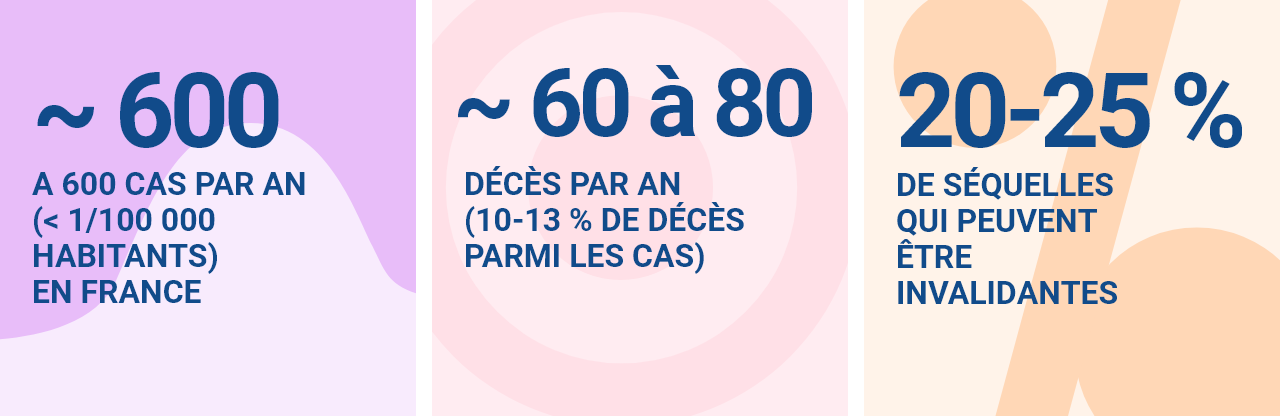
With 500 to 600 cases per year, the incidence rate of IIM is less than 1 case per 100,000 inhabitants.
Over the past 10 years, it has fluctuated between 0.6 and 0.9 per 100,000 inhabitants depending on the year, with the exception of the 2020–2022 pandemic period, during which it was exceptionally low. IMIs primarily affect infants, young children, and young adults (ages 15–24), and for certain serogroups, the elderly. The majority of cases are sporadic. The case fatality rate for IIM is 10–12%, but it varies by serogroup, with a higher rate for serogroup W cases (19% in 2023).
Since 2022, trends in IIM have been marked by an increase in IIM Y and W and a decrease in IIM C compared to the pre-pandemic period. In 2023, the distribution of serogroups among all reported cases was as follows: B (44% of cases), W (29%), Y (24%), and C (<1%), and other rarer strains (<1%). The incidence of C-serogroup IIMs is at low levels, reflecting in part the impact of meningococcal conjugate vaccines and herd immunity achieved in the population through vaccination of individuals aged 1–24 years.
Key statistics on invasive meningococcal infections
Transmission
Meningococcal transmission occurs through nasopharyngeal secretions (Flügge droplets) due to close and repeated contact. Transmission is facilitated within the household or in communal living settings. The incubation period ranges from 2 to 10 days (average of 3–4 days).
When a case of IIM occurs, it is estimated that there is a risk of transmission for individuals who have been directly exposed to the case’s nasopharyngeal secretions within the ten days preceding the onset of IIM (see the chapter on prophylaxis).
Characteristics of the disease
IMM most commonly presents as meningitis (inflammation of the membranes surrounding the brain and spinal cord) and/or sepsis. Other clinical forms may occur (arthritis, septic pericarditis, etc.). The most severe form is purpura fulminans, characterized by septic shock and extensive, necrotic purpura.
Laboratory diagnosis
Laboratory diagnosis is based on:
the isolation of the bacterium (positive culture) or a positive PCR from a normally sterile site (blood, cerebrospinal fluid (CSF), synovial fluid, pleural fluid, pericardial fluid, peritoneal fluid) or from a purpuric skin lesion;
the presence of Gram-negative diplococci on direct examination of the CSF (meningitis).
CSF findings suggestive of purulent bacterial meningitis combined with the presence of purpuric skin lesions are consistent with invasive meningococcal infection.
Treatment
Suspected IIM requires prompt medical evaluation and urgent transfer to a hospital. Management includes administration of antibiotics (C3G) intravenously if possible or intramuscularly.
Prophylaxis for invasive meningococcal infections
When an IIM occurs, a short course of preventive antibiotic treatment is promptly offered to individuals who have been in close contact with the patient within the 10 days preceding hospitalization (the patient’s contagious period). Risk assessment takes into account proximity (less than one meter), type of contact (face-to-face), and duration.
This treatment aims to prevent the occurrence of a new case among the patient’s contacts. Antibiotic prophylaxis must be administered as soon as possible and is no longer effective more than 10 days after the last contact with the patient.
Vaccination is also offered to contacts who are regularly and repeatedly in close proximity to the patient if the patient has been infected with meningococcal serogroups A, C, W, or Y.
For more information on prophylaxis for IIM cases: INSTRUCTION No. DGS/SP/2018/163 of July 27, 2018, regarding the prophylaxis of invasive meningococcal infections.
Vaccination Recommendations
Since January 1, 2025, vaccination of all infants against meningococcal B has been mandatory, with 3 doses at 3 months, 5 months, and a booster at 12 months. Replacing vaccination against meningococcal C, the tetravalent ACWY vaccine is also mandatory for all infants as of January 1, 2025, with two doses at 6 and 12 months of age.
The ACWY vaccine has also been recommended since January 1, 2025, for adolescents aged 11 to 14, regardless of their prior vaccination history. Catch-up vaccination is recommended up to age 24 for individuals who have not yet been vaccinated.
In addition, there are specific recommendations for meningococcal vaccination for certain population groups (immunocompromised individuals or those at risk of IIM).
For more information on recommendations and vaccines: https://vaccination-info-service.fr/Les-maladies-et-leurs-vaccins/Meningites-et-septicemies-a-meningocoques
When there are clusters of IIM linked to the same type of meningococcus in a social community or geographic area, vaccination of the population may be considered based on an assessment of the situation by a group of experts. The type of vaccine depends on the serogroup involved. Thus, in recent years, several localized vaccination campaigns have been organized: against IIM B (in the Beaujolais region in 2016, in the Côtes d’Armor in 2017, and in Strasbourg and an area east of Lyon in 2023) as well as against IIM W (students on the Dijon campus in 2017 and 2018).
The epidemiological situation is closely monitored, enabling the French National Authority for Health to evaluate and adapt vaccination strategies against the various serogroups.
Reference materials
In relation to

Vaccination
thematic dossier
Contagious diseases most often affect children at a very young age. Because children are particularly vulnerable, they are a priority target for vaccination programs.











