


Monitoring of bacterial antibiotic resistance in community care and long-term care facilities. Primo National Initiative. Summary Results, 2022
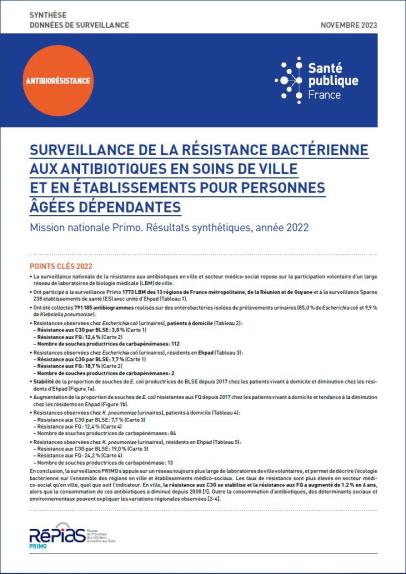
KEY POINTS FOR 2022 • National surveillance of antibiotic resistance in community and healthcare settings relies on the voluntary participation of a broad network of community clinical laboratories. • A total of 1,773 CLS from the 13 regions of mainland France, Réunion, and French Guiana participated in the Primo surveillance program, while 238 healthcare facilities (HCFs) with nursing home units participated in the Spares surveillance program. • A total of 791,185 antibiotic susceptibility tests were collected on Enterobacteriaceae isolated from urine samples (85.0% Escherichia coli and 9.9% Klebsiella pneumoniae). • Resistance observed in Escherichia coli (urinary), home-bound patients: – Resistance to C3G by ESBL: 3.0% – Resistance to FQ: 12.6% – Number of carbapenemase-producing strains: 112 • Resistance observed in Escherichia coli (urinary), nursing home residents: – Resistance to C3G via ESBL: 7.7% – Resistance to fluoroquinolones (FQ): 18.7% – Number of carbapenemase-producing strains: 2 • Stability in the proportion of ESBL-producing E. coli strains since 2017 among home-dwelling patients and a decrease among nursing home residents (Figure 1a). • Increase in the proportion of FQ-resistant E. coli strains since 2017 among patients living at home and a downward trend among nursing home residents (Figure 1b). • Resistance observed in K. pneumoniae (urinary tract), home-dwelling patients: – C3G resistance due to ESBL: 7.7% – Fluoroquinolone resistance: 12.4% – Number of carbapenemase-producing strains: 84 • Resistance observed in K. pneumoniae, nursing home residents: – Resistance to C3G via ESBL: 19.0% – Resistance to fluoroquinolones: 24.2% – Number of carbapenemase-producing strains: 13 In conclusion, the PRIMO surveillance program relies on an ever-expanding network of volunteer community laboratories and enables the description of bacterial ecology across all regions in urban areas and long-term care facilities. Resistance rates are higher in long-term care facilities than in urban areas, regardless of the indicator. In the community, resistance to C3Gs is stabilizing, and resistance to fluoroquinolones has increased by 1.2% over 6 years, even though the use of these antibiotics has declined since 2000. In addition to antibiotic use, social and environmental factors may explain the observed regional variations.
Author(s): Lemenand Olivier, Thibaut-Jovelin Sonia, Coeffic Thomas, Caillon Jocelyne, Birgand Gabriel, Boutoille David
Publishing year: 2023
Pages: 12 p.
Collection: Monitoring data
In relation to
Our latest news

news
Shamonda Virus: First Human Case Detected in France—What Do We Know?

news
Call for Nominations for the Renewal of the Scientific Advisory Board of the...

news












