



The disease
An infection is considered healthcare-associated if it occurs during or following a patient’s care (diagnostic, therapeutic, palliative, preventive, or educational), and if it was neither present nor in the incubation period at the start of care. The primary criterion defining a healthcare-associated infection (HAI) is the provision of a medical procedure or care in the broadest sense by a healthcare professional. No distinction is made regarding the location where the care is provided or administered. If contracted in a healthcare facility, an HAI is a nosocomial infection (CTINILS 2007, Ministry of Health, Youth, and Sports, DGS/DGOS).
Healthcare-associated infections occur during the care of a patient in the three healthcare sectors. The healthcare sector refers to the location where the patient is treated. This includes healthcare facilities (hospitals, clinics, etc.), the community sector (general practitioners’ offices, dentists, home care, etc.), and medical-social facilities (nursing homes, residential facilities for adults with disabilities, etc.).
When linked to hospitalization in a healthcare facility, these infections are called nosocomial infections. Patients, residents, and healthcare professionals may be affected.
Healthcare-associated infections (HAIs) represent a public health challenge. These infections pose risks not only to individuals (mortality, morbidity) but also to the broader community (epidemics, increased costs, etc.).
The most common healthcare-associated infections are urinary tract infections, pneumonia, surgical site infections, and bacteremia (ENP 2022).
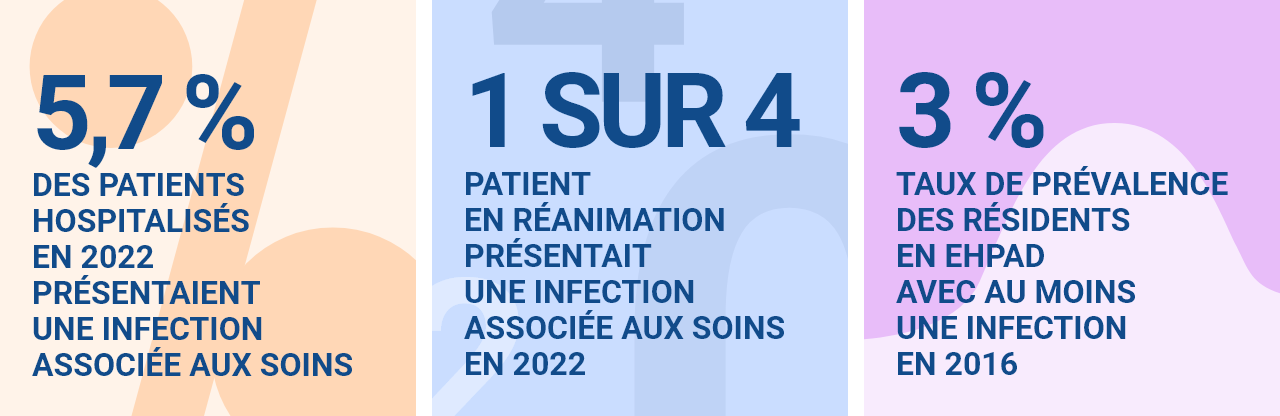
Key statistics on the disease
Transmission of Healthcare-Associated Infections
There are three major risk factors for acquiring a healthcare-associated infection:
the patient’s condition: underlying medical conditions
healthcare procedures: diagnostic, therapeutic, palliative, preventive, educational, or surgical procedures
the environment in which care is provided: facilities, staff hygiene, organization of care, patient transport, visitors
Prevention of healthcare-associated infections
Hand hygiene is the primary measure for preventing healthcare-associated infections, whether within a healthcare facility or as part of a coordinated care system in a patient’s home.
Specific hygiene measures govern each type of care procedure.
Vaccination of healthcare professionals and at-risk patients is an important preventive measure against the transmission of germs.
In relation to

Antibiotic resistance
thematic dossier
Antibiotic resistance renders one or more antibiotics ineffective against a bacterial infection. This phenomenon can make it difficult, or even impossible, to treat certain infections.

Measles
thematic dossier
Measles is one of the most contagious infections, with potentially serious complications, and it can be eradicated worldwide. High vaccination coverage is essential to interrupt the spread of the...












