



The disease
A viral zoonosis
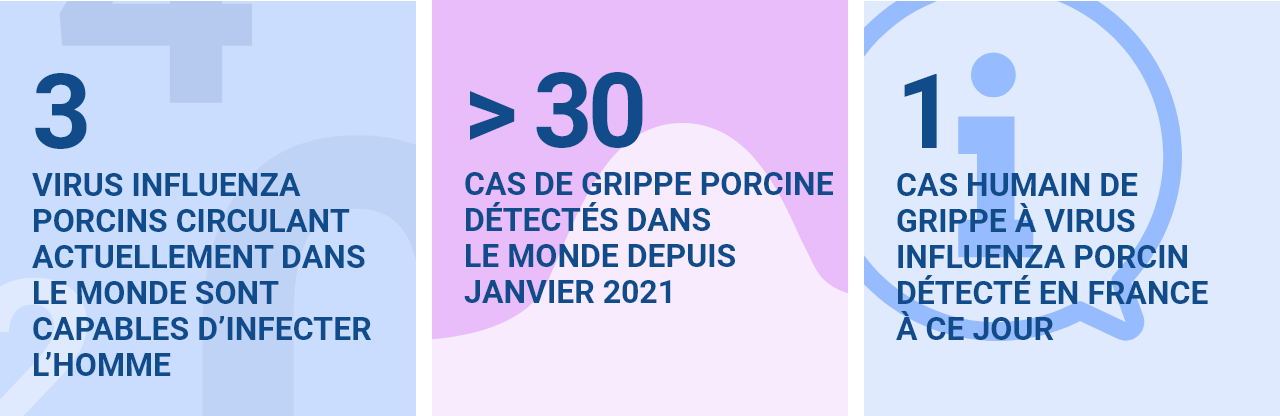
Sporadic cases of human infection with swine-origin influenza viruses occur regularly worldwide. Since January 2021, more than 30 cases of human infection with swine-origin A(H1N1)v, A(H1N2)v, and A(H3N2)v viruses have been detected in the Americas, Asia, and Europe.
Human cases of infection with swine influenza viruses are generally mild, but severe forms have been reported, including in people without risk factors. Human cases are primarily primary cases, occurring following exposure to live pigs or a contaminated environment, particularly in the context of pig farming, veterinary care, or live animal fairs.
Several events of human-to-human transmission of swine influenza viruses have been reported or suspected, generally between a primary case and a close contact, but no sustained transmission chains (i.e., involving multiple generations of successive human infections) have been reported since the 2009 pandemic. Nevertheless, the high mutation and reassortment capabilities of influenza viruses do not rule out the emergence of a virus capable of being efficiently transmitted from person to person, which could, if necessary, lead to an epidemic or even a pandemic.
Santé publique France is responsible for epidemiological surveillance and the validation of the classification of possible cases of human infection with an influenza virus of animal origin in France.
Key Facts About Swine Flu
A disease in pigs that can be transmitted to humans—and vice versa
In pigs
Swine influenza viruses circulate naturally among domestic and farm pigs. Wild boars are also susceptible to infection, though they do not serve as a natural reservoir for these viruses.
Infection in pigs is generally symptomatic, with symptoms comparable to those of human influenza, but paucisymptomatic and asymptomatic forms can occur, making outbreaks of influenza more difficult to detect.
Three subtypes of influenza A virus currently exist in pigs worldwide, including in France:
the H1N1 and H3N2 subtypes, which differ from those circulating in humans,
the H1N2 subtype.
Human cases caused by these three subtypes are sporadically detected worldwide. Pigs are also susceptible to human influenza A viruses, particularly the A(H1N1)pdm09 virus, which is regularly detected in the French pig population, indicating transmission of human viruses to pigs.
Swine influenza viruses are excreted in large quantities in the respiratory secretions of pigs. They are thus found in the environment, in the form of aerosols or contaminated dust.
In Humans
Transmission to humans likely occurs through contact while handling infected animals (tagging, veterinary care, etc.) or through inhalation of contaminated aerosols or dust. Exposure on farms, in slaughterhouses, or at live animal shows poses the primary risk of infection. The risk of human infection through the consumption of any food product derived from pigs is considered negligible or non-existent.
Exposure to a zoonotic influenza virus is defined as any contact without protective measures (failure to wear respiratory protection and specific protective clothing) with:
domestic birds (on a farm or in a backyard, at a market where live poultry is sold, or in laboratory experiments), whether alive or dead;
isolated, sick, or dead wild birds in a high-risk area (HRA) or any geographic area where an AI virus has been identified (see the list of risk areas in Annex III of the Order of March 16, 2016, regarding epizootic risk levels due to infection of avian fauna by a highly pathogenic avian influenza virus and the associated surveillance and prevention measures for poultry and other captive birds and the ESA platform);
pigs or wild boars (whether in confined or non-confined farming, domestic, in slaughterhouses, at fairs or exhibitions, or used in experiments), alive or dead;
sick or dead wild mammals (terrestrial or marine);
a contaminated environment (air, bedding, droppings, etc.);
a human case of avian/swine influenza virus infection confirmed biologically (see definition of a contact person);
samples or biological materials contaminated with avian/swine influenza virus, for example in research or diagnostic laboratories.
Special case: In situations involving significant aerosolization (high-pressure cleaning, etc.), a residual risk cannot be ruled out for staff despite the application of precautionary measures.
Management based primarily on prevention
To date, there is no vaccine specifically targeting swine influenza viruses available for humans.
Since spring 2022, the French National Authority for Health (HAS) has recommended seasonal flu vaccination for healthcare professionals exposed to avian and swine influenza viruses. Such vaccination does not reduce infection by an influenza virus of animal origin, as the seasonal flu vaccine does not contain avian or swine viral strains, but aims to reduce the risk of a new virus emerging that is better adapted to humans in the event of a person being co-infected by an avian virus and a human virus (a phenomenon known as “reassortment”).
Antiviral drugs such as neuraminidase inhibitors (oseltamivir) are prescribed in cases of severe illness requiring hospitalization, or for individuals with risk factors for influenza-related complications. Treatment with oseltamivir primarily reduces the duration of symptoms and the patient’s viral load. It is supplemented by symptomatic treatment tailored to the patient’s clinical condition.
Individual protective measures are recommended for people exposed to pigs, such as standard hygiene practices (regular handwashing, not eating or drinking in the livestock area), as well as the wearing of disposable protective clothing, a respiratory protection mask (FFP2 level), goggles or a protective visor, and impermeable protective gloves. These measures are detailed in Annex 3 of the opinion of the High Council for Public Health regarding the prevention of human transmission of swine and avian influenza viruses, dated December 10, 2021.
Learn more:
Report on swine influenza (ANSES)
Page dedicated to Résavip (animal health epidemiological surveillance platform) (ANSES)
Website of the National Reference Center for Respiratory Infections (including influenza)
For more information on the global situation:
In relation to

Avian influenza
thematic dossier
Some avian influenza viruses can infect humans, and sporadic cases are regularly detected, but the risk of transmission remains low. No cases of human-to-human transmission have been reported...












