


GAST - Occupational Health Alert No. 5
Subscribe
If you would like to receive the newsletter by email, please subscribe to our mailing list.
Highlights
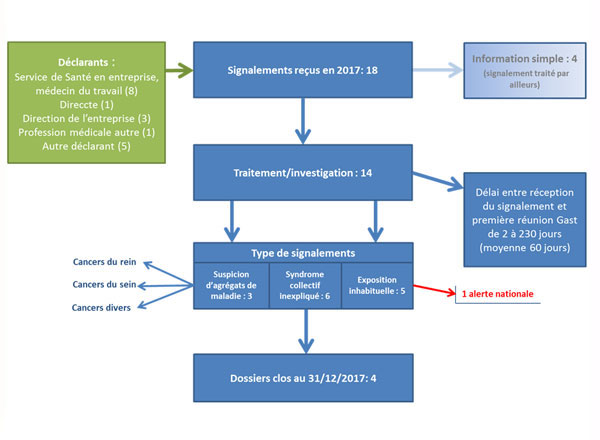
Fourteen reports were processed through a GAST in 2017. These primarily involved unusual exposures or unexplained mass illness events (see 2017 Report).
Cases of ENT and skin irritation occurred among physical therapists at a spa in the Occitanie region in June 2017 (see Focus).
Publication of two reports:
Relevance and feasibility of an epidemiological study or a decontamination campaign related to pollution from chlorinated solvents (TCE/PCE) at Saint-Exupéry Middle School and the Liberté Vincennes Daycare Center (Val-de-Marne).
January–May 2018: Presentation of the Gast system to members of the Aquitaine Society of Occupational Medicine, the National Ethics Committee on Health and Environmental Alerts, and the Specialized Committee on Occupational Diseases of the National Advisory Council on Working Conditions.
June 2018: Workshop on “Monitoring, Vigilance, and Alerts in Occupational Health,” led by Santé publique France and ANSES, at the National Congress on Occupational Medicine and Health in Marseille (see Congress Workshop).
EFICATT Database
The EFICATT database, “Accidental Exposure to an Infectious Agent and Recommended Actions in the Workplace,” is a tool created at the initiative of the INRS’s Studies and Medical Assistance Department in collaboration with GERES (Study Groups on the Risk of Healthcare Workers’ Exposure to Infectious Agents).
This tool, intended for healthcare professionals, particularly occupational physicians, provides them with guidance when faced with a situation involving a risk of infectious disease transmission. EFICATT provides the information needed to assess the risk, enabling the determination of immediate actions to be taken and the implementation of appropriate measures and medical follow-up.
Each fact sheet is developed by experts appointed by a multidisciplinary Scientific Committee according to a schedule (new fact sheets and updates) validated and coordinated by the Editorial Board.
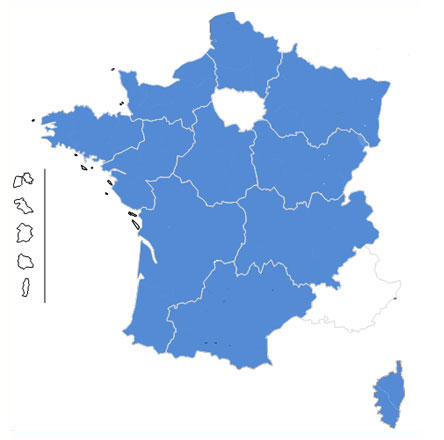
The year 2017 was marked by the creation of the Corsican GAST in January, bringing the total number of GASTs in operation as of December 31, 2017, to 11.
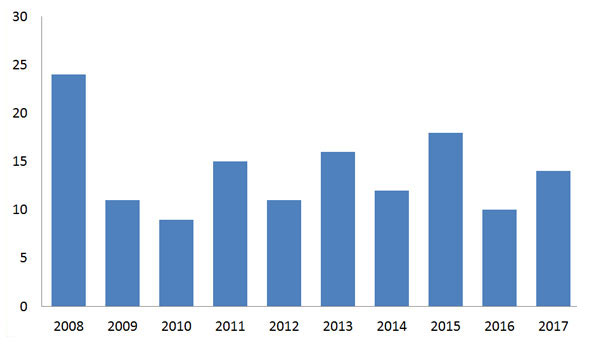
Excluding the peak in reports handled in 2008, which led to the creation of the first Gast in Aquitaine, the number of reports has remained generally stable year over year. In 2017, 14 reports of unusual health events in the workplace were handled, a number close to the average of 13 observed in previous years.
Number of events handled by GASTs per year
In 2017, occupational health services and occupational physicians remained the primary reporters. Last year was notably marked by a report of occupational and para-occupational exposure to lead, which warranted the issuance of a national alert to the General Directorate of Labor and the General Directorate of Health (report presented in Bulletin No. 4).
2017 Annual Report on Occupational Health Monitoring and Alert Activities
As in previous years, the team sought to raise awareness of the system through various presentations:
to inter-company health services (CMIE, AHI33)
to occupational medicine societies (Paris, Lyon)
by teaching courses to students in the Master 2 Public Health and Environmental Risks program at Paris Descartes University
by publishing the occupational health alert bulletin twice a year
Workshop at the National Congress on Occupational Medicine and Health
On the occasion of the National Congress on Occupational Medicine and Health, June 5–8, 2018, at the Chanot Convention Center in Marseille (https://www.medecine-sante-travail.com the Occupational Health Directorate of Santé publique France), in collaboration with ANSES, will lead the workshop titled “Monitoring, Vigilance, and Alert Systems in Occupational Health” on the afternoon of Tuesday, June 5.
Workshop “Monitoring, Vigilance, and Alerting in Occupational Health” – Tuesday, June 5, 2018, at 2:00 PM – Duration: 2.5 hours
Facilitators/Speakers: Pascal Empereur-Bissonnet (Santé publique France, Saint-Maurice), Juliette Bloch (ANSES, Maisons-Alfort).
Speakers: Annabelle Lapostolle (Santé publique France, Saint-Maurice), Isabelle Vanrullen (ANSES, Maisons-Alfort).
Workshop description:
Occupational health physicians and nurses are increasingly called upon to address unusual health events—whether observed or suspected—in the workplace, such as clusters of cancers, unexplained collective syndromes, atypical exposures, or new and emerging health phenomena. The objective of this workshop is to raise awareness of national occupational health surveillance, vigilance, and alert systems that enable the reporting of these events and facilitate a public health response; to demonstrate their respective utility and complementarity, as well as their connection to European systems; and to explain how to utilize them. The Occupational Health Alert Groups (GAST) system of Santé publique France will be presented, along with a concrete example of the management of an unexplained collective syndrome, which will be detailed by the Intervention Unit in the Provence-Alpes-Côte-d’Azur region, as well as the National Network for Vigilance and Prevention of Occupational Diseases (RNV3P) led by ANSES: objectives, organization, surveillance of emerging cases, and links with the European Occwatch network.
Cases of ENT and skin irritation among physical therapists working at a spa
Stéphanie Rivière,
Epidemiologist at the Occitanie Regional Health Agency of Santé publique France
On June 16, 2017, a departmental branch of a union sent a letter to the labor inspector, with copies to Carsat, the Occitanie Regional Health Agency (ARS), and the occupational physician, to report cases of ENT and skin irritation among physical therapists working at a spa in the region. Of the 18 physical therapists working at this center, five had been placed on sick leave and two had terminated their employment contracts early. The employees suspected a new disinfection process, implemented at the start of the 2017 season, involving a “chemical” added to the water. Furthermore, they specifically blamed one of the center’s treatment rooms.
The thermal spa, which specializes in both government-subsidized treatments and non-subsidized activities, has 90 employees. It features 20 massage rooms, deep-penetration shower rooms, and various thermal water pools.
This report was handled by the Occitanie Occupational Health Alert Group (GAST).
A multidisciplinary investigation was conducted, focusing on three areas:
epidemiological component to characterize the health situation (led by Santé publique France);
a technical and toxicological component: study of the water disinfection process, evaluation of the automatic disinfection system (amount of steam and aerosol), comprehensive study of the ventilation system and airflow in the cabins (led by Carsat and the Labor Inspectorate), and assessment of the toxicological risks of the disinfectant used (led by CAPTV);
regulatory component concerning the products used (conducted by the Direccte).
The results of the investigation led to the following conclusions.
From an epidemiological perspective, the occurrence of several cases (11 physical therapists out of 12 respondents) over a period of approximately two months suggested the existence of a cluster of cases with a persistent common source of exposure in the workplace. No new onset of symptoms was reported in the epidemiological investigation after the date when automatic disinfection and daily disinfection were discontinued, which supported the role of the disinfection processes in the onset of symptoms.
The new disinfectant used by the company during the 2017 season contained the active ingredient PHMB (polyhexamethylene biguanide). This substance was under evaluation at the European level. During the transitional period (lack of marketing authorization), risk management is the responsibility of the employer and relies primarily on compliance with the measures outlined in the safety data sheet.
The symptoms presented by the physical therapists were consistent with the health effects mentioned in the PHMB toxicology data sheet.
Technical investigations showed that the use of the PHMB disinfectant occurred under conditions of improper application (spraying) and poor ventilation of the premises.
The architectural layout of the massage rooms, the water and ventilation systems, as well as the results of technical tests and the epidemiological investigation, suggested that all of the rooms were potentially affected by the issue.
Following the GAST’s intervention, several proposals were made: improvements to the ventilation systems in all treatment rooms, replacing the active ingredient PHMB, and providing training for staff on chemical risks. Additionally, a national report was submitted to the agency responsible for evaluating the active ingredient.
The epidemiologist’s opinion:
“This investigation was complex due to the variety of areas examined (regulatory, technical, health-related) but yielded valuable insights. In my view, it perfectly illustrates the importance of addressing these issues through collaboration between institutions and specialists, with each contributing their expertise in complementary fields.”
The ongoing internal evaluation of the Gast program: the third phase (quantitative approach) is currently underway
A meeting of the National Steering Committee for the Gast initiative is scheduled for October 2018
The Gast program will be rolled out across the entire metropolitan territory: Gast will be established in Provence-Alpes-Côte-d’Azur in June 2018 and in Île-de-France by the end of the year
An oral presentation on an “Investigation of an unexplained collective syndrome among employees of a public local government in Nouvelle-Aquitaine” (investigation conducted within the framework of Gast Nouvelle-Aquitaine) will be given at the European Congress of Epidemiology held in Lyon in July 2018
Suspected unusual event
Have you observed or suspect an unusual health event occurring in the workplace?
Report it to Santé publique France by contacting the regional health surveillance and emergency response platform of your regional health agency.












