


GAST - Occupational Health Alert No. 1
Subscribe
If you would like to receive the newsletter by email, please subscribe to our mailing list.
Key Highlights
Currently deployed in 12 metropolitan areas, the system is intended to be expanded to cover the entire country, including the overseas departments.
From 2008 to 2014, 30 reports were processed through a Gast. These primarily involved suspected clusters of cancers or unexplained collective syndromes.
April 2015: Presentation of the Gast system during a workshop on spatio-temporal clusters at the Aderest conference (view abstract)
June and November 2015: organization of training sessions on the assessment and management of spatio-temporal clusters of non-infectious diseases for DST (Department of Occupational Health) liaisons
January 2016: Creation of Gast Auvergne-Rhône-Alpes
Cases of severe silicosis linked to engineered stone
ANSES reports that professionals working with engineered stone containing very high levels of crystalline silica face a potential risk. This material is used to manufacture kitchen countertops and bathroom surfaces.
Foreign publications (from Israel, Spain, etc.) report cases of silicosis with short latency periods (≈ about ten years of exposure), the severity of which may require a lung transplant. No cases have yet been reported in France. Although this material is not typically manufactured in France, many professionals cut and sand imported stone to fit countertops. These activities must be performed using a “wet method” while wearing a P3 respirator.
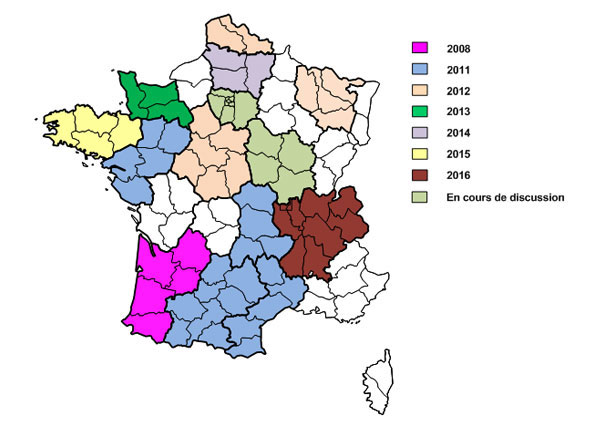
As of February 1, 2016, the Gast system is in place in 12 regions: Aquitaine, Auvergne, Lower Normandy, Brittany, Centre, Pays de la Loire, Picardy, Midi-Pyrénées, Nord-Pas-de-Calais, Languedoc-Roussillon, Lorraine, and Rhône-Alpes. The creation of a GAST is currently under consideration in Burgundy and Île-de-France. In other regions, occupational health reports are handled by the Cire, with support from a lead epidemiologist from the InVS’s occupational health department.
Between 2008 and 2014, 30 reports of unusual health events were processed through a GAST. These primarily involved the onset of diseases or symptoms (26 reports), and 4 were related to exposures.
Most often, these reports were submitted by occupational health services.
In terms of responsiveness, the average response time since 2008 was 14 days from receipt of the report to the GAST members’ conference call (min: 1 day; max: 2 months). The average time between receipt of the report and its closure was 90 days (min: 7 days; max: >2 years).
Map of GAST deployment as of February 1, 2016, by year of establishment (regional boundaries do not reflect territorial reform)
Number of reports - 2008 to 2014
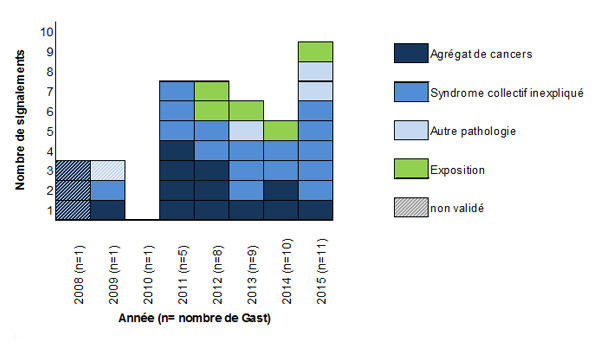
Summary of reports from 1999 to 2014
Focus on two reports
Fungal contamination of a local government’s departmental archives
In 2014, a local government reported to the Regional Health Agency the presence of mold in the departmental archives, some of which posed a pathogenic risk to humans. The GAST was consulted regarding the health effects of exposure to these molds.
After reviewing the case and consulting with GAST, it was decided: to identify individuals with known allergies or compromised immune systems and prevent their exposure during work duties (specifically maintenance, research, and cleaning of documents in storage areas); to inform employees about the potential effects and instruct them to report the onset of coughing, shortness of breath, or a fever outside of the winter season; to carry out dust removal activities, recommend the use of FFP2 masks, and provide a single type of glove (vinyl); to undertake decontamination of the premises (walls, surfaces, shelves) housing the archives and archival documents in order to systematically decontaminate all affected materials.
Occurrence of headaches, coughing, and fatigue among employees of a paper reaming company
In 2012, an occupational physician reported to the Regional Health Agency the occurrence of headaches, irritative cough, and asthenia among three employees sharing the same office at a paper ream manufacturing company. The Gast was called upon to address this report.
An investigation was conducted, including an on-site visit to the company with the Cire and the Occupational Pathology Consultation (CPP). A pattern linking the symptoms reported by the employees to their work was identified, but no evidence was found regarding factors inside or outside the premises that could be causing these symptoms.
Following this visit, GAST members recommended that employees still experiencing symptoms consult with the CPP to objectively assess their symptoms. During these consultations, employees mentioned social tensions, suggesting a psychosocial origin. The reporting occupational physician was informed of these findings.
Starting in January 2016: Adaptation of the program’s structure to the territorial reform
March 2016: Presentation of the Gast system to the Inserm network of occupational health physicians
June 21–24, 2016: Facilitation of a workshop titled “Response to Reports of Unusual Health Events in the Workplace” at the 34th National Congress of Occupational Medicine and Health in Paris
2017: Evaluation of the Gast system
Suspected unusual event
Have you observed or suspect an unusual health event occurring in the workplace?
Report it to Santé publique France by contacting the regional health surveillance and emergency response platform of your regional health agency.












