


The disease
A bacterial zoonosis
Anthrax (not to be confused with the French term anthrax, which refers to a staphylococcal infection) is a zoonosis caused by Bacillus anthracis.
All species of domestic and wild mammals (especially herbivores) and rare species of birds can be infected with anthrax.
Found worldwide, the disease is also present in France: the burial over the past centuries of animal carcasses that died from anthrax contributed to the contamination of certain soils known as “cursed fields,” where outbreaks have historically occurred periodically. The bacterial spores are indeed highly resistant and can survive for several decades in the soil.
Clinical forms in humans include cutaneous, gastrointestinal, or pulmonary, depending on the route of exposure.
Reporting of the disease is mandatory. Immediate reporting of any suspected or confirmed case of anthrax infection allows for the necessary investigations to identify the source of exposure, whether natural or malicious.
In this context, Santé publique France’s priorities are:
detecting all human cases of B. anthracis infection as early as possible to determine the source of contamination and support authorities in implementing control measures;
in cases of animal anthrax, to contribute to the risk assessment of people exposed to infected animals, in order to prevent the onset of the disease;
to inform healthcare professionals and public authorities.
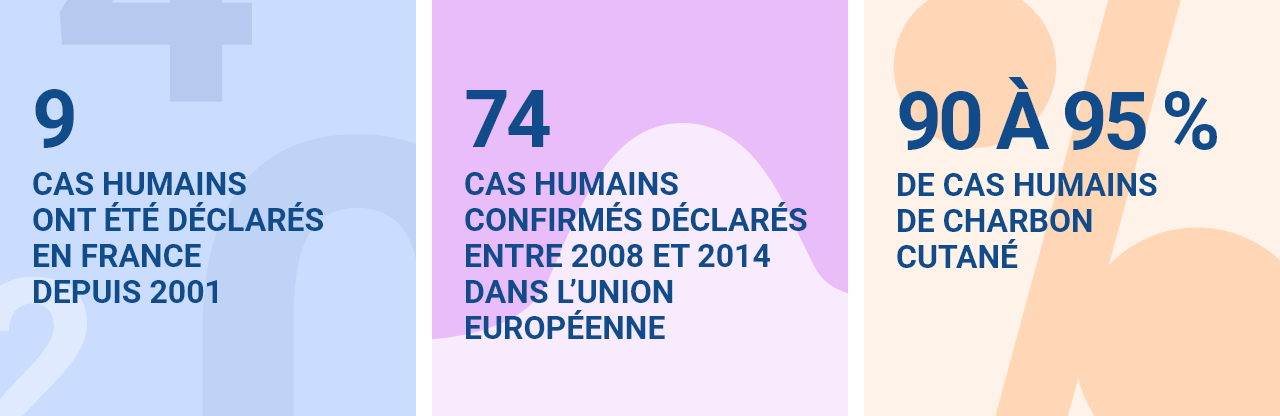
Key Figures on Coal
Routes of contamination
Anthrax affects many species of mammals, primarily herbivores (cattle, sheep, goats, and horses).1
Humans can become infected in several ways:
through skin contact with spores present on contaminated animal materials or products;
by inhaling an aerosol of spores that enter the pulmonary alveoli and are transported via the lymphatic system to the mediastinal lymph nodes. The germination of spores at this site releases toxins causing hemorrhages, edema, and tissue necrosis;
by ingesting contaminated products, with spore germination releasing toxins at various levels of the digestive tract: mouth, esophagus, or intestine.
Person-to-person transmission has never been documented.
Direct contact with an infected animal is the most common route of transmission, but such contact is not essential for infection. Transmission from soil or surfaces contaminated with biological fluids from infected animals is possible.
The persistence of spores in the environment is responsible for resurgences of the bacterium and animal disease, for example following weather events such as floods, or construction or earthmoving work. These situations constitute high-risk exposure scenarios for humans, either directly to spores brought to the surface or to newly infected animals.
Bacillus anthracis is on the list of agents likely to be used in malicious acts: in 1979, a massive outbreak of inhalational anthrax occurred in Sverdlovsk (former USSR) and killed 68 people. It was linked to the accidental release of an aerosol of dry anthrax spores. In 1970, the WHO estimated that 50 kg of anthrax spores dispersed by aircraft over an urban area of 5 million inhabitants could infect 250,000 people and result in the deaths of 100,000 people. In 2001, the mailing of powder-filled envelopes containing B. anthracis to several prominent American figures, particularly members of Congress, led to the deaths of 5 people and required unprecedented measures to decontaminate the affected buildings.
Prevention
In France, those most at risk of anthrax exposure are individuals engaged in high-risk occupational activities.2
People in contact with live or dead animals or their byproducts: livestock farmers, veterinarians, slaughterhouse workers, rendering plant workers, tanners...
People in contact with contaminated soil (“cursed fields”): public works…
People working in veterinary or medical laboratories that receive these types of samples.
Preventing occupational anthrax exposure relies on reducing potential sources of contamination and adhering to hygiene rules:
wearing personal protective equipment appropriate for the tasks and work environment (laboratory, livestock farming, rendering);
regular cleaning of work clothes;
frequent and systematic handwashing (after contact with animals, waste, or animal feces; before meals and breaks; and at the end of the workday).
There is no commercially available vaccine for humans.
Learn more:
INRS website: www.inrs.fr
INERIS website: www.ineris.fr/fr MSA
website: www.msa.fr/lfy
Symptoms and Diagnosis
The disease in humans generally occurs in three forms: cutaneous, inhalation, or gastrointestinal, with cutaneous anthrax being the most common form:
Inhalation form
Improperly referred to as the "pulmonary" form (it is not a form of pneumonia).
According to available data, the disease appears to have two phases: 1) an initial infectious syndrome that can last from a few hours to a few days; 2) the secondary and fulminant onset of respiratory failure associated with a septicemic syndrome. Chest X-rays show mediastinal widening due to lymphadenopathy. In half of cases, patients develop a hemorrhagic meningeal form. In the absence of very early antibiotic treatment (during the initial phase of the disease), the case-fatality rate ranges from 80% to 100%. The average time from symptom onset to death is 3 days.
Cutaneous form
Exposed skin areas (arms, hands, face, and neck) are most commonly affected.
The disease begins with an itchy macule or papule that progresses on the second day to a circular ulcer. Small vesicles measuring 1 to 3 mm may appear, releasing a clear or serosanguineous fluid containing numerous bacilli. The lesion progresses to a black, painless eschar, often associated with severe local edema. The scab dries out and falls off within 1 to 2 weeks without leaving a scar.
Lymphangitis and painful lymphadenopathy may develop, and the disease can progress to a septicemic syndrome. It responds well to appropriate oral antibiotic treatment. Without treatment, the case-fatality rate can reach 20%. With treatment, it is less than 1%.
Gastrointestinal form
It begins with acute gastroenteritis that can rapidly progress to septicemic syndrome with bloody diarrhea. Death can occur within a few hours (estimated case-fatality rate between 25% and 60%). Oropharyngeal forms with lymphadenopathy and sublingual edema have been described.
Confirmation of the diagnosis of anthrax can be obtained by:
the isolation and identification of Bacillus anthracis from clinical specimens (blood cultures, skin swabs, cerebrospinal fluid, lymph node biopsies, etc.) to be performed prior to any antibiotic therapy
gene amplification
An antibiotic susceptibility test must be performed routinely to adjust antibiotic therapy if necessary.
Treatment
Treatment of anthrax relies on a combination of antibiotic therapy initiated as early as possible and non-specific medical measures to manage symptoms, including intensive care if necessary.












