


Evaluation of the Colorectal Cancer Screening Program for the 2010–2011 Period: National Indicators
Indicators of the Quality of Screening Tests and Follow-up Examinations
This subsection presents indicators on the performance of screening tests and follow-up examinations in the event of a positive test result, such as the rate of individuals with at least one unanalyzed test, the rate of individuals with an unanalyzed test that was not retaken, the positive test rate, and the percentage of colonoscopies performed…
The available European recommendations¹ are:
the rate of unrepeated non-analysable tests, i.e., the rate of people who have only returned non-analysable tests:
the acceptable level is 3%
the desirable level is 1%
the colonoscopy completion rate:
the acceptable level is 90%
the target level is 95%
Percentage of complete colonoscopies:
the acceptable level is 85%
the desirable level is 90%
Additional information:
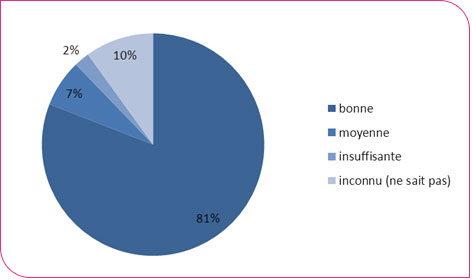
Breakdown of colonoscopies performed by quality of preparation
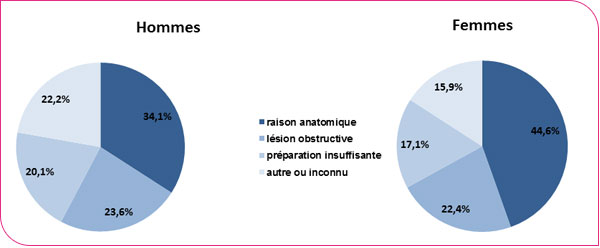
Breakdown of incomplete colonoscopies by reason
Colonoscopy morbidity
The completeness of data collection on colonoscopy complications, particularly deaths occurring in the days following the procedure, is not guaranteed at the national level. The variable tracking colonoscopy incidents and accidents has 54.9% of unknown data, making it impossible to determine whether the information is missing or if the colonoscopy proceeded without complications. These statistics cannot therefore be presented. More detailed analyses need to be conducted on this topic.
1 Segnan N, Patnick J, von Karsa L (eds). European guidelines for quality assurance in colorectal cancer screening and diagnosis. First Edition. Luxembourg: European Commission, 2010.
Program monitoring indicators
This subsection presents program monitoring indicators: the time taken to perform a colonoscopy and the percentage of patients lost to follow-up.
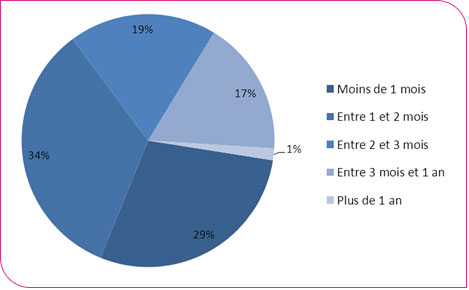
Distribution of time to colonoscopy
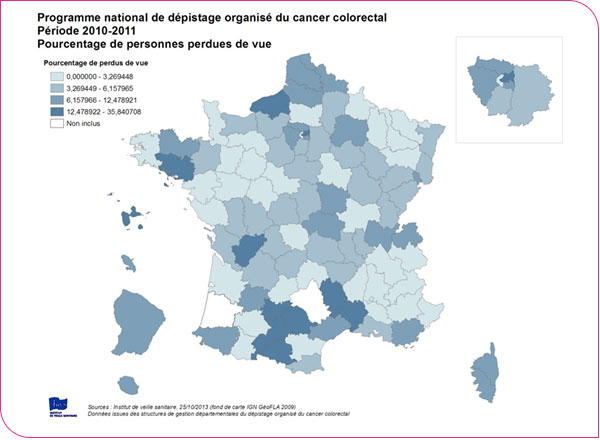
Geographic distribution of the percentages of lost-to-follow-up cases
A person is considered lost to follow-up when the managing facility has no news 24 months after their positive test result.
Across all 97 departments, the percentage of "lost to follow-up" cases is 6.7% (7.0% among men and 6.3% among women) and varies by department (from 0.5% in Creuse to 35.8% in Tarn-et-Garonne). These departmental disparities reflect the heterogeneity in documentation of test follow-up within management structures (for example, the transmission of information by healthcare professionals to the management structure is more or less systematic).
Indicators of detected lesions
This subsection presents indicators of detected lesions. These include indicators regarding the nature of lesions detected by diagnostic examinations (colonoscopy or other) and the detection rates of lesions (adenomas, advanced adenomas, and cancers).
Indicators of detected lesions (xls format and pdf format)
Advanced adenomas are adenomas measuring 10 mm or more, or those with high-grade dysplasia, or those with a villous component.
Indicators of detected cancers
The stage of cancers detected by the organized screening program was determined according to the TNM classification system for malignant tumors. Since this classification applies only to carcinomas of the colon and rectum, only cancers histologically classified as "adenocarcinoma" are described in this section. For colon cancers, the pTNM histopathological classification was used. For rectal cancers, which may undergo neoadjuvant treatments prior to surgery, resulting in a change in the T, N, or M stage of the detected tumor, the quality of the available data and the heterogeneity of the methods used to document staging information do not allow for the determination of the pre-treatment TNM stage. Consequently, only colon cancers (including the rectosigmoid junction) and rectal cancers that did not receive neoadjuvant therapy were included.
The cancer stage is considered unknown when at least one of the T, N, or M values is unknown (unless pT=Tis, in which case the TNM stage is in situ, or if M=M1, in which case the TNM stage is IV). Of the 7,414 cancers detected through the program, this information is missing in 27.5% of cases. This national percentage reflects significant regional variation (Percentage of unknown stage (xls format and pdf format)), as information on the metastatic status of detected cancers is difficult to obtain.
The description covers only the 52 departments with no more than 30% of missing data on cancer stages, corresponding to 4,042 detected adenocarcinomas of the colon and rectum (without neoadjuvant treatments).
Indicators of detected cancers (xls format and pdf format)












