


Monitoring of bacterial antibiotic resistance in outpatient care and long-term care facilities. Mission Primo. Summary results, 2023
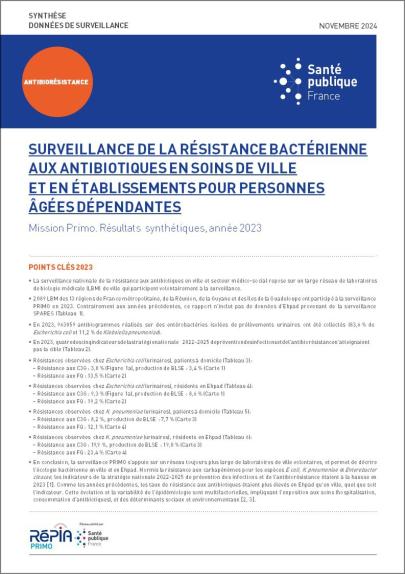
The national surveillance of antibiotic resistance in community and healthcare settings relies on a broad network of community clinical laboratories (LBMs) that voluntarily participate in the surveillance program. A total of 2,089 LBMs from the 13 regions of mainland France, Réunion, French Guiana, and the islands of Guadeloupe participated in the PRIMO surveillance program in 2023. Unlike in previous years, this report does not include data from long-term care facilities (Ehpad) derived from the SPARES surveillance program. In 2023, 963,059 antibiotic susceptibility tests performed on Enterobacteriaceae isolated from urine samples were collected (83.6% Escherichia coli and 11.2% Klebsiella pneumoniae). In 2023, four of the five indicators of the 2022–2025 National Strategy for Infection Prevention and Antibiotic Resistance did not meet the target. Resistance observed in Escherichia coli (urinary), home-bound patients: C3G resistance: 3.8%, ESBL production: 3.4%; FQ resistance: 13.5%; Resistance observed in Escherichia coli (urinary), nursing home residents: C3G resistance: 9.3%, ESBL production: 8.6%; Resistance to FQs: 19.2% Resistance observed in K. pneumoniae (urinary tract), outpatients: Resistance to C3Gs: 8.2%, production of ESBL: 7.7%; Resistance to FQ: 12.1%; Resistance observed in K. pneumoniae (urinary), nursing home residents: Resistance to C3G: 19.9%, production of ESBL: 19.0%; Resistance to FQ: 23.4%. In conclusion, the PRIMO surveillance program relies on an ever-expanding network of volunteer community laboratories and enables the description of bacterial ecology in the community and in nursing homes. With the exception of carbapenem resistance in E. coli, K. pneumoniae, and Enterobacter cloacae, the indicators of the 2022–2025 national strategy for infection prevention and antibiotic resistance were on the rise in 2023. As in previous years, antibiotic resistance rates were higher in nursing homes than in community settings, regardless of the indicator. This trend and the variability in epidemiology are multifactorial, involving exposure to healthcare (hospitalization, antibiotic use), as well as social and environmental determinants.
Author(s): Lemenand Olivier, Thibaut-Jovelin Sonia, Coeffic Thomas, Birgand Gabriel
Publishing year: 2024
Pages: 13 p.
In relation to
Our latest news

news
Growing Up with Screens. A special report in *La Santé en action* No. 474,...

news
Seniors, pregnant women, and nursing home staff: What is the status of their...

news












