



Monkeypox Cases: Update as of August 18, 2022
Update as of August 18, 2022, following reports of monkeypox cases in France and around the world.
In early May 2022, cases of monkeypox with no direct link to travel to Central or West Africa—where the virus is present—or to people returning from such trips were reported in Europe and around the world. Since then, the outbreak has spread to a growing number of countries, and the disease is subject to enhanced surveillance in both France and Europe. Today, the Agency is updating its surveillance efforts and will soon release new indicators.
More information on monkeypox (disease description, transmission, symptoms...)
Epidemiological surveillance that adapts to evolving knowledge and diagnostic practices
Surveillance in France and internationally initially relied on case confirmation through a biological test (PCR). As the outbreak progressed and knowledge of case symptoms grew, clinicians no longer routinely relied on laboratory testing for clinically suggestive cases where exposure to risk or contact with a PCR-confirmed case was documented.
To better interpret epidemiological trends, the Agency is adapting surveillance to cover all cases and no longer limit it to biologically confirmed cases alone. This change allows for a more accurate description of the situation on the ground, quantifies the impact of the outbreak, and accounts for changes in diagnostic practices by clinicians.
As a reminder, Monkeypox virus infections (whether cases are biologically confirmed or clinically suggestive with risk exposure) must be subject to mandatory reporting (Orthopoxvirus form, including smallpox) to enable the transmission of information to the Regional Health Agency, and subsequently to Santé publique France, as part of surveillance efforts.
To date, only biologically confirmed cases must be reported at the European level.
The new indicators are expected to be published next week following a necessary verification period to ensure their robustness and reliability.
Update on the Situation in France
As of 12:00 p.m. on August 18, 2022, 2,889 confirmed cases had been reported in France. The breakdown of cases by region of residence (or by region of reporting when the region of residence is unknown) is as follows: 1,692 cases in Île-de-France, 251 in Occitanie, 217 in Auvergne-Rhône-Alpes, 203 in Provence-Alpes-Côte d’Azur, 140 in Hauts-de-France, 113 in Nouvelle-Aquitaine, 76 in Grand Est, 58 in Pays-de-la-Loire, 32 in Normandy, 31 in Brittany, 29 in Bourgogne-Franche-Comté, and 27 in Centre-Val de Loire. For Martinique, Corsica, Guadeloupe, and Saint Martin, each of these regions reported fewer than 5 cases. Twelve cases reside abroad.
All cases recorded to date are adult males, except for 34 adult females and 7 children. Adult cases have a median age of 36 years; 25% of adult cases are under 30 years old, and 25% are between 43 and 77 years old.
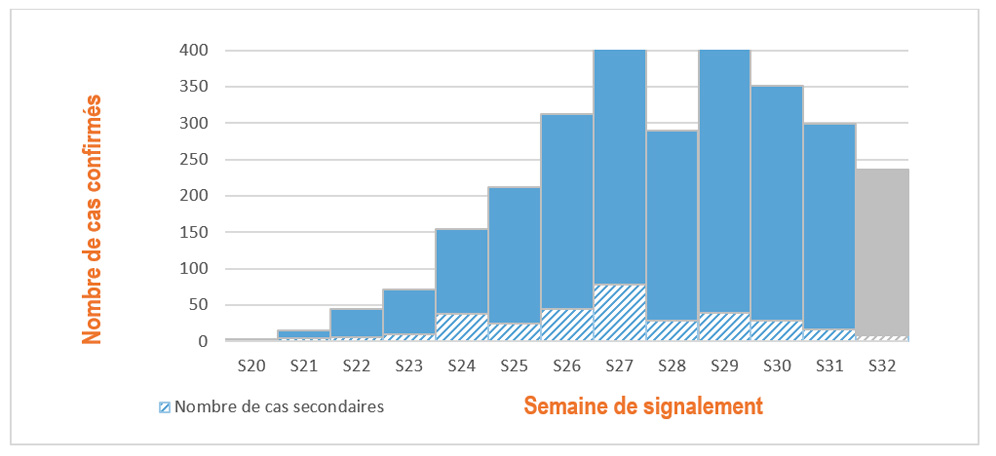
The distribution of cases by date of symptom onset (when known) is shown in Figure 1. Due to reporting delays, data from the past few weeks are not consolidated. Reports received do not always include the date of symptom onset. As an alternative to this information, the distribution of cases by date of reporting is shown in Figure 2.
The dip in reported cases observed in week 28 (July 11–17) can be explained by the public holiday (July 14).
Figure 1. Confirmed cases of monkeypox (n=1,966 cases) by week of symptom onset, France, May–August 2022 (data as of August 18, 2022 – 12:00 p.m.)
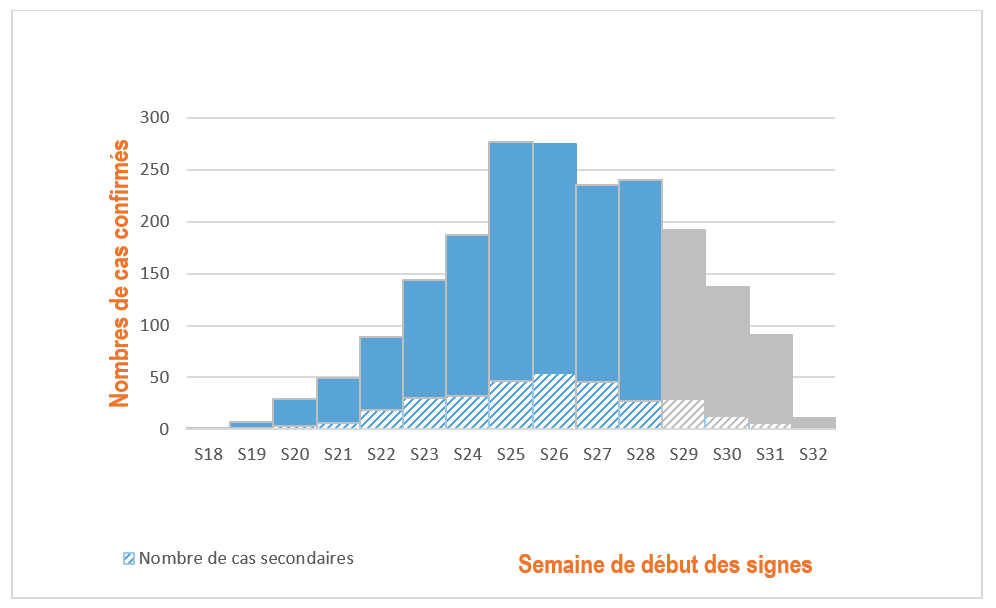
Figure 2. Confirmed cases of monkeypox (n=2,888 cases) by week of reporting, France, May–August 2022 (data as of August 18, 2022 – 12:00 p.m.)
Information and Prevention Initiatives
Given what has been observed in Europe regarding the disease, targeted communication was quickly implemented for men who have sex with men (MSM). The website sexosafe.fr, dedicated to the sexual health of MSM, is regularly updated with a summary of current knowledge on the subject and prevention measures. Poster, radio, and digital campaigns provide information to the public, complementing on-the-ground efforts. Since June 17, the digital campaign has generated nearly 689,463 clicks on banners and over 599,065 visits to the Sexosafe website.
All information on vaccination is updated weekly on the page for the general public and the page for healthcare professionals (accessible without a login) on the vaccination-info-service website.
Prevention efforts are continuously adapted to the evolving situation and the current state of knowledge.
To make information more accessible to vulnerable people in precarious situations, a visual resource—translated into 6 languages and developed with professionals who work with these individuals—is available on Santé Publique France.
Monkeypox Dossier (publicly accessible section)
The MOBCO Newsletter No. 7, developed in collaboration with frontline workers, compiles a series of questions and answers on the topic of monkeypox. It is intended for professionals or volunteers in contact with people in precarious situations.
In France, ongoing surveillance of monkeypox through the mandatory reporting system has been strengthened, and information and alert messages are being sent to healthcare professionals. Discussions are also continuing with other European countries, the WHO, and the ECDC.
Monkeypox Info Service: A Helpline to Answer Questions About Monkeypox
Since Wednesday, July 13, a helpline has been available to answer questions about monkeypox. Funded by Santé publique France and operated by SIS Association, the “Monkeypox Info Service” hotline is available daily from 8 a.m. to 11 p.m. at the toll-free number 0 801 90 80 69 (free calls and services; anonymous and confidential). This service is responsible for promoting prevention messages and protective measures, providing information on symptoms, treatments, and vaccination, and offering advice and referrals to care services.
Since the hotline opened, 6,133 calls have been handled by the Monkeypox Info Service.
Preventive Vaccination Against Monkeypox
In response to the spread of the Monkeypox virus, the High Authority for Health, following a referral from the Directorate General of Health, recommended in its opinion dated July 7, 2022, that preventive vaccination be offered to groups most at risk of exposure to the virus.
Regarding the rollout of the vaccination, 103,000 doses of third-generation vaccine had been delivered by the Agency to the regions as of August 18, 2022.
Since July 11, 2022, in addition to individuals who have had high-risk contact with an infected person, individuals meeting the criteria established by the HAS may schedule an appointment to be vaccinated throughout the country:
men who have sex with men and report having multiple sexual partners
transgender individuals reporting multiple sexual partners
sex workers
professionals working in venues where sexual services are provided
Vaccination may also be considered on a case-by-case basis for healthcare professionals who care for infected individuals.
To learn more about vaccination and access to vaccination sites:
Monkeypox Cases: Update as of August 16, 2022 (News from 08/19/22)
Monkeypox cases: update as of August 11, 2022 (news from 08/12/22)
Monkeypox cases: update as of August 9, 2022 (news from 08/10/22)
Monkeypox cases: update as of August 4, 2022 (news from 08/05/22)
Monkeypox cases: update as of August 2, 2022 (news from 08/03/22)
Monkeypox cases: update as of July 28, 2022 (news from 07/29/22)
Monkeypox cases: update as of July 26, 2022 (news from 07/27/22)
Monkeypox cases: update as of July 21, 2022 (news from 07/22/22)
Monkeypox cases: update as of July 19, 2022 (news from 07/20/2022)
Monkeypox cases: update as of July 12, 2022 (news from 07/13/2022)
Monkeypox cases: update as of July 7, 2022 (news from 07/08/22)
Monkeypox cases: update as of July 5, 2022 (news from 07/05/22)
Monkeypox cases: update as of June 30, 2022 (news from 06/30/22)
Monkeypox cases: update as of June 28, 2022 (news from 06/28/22)
Monkeypox cases: update as of June 23, 2022 (news from 06/23/22)
Monkeypox cases: update as of June 21, 2022 (news from 06/21/22)
Monkeypox cases: update as of June 16, 2022 (news from 06/16/22)
Monkeypox cases: update as of June 14, 2022 (news from 06/14/22)
Monkeypox cases: update as of June 9, 2022 (news from 06/09/22)
Monkeypox cases: update as of June 7, 2022 (news from 06/07/22)
Monkeypox cases: update as of June 3, 2022 (news from 06/03/22)
Monkeypox cases: update as of June 1, 2022 (news from 06/01/22)
Monkeypox cases: update as of May 30, 2022 (news from 05/30/22)
Monkeypox cases: update as of May 28, 2022 (news from 05/29/22)
Monkeypox cases: update as of May 27, 2022 (news from 05/27/22)
Monkeypox cases: update as of May 25, 2022 (news from 05/25/22)
Monkeypox cases: update as of May 24, 2022 (news from 05/24/22)
Monkeypox cases: update as of May 23, 2022 (news from 05/23/22)
First confirmed case of Monkeypox in France (press release dated 05/20/22)
European Monkeypox cases: enhanced surveillance implemented (news update from 05/19/22)
Smallpox B (Mpox)
thematic dossier
Smallpox B (Mpox), formerly known as monkeypox, is a rare viral infectious disease caused by the monkeypox virus and transmitted primarily from rodents to humans, and then from person to person,...
Safe Sex
HIV and STI prevention, testing, and sexual orientation—the Sexosafe website addresses issues related to sexuality among men.
Vaccination Information Service
What are vaccines for? How do they work? At what age should children be vaccinated? Vaccination-info-service.fr answers the most frequently asked questions about vaccination. A separate...












