


Rubella: 2014 Epidemiological Data
In 2014, the Rénarub network comprised 162 laboratories nationwide, including 154 in metropolitan France and 8 in the overseas departments. The effective participation rate of the laboratories surveyed was 75% (laboratories participating in both survey semesters), with 82% of laboratories participating in at least one survey semester (see list of participating laboratories). The return rate of completed forms by clinicians treating the patients was 100% (48 forms).Three confirmed maternal rubella infections and three probable infections were identified in metropolitan France, none in the overseas departments and territories (Table 1). Two congenital infections were diagnosed, resulting in two cases of congenital rubella syndrome.
|
2005 |
2006 |
2007 |
2008 |
2009 |
2010 |
2011 |
2012 |
2013 |
2014 |
Number of cases reported by laboratories (IgM+) |
110 |
118 |
75 |
65 |
144 |
123 |
140 |
149 |
151 |
92* |
Excluded cases |
94 |
111 |
70 |
63 |
137 |
119 |
132 |
136 |
139 |
86 |
Possible primary or reinfection |
5 |
7 |
4 |
7 |
14 |
6 |
5 |
6 |
1 |
|
Lost track of, files not returned |
9 |
26 |
4 |
31 |
47 |
23 |
12 |
17 |
2 |
2 |
Other** |
80 |
78 |
62 |
25 |
76 |
90 |
115 |
113 |
137 |
83 |
Confirmed and probable maternal rubella infections |
16 |
7 |
5 |
2 |
7 |
4 |
8 |
13 |
12 |
6 |
Confirmed primary infections |
11(c) |
3 |
4 |
1 |
5 |
2 |
5 |
12 |
10 |
3 |
Confirmed re-infections |
1 |
1 |
||||||||
Confirmed infections |
1 |
|||||||||
Probable primary infections |
2 |
2 |
1 |
1 |
1 |
3 |
1 |
3 |
||
Probable re-infections |
1 |
1 |
1 |
1 |
1 |
1 |
||||
Probable infections |
1 |
|||||||||
Number of congenital infections |
9 |
2 |
2 |
1 |
2 |
3 |
5 |
2 |
||
Congenital rubella syndrome (newborns) |
2 |
1 |
1 |
3 |
2 |
|||||
Teratogenic rubella (termination of pregnancy) |
1 |
|||||||||
Non-teratogenic rubella infection or unknown clinical status (newborns or fetuses) |
7 |
2 |
1 |
1 |
3 |
2 |
(c) twin pregnancy
* In 2014, the decline in the number of initial cases can be explained in part by the "screening" now conducted by the CNR upon receipt of these cases, but also by a decrease in laboratory participation (-7% compared to 2013)** including Absence of pregnancy, Rubella immunity prior to pregnancy, vaccination during pregnancy
Trend in the ratio of rubella infections among pregnant women to live births – Metropolitan France, 1976–2014 (MMR = trivalent measles-mumps-rubella vaccine)
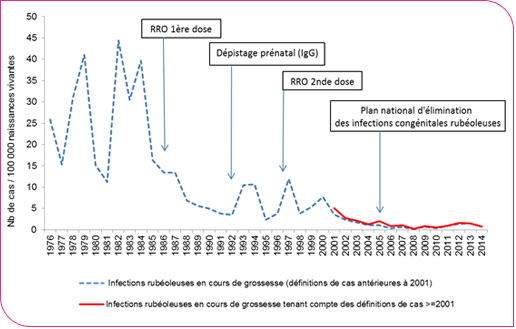
In 2014, the pregnancy outcome was reported for all 6 cases. Among the 6 children born to infected mothers, 2 were born infected and exhibited signs of congenital rubella syndrome, 2 were born uninfected, and for 2 asymptomatic children, the infection status was not determined. No pregnancies were terminated.
Trend in the number of maternal infections resulting in pregnancy terminations or the birth of children with congenital rubella syndrome – 1997 to 2014
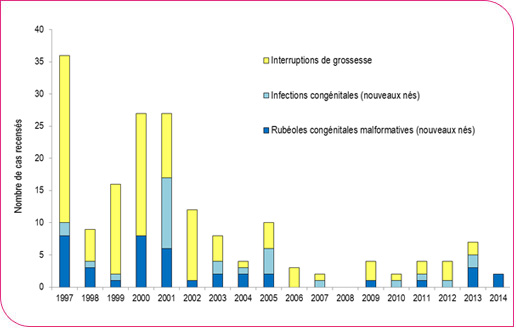
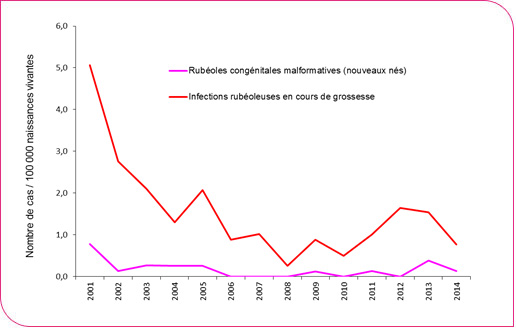
The ratio of "newborns with congenital rubella syndrome (CRS) recorded by Rénarub / number of live births (LB)" in mainland France was 0.13 per 100,000.
Trends in the ratio of rubella infections among pregnant women and congenital rubella syndrome cases per live births – Metropolitan France, 2001–2014
The mother’s country of birth was documented for all 6 maternal infections; 3 were born outside France (North Africa, West Africa, and Southern Africa).
There were no clusters of cases, and the 6 maternal infections were distributed throughout the country.
Data collected through the Rénarub network in 2014 continue to indicate low residual circulation of the rubella virus, reflecting a high level of immunity among women of childbearing age due to catch-up vaccination. This level of susceptibility to the virus was estimated in mainland France at 3.1% among women aged 18 to 32 in the seroprevalence survey conducted among blood donors in 2013. However, the level of susceptibility is higher among men (7.8%), and vaccination coverage levels in France vary by department, which could facilitate the emergence of localized outbreaks of viral circulation. Half of the maternal infections in 2014 involved women born in countries where vaccination programs do not include rubella vaccination. However, we do not know the date of arrival of these women in France. An underestimation of the actual number of maternal infections is possible within the Rénarub network, which may be primarily due to a lack of diagnosis in pregnant women, as rubella infections are frequently asymptomatic or atypical. The active participation, since the creation of Rénarub, of specialized laboratories—which receive control samples when a maternal infection is suspected—suggests that even if the network is not entirely comprehensive, and even if the participation rate of all laboratories or clinicians is not 100%, the vast majority of confirmed and probable cases are captured by the surveillance system. The National Reference Center (NRC) for Maternal-Fetal Rubella Infections was established in 2012 to provide expertise to laboratories, diagnostic support when needed, assistance in dating maternal primary infections, and to contribute to epidemiological and virological surveillance. The NRC is now integrated into the data transmission system for information collected by partner laboratories in the Rénarub network.












