


Rubella: 2011 Epidemiological Data
In 2011, the Rénarub network comprised 246 laboratories covering the entire country, including 236 in mainland France (9 in the Overseas Departments and 1 in the Overseas Territories). The effective participation rate of the laboratories surveyed was 85% (laboratories participating in both survey semesters), with 97% of laboratories participating in at least one survey semester (see list of participating laboratories). The return rate for files sent to clinicians was 94% (132 out of 140 files).
Eight confirmed (5 cases) and probable (3 cases) maternal rubella infections were identified in mainland France, none in the French overseas departments and territories (Table 1).
Table 1 – Distribution of the number of cases reported in mainland France according to case definitions | |||||||
|
2005 |
2006 |
2007 |
2008 |
2009 |
2010 |
2011 |
Number of cases reported by laboratories (IgM+) |
110 |
118 |
75 |
65 |
144 |
123 |
140 |
Excluded cases |
94 |
111 |
70 |
63 |
137 |
119 |
132 |
Possible primary or reinfection |
5 |
7 |
4 |
7 |
14 |
6 |
5 |
Lost track of, files not returned |
9 |
26 |
4 |
31 |
47 |
23 |
12 |
Absence of pregnancy |
22 |
11 |
22 |
9 |
17 |
15 |
20 |
Rubella immunity prior to pregnancy |
55 |
65 |
40 |
16 |
52 |
69 |
83 |
Other (including vaccination during pregnancy) |
3 |
2 |
7 |
6 |
12 |
||
Confirmed and probable maternal rubella infections |
16 |
7 |
5 |
2 |
7 |
4 |
8 |
Confirmed primary infections |
11(*) |
3 |
4 |
1 |
5 |
2 |
5 |
Confirmed re-infections |
1 |
||||||
Confirmed infections |
1 |
||||||
Probable primary infections |
2 |
2 |
1 |
1 |
1 |
3 |
|
Probable re-infections |
1 |
1 |
1 |
1 |
1 |
||
Probable infections |
1 |
||||||
|
|
|
|
|
|
|
|
Number of congenital infections |
9 |
0 |
2 |
0 |
2 |
1 |
2 |
Congenital rubella syndrome (newborns) |
2 |
1 |
1 |
||||
Rubella with congenital malformations (pregnancy termination) |
1 |
||||||
Non-teratogenic rubella infection or unknown clinical status (newborns or fetuses) |
7 |
2 |
1 |
1 |
|||
(*) twin pregnancy
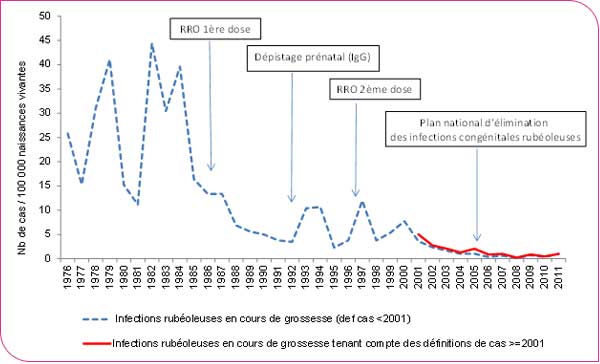
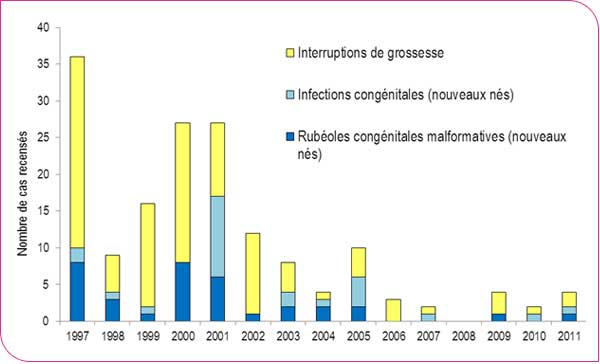
Two pregnancies were terminated due to maternal rubella infection (transmission to the fetus confirmed in 1 case). The ratio of "rubella infections during pregnancy recorded by Rénarub / number of live births (LB)" in mainland France was 1.01 per 100,000.
Trend in the ratio of rubella infections in pregnant women to live births – Metropolitan France, 1976–2011 (MMR = trivalent measles-mumps-rubella vaccine)
Among the 6 children born to infected mothers, 1 child was born with congenital rubella syndrome, 3 were born uninfected, and for 2 asymptomatic children, the infection status was not determined.
Trend in the number of maternal infections leading to medical terminations of pregnancy or the birth of children with congenital rubella syndrome – 1997 to 2011
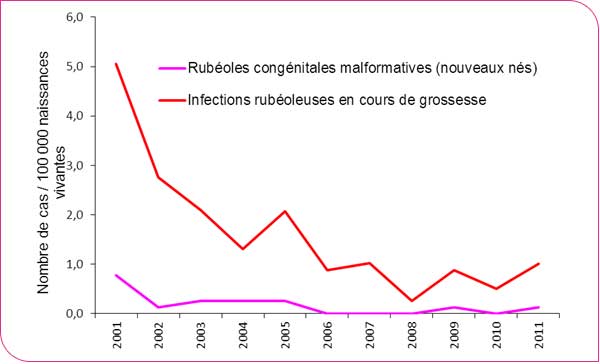
The ratio of "newborns with congenital rubella syndrome (CRS) recorded by Rénarub / number of live births (LB)" in metropolitan France was 0.13 per 100,000.
Trends in the ratio of rubella infections among pregnant women and congenital rubella syndrome cases per live births – Metropolitan France, 2001–2011
While between 2002 and 2005, the "infections/live births" ratio was higher among young women aged 15–19 (13.1 to 20.1 cases per 100,000 live births depending on the year), this ratio has been zero for this age group since 2008 (Table 2).
Table 2 - Rubella infections by age of pregnant women, mainland France, 2001–2011 | |||||||
Rate of infections per 100,000 live births* |
|||||||
Age groups |
Average 2002–2005 |
2006 |
2007 |
2008 |
2009 |
2010 |
2011 |
15–19 years |
15.1 |
0.0 |
6.8 |
0.0 |
0.0 |
0.0 |
0.0 |
20–24 years |
6.6 |
2.8 |
2.9 |
0.0 |
0.0 |
1.0 |
1.9 |
25–29 years |
0.9 |
0.4 |
0.0 |
0.4 |
1.2 |
0.4 |
1.6 |
30–34 years |
0.9 |
0.8 |
0.4 |
0.0 |
0.8 |
0.4 |
0.8 |
35–39 years |
0.7 |
0.8 |
0.0 |
0.0 |
0.7 |
0.0 |
0.0 |
40–44 years old |
1.8 |
0.0 |
0.0 |
3.2 |
3.1 |
3.1 |
0.0 |
Total |
1.9 |
0.9 |
0.6 |
0.1 |
0.9 |
0.5 |
1.0 |
* NV=live births
These data suggest low residual circulation of the rubella virus and may reflect improved catch-up vaccination among non-immune adolescent girls and young women. The actual number of maternal infections may be underestimated within the Rénarub network, primarily due to underdiagnosis in pregnant women, as rubella infections are frequently asymptomatic or atypical. The active participation, since Rénarub’s inception, of specialized laboratories—which receive control samples when a maternal infection is suspected—suggests that even if the network is not entirely comprehensive, and even if the participation rate of all laboratories or clinicians is not 100%, the vast majority of confirmed and probable cases are captured by the surveillance system.












