



Prevalence surveys
Prevalence surveys provide data on hospital-acquired infections caused by antibiotic-resistant bacteria and on patients currently receiving antibiotic treatment. They are conducted every five years at all French healthcare facilities, both public and private, and the following year at long-term care facilities.
National Survey on the Prevalence of Healthcare-Associated Infections and Antibiotic Use in Healthcare Facilities
National prevalence surveys (ENP) have been regularly conducted since 1996 in all French healthcare facilities, both public and private. Their primary objective is to measure, on a given day, the prevalence of healthcare-associated infections and the use of antimicrobial treatments among hospitalized patients. The survey also describes the main characteristics of healthcare facilities in terms of their operations and patient demographics.
Prevalence surveys also aim to raise awareness among all healthcare staff in healthcare facilities regarding the risk of nosocomial infections and the importance of monitoring antimicrobial use in hospitals.
The 2017 ENP surveyed a sample of 403 healthcare facilities selected at random.
A new survey was conducted in May–June 2022. It was carried out in 1,155 healthcare facilities and covered 151,676 patients.
National Prevalence Survey of Healthcare-Associated Infections and Antibiotic Use in Nursing Homes: Prev’Ehpad
A national prevalence survey is conducted in long-term care facilities every five years. The most recent survey was conducted in 2016.
Its objective is to measure the prevalence of certain infections and antibiotic treatments prescribed to residents in long-term care facilities in France, and to describe the main characteristics of these facilities in terms of their operations and resident profiles.
Prevalence surveys also aim to engage all professionals and prescribers in nursing homes and identify priorities for action and monitoring regarding prevention policies and the appropriate use of antibiotics.
The 2016 Prev’Ehpad survey covered a sample of 367 nursing homes selected at random.
Results

actualité
Prév’Ehpad: Healthcare-associated infections and antibiotic use in nursing homes, 2016 national results
National Survey on the Prevalence of Healthcare-Associated Infections and Antibiotic Use in Nursing Homes (Prév’Ehpad 2016)
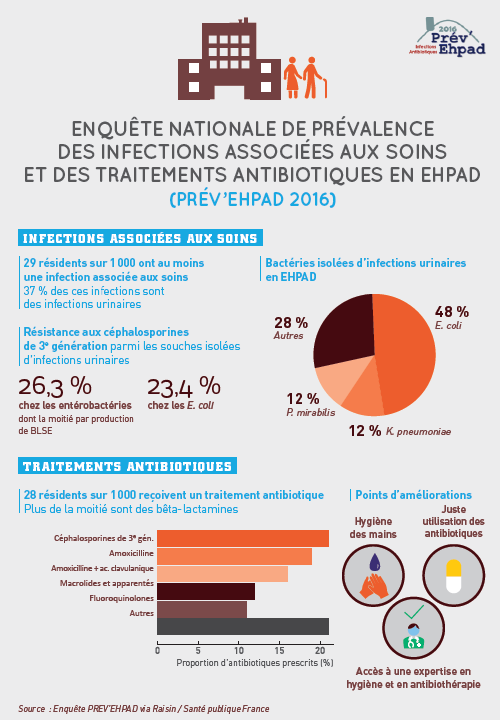
The next survey of nursing homes is scheduled for May–June 2024.
See also

enquêtes/études
2024 National Prevalence Survey of Healthcare-Associated Infections and Antimicrobial Treatments in Nursing Homes
In relation to

Healthcare-associated infections
thematic dossier
Santé publique France is tasked with monitoring and preventing these infections in healthcare facilities, long-term care facilities, and community healthcare settings, thereby helping to limit...












