


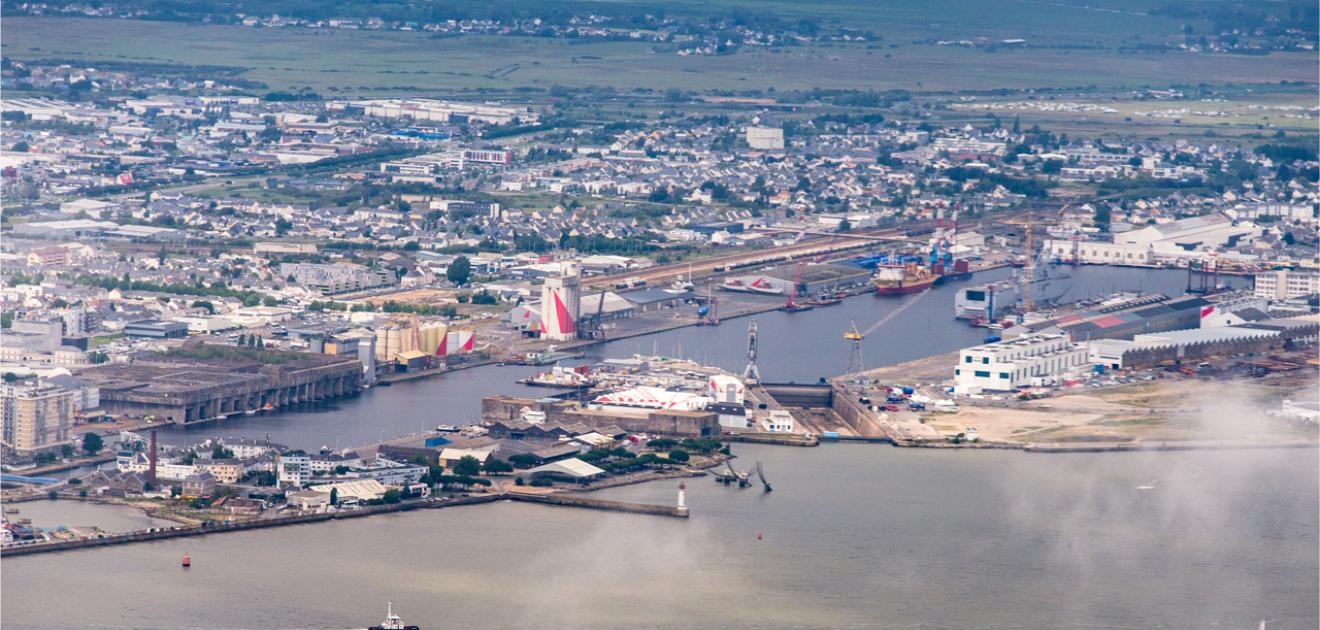
Saint-Nazaire Industrial Area
Everything you need to know about Santé publique France’s response to the request submitted by the Pays de la Loire Regional Health Agency (ARS) in 2019 regarding the relevance and feasibility of conducting a study to examine the link between industrial air pollution and the health of residents in the Saint-Nazaire industrial basin.
News
Access the presentations given at the June 8, 2026, informational meeting on the health status of Saint-Nazaire residents
Background
The industrialization of the Saint-Nazaire area dates back to 1862 with the construction of the first shipyard, followed by the establishment of the aircraft manufacturing industry in 1922. Saint-Nazaire currently has nearly 140 facilities classified for environmental protection (ICPE), mostly located along the Loire River in the municipalities of Donges, Trignac, Montoir-de-Bretagne, and Saint-Nazaire.
The nature of these activities is diverse: shipbuilding and aircraft manufacturing, oil refining, fertilizer production, surface treatments, etc. The region also boasts several transportation infrastructures: the Saint-Nazaire/Montoir airport, the major seaport of Nantes/Saint-Nazaire, as well as rail and road networks.
For several years, the concentration of these industries has raised serious concerns among local residents regarding the environmental and health impacts associated with emissions from these facilities. These concerns were reinforced by the publication in 2019 of two epidemiological studies:
an assessment of the health status of the population in the Saint-Nazaire area conducted by the Regional Health Observatory (ORS) of the Pays de la Loire, and
a cancer risk map of this area produced by the General Cancer Registry of Loire-Atlantique and Vendée.
These studies concluded that the health status of residents in the Saint-Nazaire area is poorer than that of the rest of the Loire-Atlantique department or of France as a whole, resulting in excess premature mortality, as well as higher incidence and mortality rates for several diseases, including lung cancer and cancers of the upper aerodigestive tract in men, and certain respiratory and cardiovascular diseases.
In light of this situation, in June 2019, several local residents’ associations submitted a petition with nearly 2,500 signatures to the Regional Health Agency (ARS) of the Pays de la Loire, calling for an epidemiological study to assess the impact of industrial air pollution on the health of local residents. On September 6, 2019, the ARS of the Pays de la Loire referred the matter to Santé publique France to provide answers to questions raised by local stakeholders. The question posed was: What is the relevance and feasibility of an epidemiological study aimed at identifying the contribution of industrial air pollution to the occurrence of diseases observed in the general population in the Saint-Nazaire basin?
Launch of a zoning study for the Saint-Nazaire area
A zoning study began in this area in March 2021 and is expected to last between three and five years. It is led by the Saint-Nazaire Subprefecture and the DREAL (Regional Directorate for the Environment, Planning, and Housing).
What is the purpose of a zone study?
A zone study provides a comprehensive overview of the situation, as it takes a holistic view of the diversity of pollution sources present in an area (industries, as well as transportation infrastructure, residential and commercial sectors, agriculture, etc.) and the cumulative impact of their emissions on the environment, unlike traditional monitoring around an industrial site, which is conducted by considering each facility independently of the others.
This study should provide answers regarding the potential presence of pollutants at levels of concern from a public health perspective, the area of influence, the level of exposure of nearby populations, and the relevant health effects depending on the substances identified.
Santé publique France serves on the Strategic Steering Committee for this study.
Santé publique France’s Response to the Request from the Pays de la Loire Regional Health Agency
A theoretical analysis of several potential study designs in the specific context of the Saint-Nazaire area
Santé publique France participated in numerous meetings and discussions with local stakeholders (residents’ associations, government agencies, elected officials, etc.). This dialogue with the community helped to better identify the concerns of the people living in this area.
In 2023, while awaiting the results of the area-wide study, Santé publique France conducted a theoretical analysis of various study designs to distinguish those that might be worth pursuing in the Saint-Nazaire context from those that could already be ruled out at this stage.
Several study designs were examined: cohort study, case-control study, ecological study, exposure study, and quantitative assessment of the health impacts of air pollution (EQIS-PA). Their respective objectives, advantages, and limitations were examined, as well as their relevance and feasibility in the specific context of the Saint-Nazaire area.
It appears that two study designs could be considered at this stage: an ecological study and possibly an exposure study. However, pending the results of the area-wide study, Santé publique France cannot make a definitive statement on the relevance and feasibility of these two study designs.
Outlook and next steps following the referral
The results of the area-wide study are essential for subsequently deciding whether to conduct an epidemiological study and determining its methodology. In particular, they will provide information on the potential presence of pollutants in this area, whether their levels are of concern for public health, and which areas of the local population are exposed to these pollutants.
If necessary, additional work may be conducted by Santé publique France to refine the relevance and feasibility of the study designs considered and proposed in the referral (ecological study and exposure study), particularly by analyzing the availability and accuracy of health data.
However, given the unfavorable health situation observed in the Saint-Nazaire area, and beyond the potential conduct of an epidemiological study, it is necessary to immediately strengthen ongoing actions addressing various health determinants in order to improve the health of the population in this area. These include, for example, actions aimed at continuing efforts to strengthen surveillance and improve air quality in this area, the implementation of prevention and health promotion programs, and the improvement of access to healthcare for the population.
The Challenge of Epidemiological Surveillance Around Industrial Areas: Toward Nationwide Surveillance
Santé publique France is currently working on the implementation of a national surveillance project to study the association between proximity to industrial areas and the health status of nearby populations (an ecological study that would be repeated over time).
This large-scale research will generate evidence-based data useful for improving prevention and public policy on this issue.
Download

note scientifique en réponse à une saisine
20 December 2023












