Download





Following the industrial fire that occurred in Rouen on September 26, 2019, Santé publique France launched a study among residents of 122 municipalities in Seine-Maritime to assess their perceptions of the accident, the symptoms they experienced, and their health and quality of life one year after the fire.
23 October 2020
FAQs on the health and quality of life study following the industrial accident in Rouen on September 26, 2019: “A study focused on your health” and the “Santé Post-incendie 76” initiative
The industrial fire that broke out in Rouen on September 26, 2019, at the Lubrizol and NL Logistique facilities potentially exposed residents and workers in several municipalities in Seine-Maritime to various nuisances and toxic substances: the sight and sound of flames and explosions, plumes of black smoke, soot fallout, odorous chemical molecules, asbestos-cement debris, etc.
Santé publique France was commissioned by the Directorate General for Health to assess the impact on the physical and mental health of individuals who may have been exposed to one or more of these health risk factors. The description and analysis of their perceptions of the event, their exposures, and the symptoms they experienced, along with the measurement and monitoring of indicators of the population’s health status, will enable public authorities to implement public health measures if necessary and to better adapt the management of other industrial accidents.
In this context, a series of epidemiological studies has been launched to assess the health impact of the fire: the “Post-Fire Health 76” initiative. The first is a study of health and quality of life, as perceived by residents. Conducted between September and December 2020 on a representative sample of residents from 122 municipalities in Seine-Maritime affected by the accident, this study, titled "A Study Listening to Your Health" focuses on the symptoms and health issues experienced following the event, on information and awareness of recommendations, as well as on the health and quality of life of the respondents at the time of the study.
This type of epidemiological survey, conducted by directly interviewing individuals affected by the subject under study, makes it possible to collect and analyze information on the health issues experienced by residents themselves at the time of the industrial accident and in its aftermath. Its contribution is particularly valuable because the symptoms, discomfort, and perceptions of those exposed are not recorded in any available health information sources.
This study has notably made it possible to:
characterize the pollution caused by the fire on September 26, 2019, as perceived by individuals and experienced through their personal accounts;
describe the symptoms experienced by the exposed population at the time of the fire;
describe general and psychological health and quality of life one year after the fire;
identify the population’s expectations regarding information about the incident, their perception of it, and their ability to implement government recommendations
Note that this is not a study involving biological or blood samples, nor is it an individual follow-up of the health status of those exposed to the accident.
A preliminary survey was conducted in February 2020 in four municipalities affected by the fire that represented a range of situations: Petit-Quevilly, Bois-Guillaume, Préaux, and Buchy.
Its purpose was to tailor the health study questionnaire as closely as possible to the topics of interest to the population. Focus group discussions were held with residents of these municipalities, and individual interviews were conducted with their mayors and healthcare professionals. These focused on experiences of the accident and its aftermath, symptoms experienced, concerns regarding health impacts, and expectations regarding this type of situation.
It includes all residents of the 122 municipalities in Seine-Maritime that were affected by the accident and constitute the study area.
The survey was conducted on a representative sample of this population. The goal was to include 4,000 adults, who were selected at random, and one child per household, for a total of 1,200 children.
The survey was also conducted on a sample of the population from a “control area,” which was included to compare the data observed in the study population and to interpret the results. Le Havre and its northeastern outskirts were chosen as the control area.
The study protocol was developed by Santé publique France and discussed with the Health Group and the Thematic Support Committee from December 2019 to June 2020. In July 2020, the study received approval from the National Committee for Statistical Information (CNIS) and the Public Statistics Label Committee, which allowed for the random selection of the sample of respondents from an INSEE database.
It comprises an exposed area, whose residents constitute the exposed population, consisting of the 111 municipalities of Seine-Maritime (76) listed in a prefectural decree dated October 14, 2019, as potentially impacted by the plume of black smoke and soot fallout, as well as 11 other municipalities in Seine-Maritime where odors attributed to the industrial fire were reported on multiple occasions.
The exposed area thus comprises 122 municipalities in Seine-Maritime, the farthest of which is approximately 60 kilometers from the site of the fire, and has a total population of 340,000 people. It has been divided into four geographic strata:
a “proximity” zone (divided into two, 0–700 meters and 700–1,500 meters from the site of the accident)
a “southwest” stratum
a “near northeast” stratum
a “distant northeast” stratum
The study area also includes a control area, consisting of the city of Le Havre and the municipalities located within 29 kilometers of its northern periphery, whose residents constitute the control population.
Map of the study area: location of the exposed area and the control area
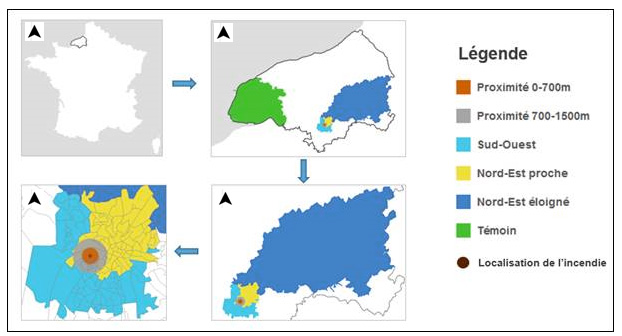
The boundaries of the Seine-Maritime department (76) are marked by the thick black line.
Source: Admin Express Cog
A wide-ranging information campaign (posters, flyers, newsletters, etc.) was launched targeting residents, mayors, and healthcare professionals in both the exposed area and the control area. A website (www.sante-post-incendie-76) and a toll-free number were set up for survey participants.
The survey took place between September and December 2020. Participants selected at random received a letter explaining how to take part in the study, either online via the dedicated website or through a telephone interview with an Ipsos researcher.
When completing the questionnaire, adults were offered the opportunity to fill out a supplementary self-administered questionnaire to assess the psychological consequences of the industrial fire on the exposed population.
A study focused on your health

depliant/flyer
6 July 2021
A study focused on your health
depliant/flyer
21 July 2020
The main questionnaire consisted of two parts, each comprising several modules that addressed different time frames regarding the respondents’ health status:
1. During the accident and its immediate aftermath
Perceived exposures during the fire: fire source, plume of black smoke
Nuisances related to the fire: odors, soot, debris
Behaviors adopted following the fire
Information and awareness of recommendations
Symptoms and health problems experienced (adults and children)
Pregnancy and breastfeeding
The participatory approach implemented with the Health Group, supplemented by a sociological preliminary survey, made it possible to adapt this section to the context of the industrial accident as well as to the expectations and concerns of the affected population.
2. At the time of the survey (approximately one year after the accident)
General health status
Use of healthcare services, lifestyle habits
Physical and psychological quality of life
Attitudes toward the environment
Living conditions
3. Supplementary questionnaire on mental health
This self-administered questionnaire focused on mental health: anxiety, depression, post-traumatic stress.
All information collected was analyzed anonymously, in accordance with the rules set forth by the General Data Protection Regulation (GDPR) and under the supervision of the French Data Protection Authority (CNIL).
Download

questionnaire
28 March 2025
A significant portion of the study population (92%) experienced at least one of the nuisances or forms of pollution caused by the accident, most commonly odors. This olfactory perception could persist for a long time and be bothersome.
Two-thirds of the population (66%) reported at least one symptom or health issue they attributed to the accident: stress, anxiety, distress, eye and throat irritation, coughing, shortness of breath, headaches, sleep disturbances, etc.
Just over one-third of symptomatic adults (37%) reported having sought medical care, most often by consulting a general practitioner, or having self-medicated (taking non-prescription medication).
Several perceived exposures (odors, black smoke, soot deposits, and having been awakened, seen, or heard the fire) are statistically associated with the symptoms most frequently experienced by adults in the aftermath of the accident and with seeking medical and psychological care.
Among children, the health issues experienced and their frequency, as well as the use of medical care reported by parents, were comparable to those of adults.
The perception of the nuisances and pollution generated by the fire had a negative effect on the perceived health of those exposed.
This decline is primarily linked to an impact on mental health, an observation consistent with the scientific literature on similar accidental events.
It is more pronounced among those who experienced the most accidental pollution and among those who perceived the odors emitted during and after the fire for an extended period.
Specifically regarding the impact on psychological health:
In the exposed area, 6% of respondents suffered from probable post-traumatic stress disorder attributed to the fire, 15% from probable generalized anxiety, and 18% from probable depression.
Prevalence rates were significantly higher among participants living within 1,500 meters of the fire: 13% for probable post-traumatic stress disorder, 24% for probable generalized anxiety, and 29% for probable depression.
The occurrence of probable post-traumatic stress disorder was associated with having heard or been awakened by the noise of the fire or the explosion. Probable generalized anxiety was also associated with having heard or been awakened by the noise, as well as with exposure to odors lasting at least several weeks. Probable depression was associated with exposure to odors—the longer the duration, the stronger the association—and with observing roof debris near one’s home.
The observation of an overall effect of the industrial fire on September 26, 2019, on perceived health—still measurable one year later—underscores the importance of the medium- and long-term health monitoring of the exposed population, which is being implemented by Santé publique France using the National Health Data System (SNDS).
The main results of the study were presented to members of the Transparency and Dialogue Committee (CTD) on July 5, 2021, in Rouen, and the specific results on mental health were presented on December 10, 2021.
Learn more:

enquêtes/études
28 November 2025

infographie
5 July 2021

rapport/synthèse
28 March 2025
Given the survey results showing impaired mental health one year after the fire, a follow-up study analyzing the dispensing of psychotropic medications was conducted. The aim was to compare psychotropic drug prescriptions during the post-fire period with those from the baseline period one year prior to the fire in both the exposed and unexposed zones.
The results of this study, conducted in parallel with the epidemiological surveillance of the entire population in the exposed zone, are available below.
Download
rapport/synthèse
11 September 2023
Everything you need to know about the industrial fire on September 26, 2019, in Rouen and the response by Santé publique France
news
Santé publique France has released the initial participation figures for the study on health and quality of life following the industrial accident that occurred in Rouen on September 26, 2019: "A...