



Epidemiological monitoring of the population living in the area affected by the industrial fire at the Lubrizol and NL Logistique warehouses
Santé publique France has established an epidemiological surveillance program for the general population living in the area affected by the industrial fire that occurred on September 26, 2019, at the Lubrizol and NL Logistique sites in Rouen.
More information on the Post-Fire Health Program 76
Everything you need to know about the industrial fire on September 26, 2019, in Rouen and the response by Santé publique France
On September 26, 2019, an industrial fire broke out in the warehouses of Lubrizol and NL Logistique, located in the Rouen port area, potentially exposing the public to various health risks (exposure to smoke, fallout, odors, and stress).
Santé publique France was commissioned by the Directorate General for Health to assess the impact on the physical and mental health of individuals who may have been exposed to one or more of these health risks. The description and analysis of their perceptions of the event, their exposures, and the symptoms they experienced, along with the measurement and monitoring of indicators of the population’s health status, should enable public authorities to implement public health measures if necessary and to better adapt the management of future industrial accidents.
In this context, a series of epidemiological studies has been launched to assess the health impact of the fire: the “Post-Fire Health-76” initiative. This initiative includes epidemiological surveillance of the population residing in the exposed area using data from the National Health Data System (SNDS).
Objectives
To describe and track changes over time in the frequency of health events within the area exposed to the industrial fire;
Compare it to that of unexposed areas and to the period before the fire to identify any difference in frequency.
This monitoring will inform public decision-making regarding the implementation of measures to care for affected populations and prevent future industrial accidents.
Study Population
The study includes individuals residing in the study area, namely:
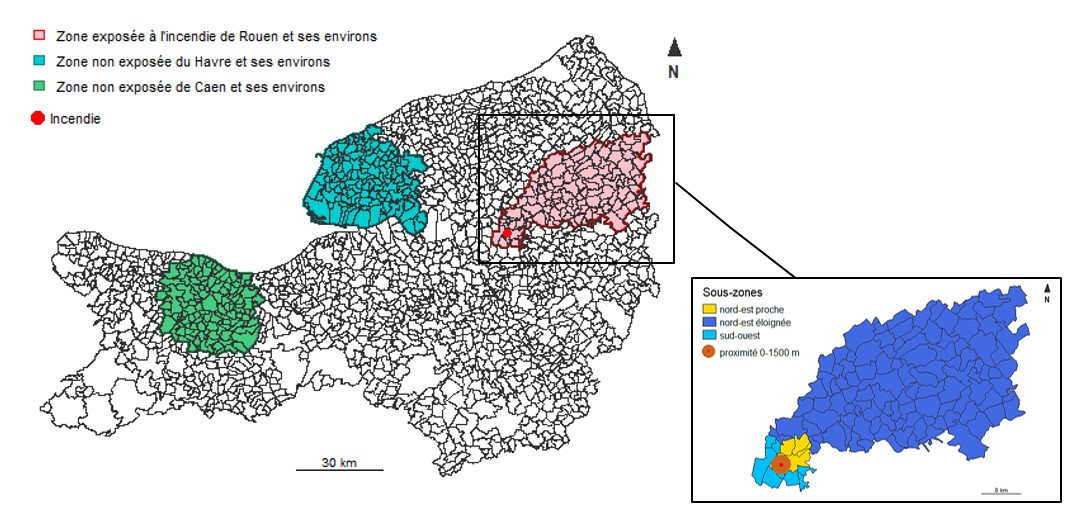
an area exposed to the fire or its consequences, comprising 119 municipalities in Seine-Maritime, divided into subzones defined in the health survey according to exposure types (odor, smoke, soot, etc.);
two unexposed areas used as references, located around the cities of Le Havre and Caen.
Areas in Rouen at risk of fire / not at risk of fire
Study Protocol
Study periods
The study period covers a three-year reference period prior to the fire and a post-fire period of varying duration depending on the health indicator, ranging from one month (cardiovascular diseases) to several years (for cancers).
Methodology
The study is based on an analysis of healthcare reimbursement data from the National Health Data System (SNDS). The occurrence of numerous health events related to cardiovascular, respiratory, mental health, or perinatal issues is tracked through these data. These health events will be identified using health indicators such as healthcare utilization, hospitalization, and prescription of medications.
Health events were selected based on:
a review of the literature,
the results of the self-reported health survey,
the pollutants emitted,
and local expectations.
The incidence rates of these health events per unit of time (per week, month, or year) during the post-fire period are calculated and compared to those observed during the reference period and in unexposed areas. This allows for the consideration of incidence rates already observed prior to the fire and temporal trends observed in areas that were not exposed to the fire. The analyses are conducted across the entire exposed area and the four sub-areas based on population counts.
Download

rapport/synthèse
11 September 2023
Epidemiological surveillance of the population living in the area affected by the industrial fire in Rouen on September 26, 2019. Study protocol.
The SNDS is a medical-administrative database. It centralizes data on hospitalizations and healthcare services (doctor visits, prescriptions, etc.) that have been reimbursed by the national health insurance system, regardless of the specific health insurance plan. It also centralizes information on long-term conditions and medical causes of death. This data, transmitted without identifying individuals, enables numerous researchers and public agencies, including Santé publique France, to study and monitor the health of the French population.
When and how will the results be available?
Results have been published and reported to stakeholders by category of health outcomes (cardiovascular health, respiratory health, mental health, etc.) since 2023, according to the follow-up timeframe (short-, medium-, and long-term) defined in the protocol. For indicators monitored over several years, reports will be issued at regular intervals.
All results will be available on the Santé publique France website and may also be featured in scientific articles.
Results
Results of the Study on Prescriptions for Psychotropic Drugs
The initial analyses focus on the dispensing of psychotropic medications (anxiolytics, hypnotics, and antidepressants) as an indicator of the population’s mental health. These results complement those of the health and quality of life study, which showed a decline in mental health one year after the fire.
Furthermore, psychotropic drug prescriptions, based on SNDS data, were also cross-referenced with data from the perceived health and quality of life survey, allowing for the consideration of various factors (questionnaire responses, reported exposures, individual factors) and a more precise analysis of the surrounding area. The results of these two studies show no difference in trends regarding the dispensing or initiation of treatment with psychotropic medications after September 26, 2019, between the area exposed to the fire and unexposed areas, including among people living nearby (among respondents and non-respondents), and regardless of exposure or symptoms experienced (among respondents only).
Results of the surveillance of hospitalizations for cardiovascular diseases
The temporal trends in hospitalizations for various cardiovascular causes were studied over the 2016–2020 period.
No increase in the incidence of these hospitalizations was observed for various cardiovascular health indicators: all cardiovascular causes, stroke, heart failure, acute coronary syndrome, and arrhythmias.
An isolated increase in hospitalizations for venous thromboembolic diseases over a period of several months was observed. However, it is unlikely that this increase is a consequence of the fire, given its prolonged duration, the fact that only this indicator is increasing, and that this trend primarily affects the area furthest from the fire.
Data Privacy and Security
The SNDS data used is pseudonymized1. Santé publique France processes this data within a specific section of the CNAM’s SNDS portal. Only aggregated, non-identifying data is extracted from the portal.
Committee Structure and Funding
The study relies on an independent thematic advisory committee titled: “Assessment of the Impact of the Lubrizol and NL Logistique Fires on Public Health,” established to support Santé publique France within the framework of SPI 76. It is composed of individuals from outside Santé publique France who are qualified in the fields of toxicology, cardiovascular and respiratory health, and medical administration. Its role is to assist with scientific decisions, the interpretation of results, and the formulation of public health proposals and actions arising from the research conducted.
This monitoring is funded through Santé publique France’s own resources.
1 Pseudonymization is a process that involves replacing directly identifying data (last name, first name, etc.) in a dataset with indirectly identifying data (alias, sequential number, etc.). This allows for the processing of individuals’ data without being able to identify them (learn more on the CNIL website).












