
What We Do
By the late 1980s, isolated cases of acute lead poisoning had given way to a form of chronic lead poisoning, often clinically latent.
Today, for Santé publique France, the challenge is to monitor epidemiological data on childhood lead poisoning and its screening, in order to identify and reduce the risks of lead exposure. Santé publique France also conducts exposure studies in the general population or among more specific populations.
A national surveillance system for childhood lead poisoning
Epidemiological surveillance of lead poisoning relies on a national surveillance system for lead levels in children (SNSPE). This system includes mandatory reporting of lead poisoning cases. These cases involve children aged 0 to 17 years inclusive who have undergone at least one blood lead level test.
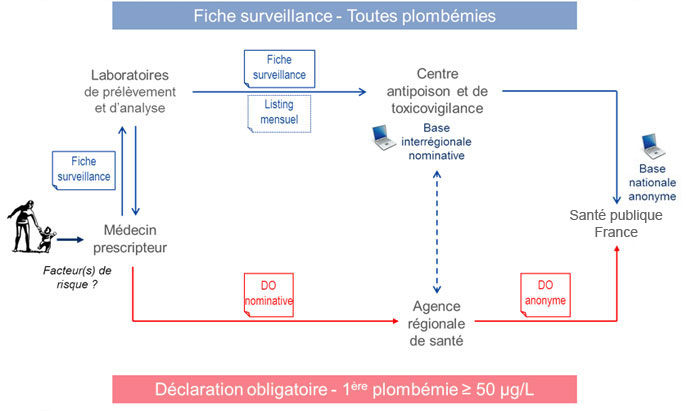
Ensuring follow-up of mandatory lead poisoning reporting through 4 key stakeholders
The prescribing physician is initially involved by ordering a blood lead level test for a minor. At this stage, the prescribing physician must complete the surveillance form, which includes, in particular:
The prescriber’s identification details
The child’s identifying information
The criteria that led to the test being ordered
The date of any previous blood test
Treatments and interventions performed following a previous blood test.
The monitoring form is given to the family, along with the blood lead level test order, which they will submit to the testing laboratory along with the blood sample.
The blood collection and testing laboratories perform the following, respectively:
Blood collection laboratory: If the laboratory performing the blood draw is different from the one conducting the blood lead level test, it forwards the form to the latter along with the blood sample, after filling in the date and method of collection.
Blood lead level testing laboratory: The laboratory performing the blood lead level test enters its identification information at the top and bottom of the form. If it performed the collection, it enters the date and method of collection. The laboratory records the blood lead level result, checks the unit, and—if applicable—the hemoglobin level result. The testing laboratory then sends its results to the prescribing physician via the completed form. It also sends a copy to the physician at the Poison Control and Toxicovigilance Center responsible for the child’s place of residence.
The Poison Control and Toxicovigilance Center (CAP-TV) enters the data from all received forms into a computerized database (named file). This personal information is disclosed only to the prescribing physician or the public health inspector. The center generates anonymous data extracts to enable regional data analysis and the creation of a national database at Santé publique France.
The prescribing physician becomes involved at a later stage, upon receipt of the blood lead level results, and only if these indicate that the case constitutes a notifiable lead poisoning (blood lead level ≥ 50 µg/L or ≥ 0.24 µmol/L measured for the first time in a child). In addition to providing medical care for the child, the prescribing physician reports the case of lead poisoning to the public health inspector at the Regional Health Agency by sending the form in a confidential envelope marked “medical confidentiality” and after informing the person exercising parental authority. This transmission serves as both a reporting procedure and a notification procedure.
Since the reporting and notification of lead poisoning cases involving minors share the same case definition and are both mandatory written procedures (a requirement specific to lead poisoning, Article L. 1334.1 of the Public Health Code), the reporting physician may fulfill both formalities by sending a single copy of the reporting form to the public health inspector at the ARS in the department where they practice.
Definition of cases to be reported and notified
| Reported cases | Type of notification form | Notified cases | Reporting and notification criteria |
|---|---|---|---|
| Blood lead level ≥50 µg/L (or 0.24 µmol/L) | Simple downloadable form | Blood lead level ≥50 µg/L (or 0.24 µmol/L) | First blood lead level of 50 µg/L or higher reported to the prescribing physician for a minor |
To report the illness

The public health inspector from the Regional Health Agency (ARS) initiates an environmental investigation prior to implementing preventive measures (reporting procedure). He also forwards the form to Santé publique France in paper format, after anonymizing it using the same procedure as for other notifiable diseases and after transferring certain epidemiologically relevant information to the central section of the form.
Santé publique France processes the notification forms and also receives anonymized files from the poison control and toxicovigilance centers (CAPTV). A duplicate check is performed, as the anonymization procedure used by the regional health agencies and the CAPTVs is identical. Santé publique France handles the statistical analysis of the data and provides feedback.
System for collecting information as part of mandatory reporting of childhood lead poisoning

bulletin national
1 June 2021
Report on Lead Poisoning Screening Among Children (Ages 0–17) in Connection with Visits to Shooting Ranges

Order of June 8, 2015
Instructions for Completing the Form
Circular DGS/2004/185 of April 21, 2004, regarding the national surveillance of lead poisoning in minors
Monitoring the Screening Process
Lead poisoning screening is performed when risk factors for lead exposure are detected. This procedure is ordered by the attending physician. Screening via blood lead level testing is fully covered by health insurance for children and pregnant women.
Analyzing data on lead exposure in the French population
Three studies—Guyaplomb, Saturn-Inf, and an investigation conducted in the Gard department—have examined lead exposure in the French population, particularly among children.
Raising public awareness and reducing lead exposure
Santé publique France makes epidemiological surveillance data available to health authorities and healthcare professionals to help them adapt their strategies regarding lead poisoning. Healthcare professionals and frontline workers in prevention and health promotion are being educated on screening for childhood lead poisoning within the general population.

Health in Action Issue 437