


COVID-19 Epidemiological Update, June 3, 2021. Epidemiological indicators continue to decline: vaccination and continued adherence to preventive measures remain essential
CP_pe_covid_030621.pdf
Download (PDF - 189.83 KB)
Press Contacts
Santé publique France
presse@santepubliquefrance.fr
Stéphanie Champion: 01 41 79 67 48
Marie Delibéros: 01 41 79 69 61
Camille Le Hyaric: 01 41 79 68 64
Published weekly, the epidemiological update on COVID-19 surveillance provides a detailed analysis of the indicators established by Santé publique France and its network of partners to track the progression of the epidemic and inform public policy decisions.
In Week 21 (May 24–30, 2021), epidemiological indicators continued to improve and pressure on hospitals continued to ease. Vaccination coverage continued to increase, with 39.1% of the population having received at least a first dose and 18.6% fully vaccinated as of June 1, 2021. While vaccination coverage is increasing among younger adults, the rate among older adults—though already high—is rising only very slightly. Although French people’s uptake of vaccination continues to rise, it is important to encourage vaccination among all individuals aged 18 and older, with specific measures to facilitate access—particularly for older adults who have not yet been vaccinated—with the goal of achieving a sufficient level of herd immunity. As health restrictions are lifted, the circulation of variants of concern must continue to serve as a reminder to maintain all control measures at a high level.
Decline in the incidence rate over the past 7 weeks
Nationally, 61,159 new cases were confirmed in week 21, or an average of approximately 8,700 cases per day. The incidence rate (adjusted for the effect of the Monday, May 24 holiday) was decreasing for the seventh consecutive week (108 cases per 100,000, a decrease of 13% since Week 20), a decline observed across all age groups. The positivity rate was decreasing for the fifth consecutive week (3.1%, a decrease of 0.4 percentage points compared to Week 20). The adjusted testing rate was stable (a 1% decrease compared to the rate in Week 20). At the regional level, the regions with the highest adjusted incidence rates in Week 21 remained Île-de-France (136 per 100,000 inhabitants) and Hauts-de-France (133). Adjusted incidence rates were decreasing in all metropolitan regions except for Nouvelle-Aquitaine (86 per 100,000, an increase of 11%). In the overseas territories, French Guiana remained the region with the highest adjusted incidence rate (370 per 100,000 inhabitants), although this was down from S20 (-10%).
Hospitalizations down, comparable to May 2020 levels
The decline in the number of new hospitalizations of COVID-19 patients and new admissions to critical care units, observed since Week 16, continued in Week 21. While the number of currently hospitalized COVID-19 patients remains high (16,146, including 2,837 in critical care units), the levels reached are comparable to those of May 2020 during the downward phase of the first wave of the epidemic.
Steady increase in variants carrying the E484K mutation
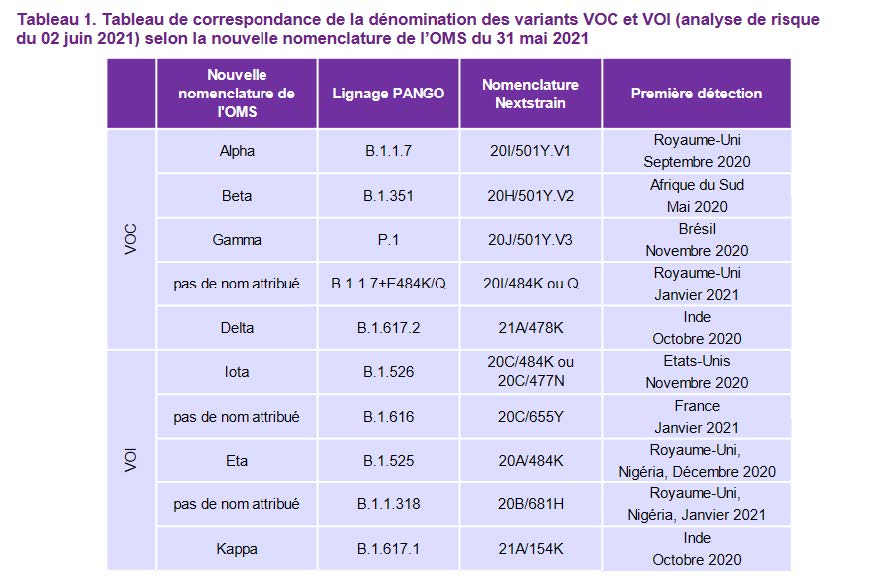
The World Health Organization (WHO) has announced a new nomenclature for naming coronavirus variants. For example, the so-called UK variant becomes the Alpha variant: see the conversion table at the bottom of the page.
The proportion of suspected cases of the Alpha variant of concern (20I/501Y.V1) remains predominant, accounting for 77.4%, according to an analysis of the screening results of positive RT-PCR tests in week 21. The proportion of suspected Beta (20H/501Y.V2) or Gamma (20J/501Y.V3) variants was 5.8% nationally, with variations by department. Available genomic surveillance data confirm this predominance of the variant of concern Alpha (20I/501Y.V1) but highlight the steady increase in variants carrying the E484K mutation (14.1% in Flash #9 vs. 12.3% in Flash #8 and 8.7% in Flash #7). Among these, the 20I/484K VOC appears to be spreading most rapidly, particularly in the Île-de-France and Hauts-de-France regions. The 20I/484Q VOC has been identified as the source of localized community transmission, with no indication to date of wider spread at the national level. Despite a recent increase in the detection of the VOC B.1.617.2, Delta (21A/478K) variant in sequenced samples, there is currently no evidence of significant circulation of this lineage within the country. These variants are being closely monitored given a possible reduction in vaccine efficacy.
Updates to screening tests, which now include the E484K, E484Q, and L452R mutations, should enable more responsive monitoring of variants carrying these mutations of interest at the national level and in the most affected regions, complementing the national genomic surveillance strategy.
Nearly a quarter of the fully vaccinated adult population in France
As of June 1, 2021:
26,219,555 people had received at least one dose of the vaccine, representing 39.1% of the population
12,470,680 had completed the full vaccination series, representing 18.6% of the population.
The estimated vaccination coverage among the adult population (aged 18 and older) was 49.8% for at least one dose and 23.7% for full vaccination. Recently made available to all individuals aged 18 and older, vaccination among young adults has increased significantly in recent weeks: more than 20% of 18- to 24-year-olds had received their first dose as of June 1, 2021. In contrast, vaccination coverage, although high among older adults, has struggled to increase in recent weeks, highlighting the need to encourage and facilitate access to vaccination for older adults who have not yet been vaccinated through targeted and specific initiatives.
Furthermore, the CoviPrev survey (Wave 24 – May 17–19, 2021) shows that the proportion of participants reporting no intention of getting vaccinated has been steadily decreasing since the start of the year, falling from 46% in January to 24% in May.
Significant Decrease in Depressive Symptoms
The results of wave 24 of the CoviPrev survey (May 17–19, 2021) showed a significant decrease in depressive symptoms for the first time since October 2020 (a 3-point drop compared to the previous wave), although the prevalence of anxiety and depressive symptoms, sleep problems, and suicidal thoughts remained higher than levels observed before the pandemic. In total, 30% of respondents reported experiencing anxiety or depression.
During this period of declining viral circulation, accelerated vaccination, and the lifting of restrictions, it remains essential to maintain a high level of adherence to prevention measures, testing, and the isolation of cases and at-risk contacts. Contact tracing remains essential to controlling the epidemic. It is also important to encourage vaccination among the entire adult population, particularly those at risk of developing severe forms of the disease.
Effective today, the PE-COVID-19 is changing
Each week, the epidemiological update on COVID-19 surveillance provides a detailed analysis of the indicators established by Santé publique France and its network of partners to track the progression of the epidemic and guide public policy decisions.
Starting this week, the PE-COVID-19 is being updated for a more fluid reading experience. The document now consolidates all data regarding the dynamics of the epidemic, the impact on the hospital system, vaccination monitoring, and contact tracing. Indicators from other surveillance efforts and surveys will be integrated into the epidemiological update based on the dynamics of the epidemic and updates to the topics covered.
All of this data remains available on the Santé publique France website and will be accessible in the epidemiological update via hyperlinks listed under its table of contents. We also invite you to visit the COVID-19 section of our website to access all of our publications and tools.

Stay informed about the COVID-19 pandemic in France and around the world
Updates, Q&As, expert interviews... everything you need to know about the novel coronavirus (SARS-CoV-2) and COVID-19 in France and around the world
Coronavirus: Circulation of SARS-CoV-2 Variants
Many variants of SARS-CoV-2 are circulating in France, and new variants carrying mutations are regularly identified. How are they monitored and classified? Learn all about the...
Our latest news

news
Shamonda Virus: First Human Case Detected in France—What Do We Know?

news
Call for Nominations for the Renewal of the Scientific Advisory Board of the...

news












