


Download

Signing of the Nutri-Score decree: another step toward better nutritional information for consumers
As part of the transnational governance of Nutri-Score, the tool’s calculation method will be updated in France in 2025 to better help consumers make informed choices, particularly by enabling them to compare products even more effectively based on their nutritional quality.
thematic dossier
Nutri-Score
Nutri-Score, introduced in France in October 2017, is a nutritional label with two main objectives:
To inform consumers clearly and transparently: Nutri-Score, displayed on the front of packaging, provides clear and easy-to-understand information on the nutritional quality of products. This system allows consumers to quickly compare products and make informed choices in favor of more balanced foods.
Encourage manufacturers to improve the composition of their products: by assigning a score ranging from A (for the best nutritional quality) to E (for the worst), this system encourages manufacturers to adjust the content of salt, sugar, fats, etc., and thus better position their products on the nutritional scale compared to those of competitors.
Nutri-Score is evolving today to help consumers better understand the nutritional quality of products. Its underlying principle remains the same and continues to be based on the nutritional values table and certain elements of the ingredient list. However, the rules for calculating the score have been revised to better reflect scientific knowledge and dietary recommendations, and to allow for a more accurate comparison of products based on their nutritional quality.
What are the changes, and which products are affected?
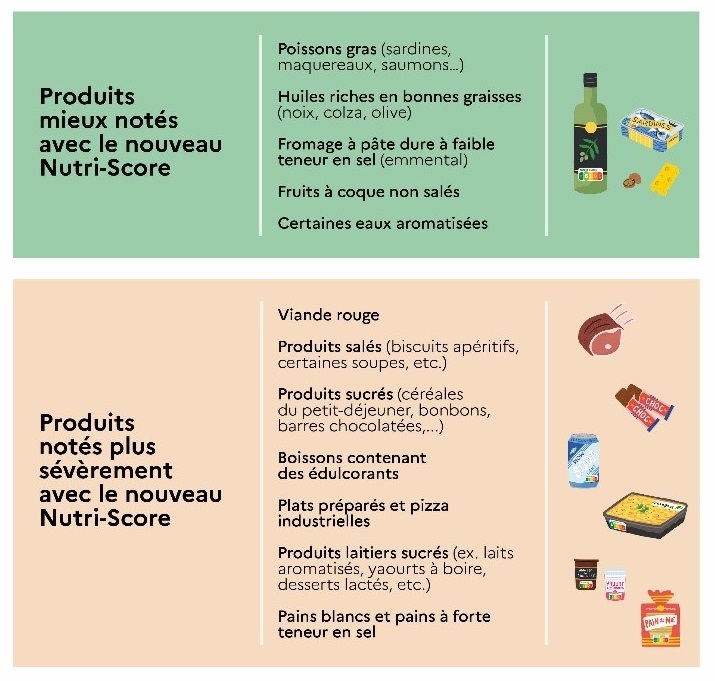
Between 30% and 40% of products will see their scores change. The main changes affect the following categories:
Oils with a lower saturated fat content, such as olive, canola, or walnut oil, will be rated B instead of C;
The rating for certain fatty fish rich in omega-3 (sardines, mackerel, etc.) will improve;
It will be easier to distinguish whole-grain starchy foods (bread, rice) from refined starchy foods;
Salty and sugary products will be rated more strictly;
Water will be the only beverage rated A; low-sugar beverages will receive higher ratings;
Drinks containing sweeteners will no longer be rated B but will be rated C through E;
The scores for milk, flavored and sweetened milk, drinkable yogurt, and plant-based beverages (almond, soy, rice, etc.) will be calculated using the beverage algorithm to facilitate comparison.
Learn more at mangerbouger.fr

Starting March 16, 2025, companies will have two years to implement the new Nutri-Score on their packaging. The “new calculation” box was created to clearly identify products whose score is calculated using the new Nutri-Score. Industry players have the option to include it on products that use the new Nutri-Score, but this remains optional.
The main changes in scores in practice
Nutri-Score: An Effective Logo
Nutri-Score has amply demonstrated its effectiveness. As of April 2024, 1,406 companies (retailers, market-leading brands, and SMEs) in France were participating in the Nutri-Score program. Since the logo’s introduction, the estimated market share of participating brands has steadily increased, reaching 62% of sales volume in 2024.
According to the latest qualitative study conducted in 2023 by Santé publique France, the majority of Nutri-Score users report having used it since its implementation. According to them, Nutri-Score aims to guide consumers toward a healthier diet and better health. It also helps inform and raise awareness among the public—and especially young people—about healthy products.
Furthermore, a U.S. study conducted in 2022 examining the effect of Nutri-Score on food product composition demonstrated that the system had improved the nutritional quality of new products brought to market.
Numerous studies have already demonstrated a link between foods with lower Nutri-Score ratings (lower nutritional quality) and the risk of developing chronic diseases such as: cancer, cardiovascular disease, metabolic syndrome, and obesity…
In September 2024, a study conducted by Inserm evaluated the new version of the Nutri-Score algorithm and showed that consuming foods with lower Nutri-Score ratings is associated with a higher risk of developing cardiovascular disease.
Finally, a recent OECD model comparing several nutrition labels confirmed the superiority of Nutri-Score over the others. The study estimated that, assuming voluntary adoption of the logo across Europe (27 countries), nearly 2 million cases of noncommunicable diseases would be prevented between 2023 and 2050.
Manger-bouger.fr: The go-to website for a balanced diet
Nutrition is a major determinant of health, and its link to certain serious chronic diseases is well established. In France, 47% of the population is overweight and 17% is obese. These figures show that it is essential to continue collective efforts to promote a healthy and balanced diet.
The mangerbouger.fr website provides advice, tools, and guides to help people of all ages eat better and be more active every day. The Menu Builder is a comprehensive meal planning tool integrated into the site, offering ideas for varied seasonal menus in line with nutritional recommendations. The website also features a “Professional Resources” section aimed at healthcare professionals, local authorities, businesses, teachers, and sports clubs.

New Nutri-Score
Eat and Move
Visit mangerbouger.fr for comprehensive information on nutrition, tools and tips to help you eat better and be more active, as well as a wide variety of recipes.

Nutrition and Physical Activity
thematic dossier












