




Data
Epidemiological Situation: Latest Cases Reported in France
- Metropolitan France | In 2018, 7 imported cases were reported in Metropolitan France (mandatory reporting was completed for only 4 of them). None of them had been vaccinated; all were infected in Brazil. No imported cases were reported between January 2019 and April 2022.
- Overseas Territories | In 2017, the National Reference Center for Arboviruses at the Pasteur Institute in French Guiana confirmed a yellow fever virus infection in a person who died in French Guiana. It could not be determined whether the case was locally acquired or imported. In 2018, a second case of yellow fever, identified as locally acquired, was hospitalized in French Guiana and then in Paris. In 2020, two people died of yellow fever in French Guiana: one had been infected in Brazil (imported case), the other in French Guiana (autochthonous case). No other cases have been identified since.
Vaccination Coverage in French Guiana
International situation:
In Africa:
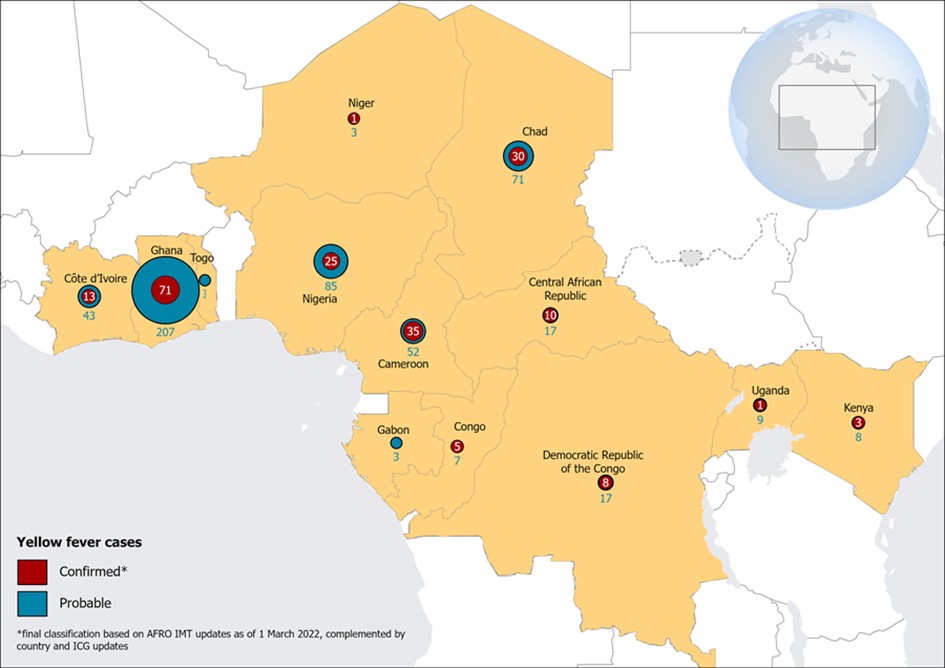
In 2021, 300 probable cases and 88 confirmed cases of yellow fever were reported in nine countries in the WHO African Region (Cameroon, Côte d’Ivoire, Ghana, Niger, Nigeria, the Central African Republic, the Democratic Republic of the Congo (DRC), the Republic of the Congo, and Chad). There were 66 deaths in six countries among the probable cases (Ghana = 42; Cameroon = 8; Chad = 8; Nigeria = 4; Congo = 2; DRC = 2). The overall case fatality rate among probable cases is 22%, with significant variation between countries—for example, between Ghana (40%) and Cameroon (21%).
During the period from January 12 to March 15, 2022, a total of 53 suspected cases of yellow fever, including six deaths, were reported in Isiolo County, central Kenya. Two samples were confirmed by RT-PCR, and six tested positive by ELISA. The last reported yellow fever outbreak in Kenya occurred in 2011. The WHO assesses the public health risk as high at the national and regional levels.
Between January 1 and April 25, 2022, seven suspected cases tested positive for yellow fever antibodies using the plate reduction neutralization assay but were not confirmed by PCR.
Geographic Distribution of Probable and Confirmed Cases of Yellow Fever in Africa (September 1, 2021, to March 20, 2022)
Source: WHO March 2022 EYE Strategy Newsletter
In Latin America
In Brazil, a resurgence of the yellow fever virus has been reported in the non-Amazon region since 2014. The expansion of the historical area of yellow fever transmission into zones previously considered low-risk has led to two waves of transmission: one during the 2016–2017 season, with 778 confirmed cases, including 262 deaths, and another during the 2017–2018 season, with 1,376 confirmed cases, including 483 deaths. As a result, since 2020, Brazil has revised its recommendations for yellow fever vaccination zones to include the entire country. More recently, between July 1 and December 23, 2021, a total of 103 suspected cases of yellow fever were reported, one of which was confirmed.
In Peru, in 2021, a total of 18 cases of yellow fever were reported, 10 of which were confirmed. Seven patients died.
In Venezuela, 11 confirmed cases were reported in 2021 (no deaths).
In relation to

Vaccination
thematic dossier
Contagious diseases most often affect children at a very young age. Because children are particularly vulnerable, they are a priority target for vaccination programs.











