thematic dossier



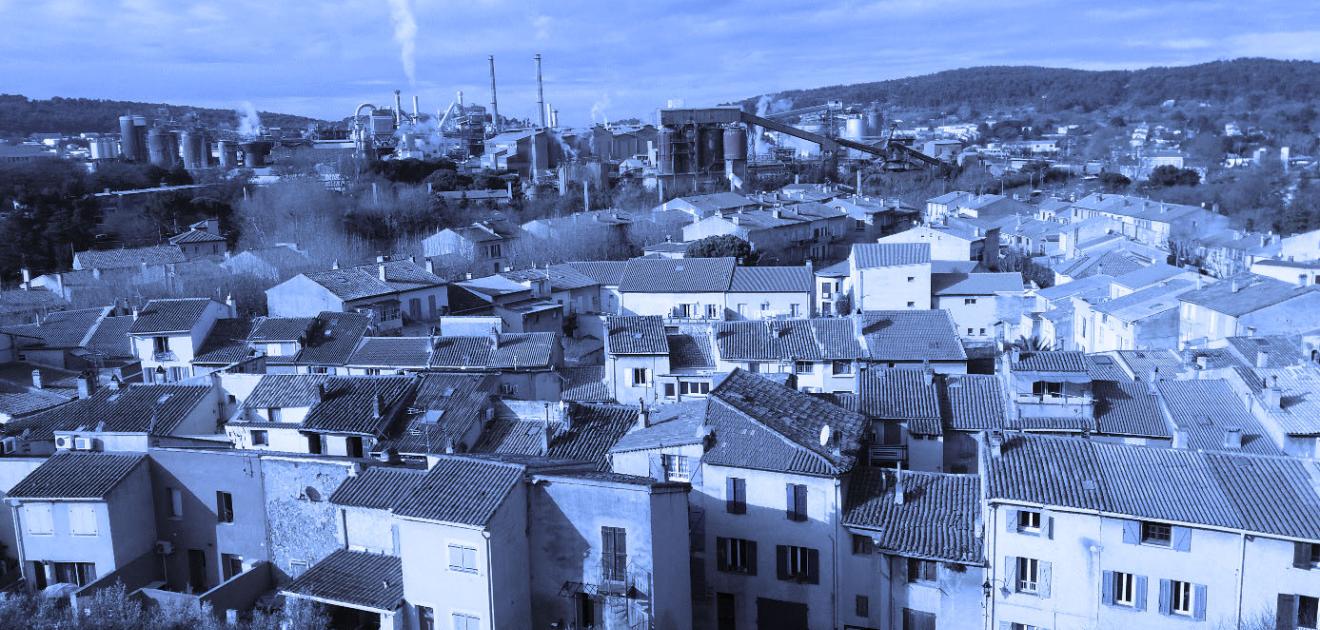
An alumina production plant was established in 1893 by the Péchiney company in the municipality of Gardanne (Bouches-du-Rhône). It was operated until 2021 by the Altéo company. Dumped into the Mediterranean between 1966 and 2006, the industrial residues from this plant were gradually stored as solid waste starting in 2006 (and entirely since 2015) at the Mange-Garri storage site, approximately 2 km northwest of the Gardanne production plant, in the municipality of Bouc-Bel-Air.
In this context, and in response to concerns from residents living near the industrial sites, Santé publique France was consulted on two occasions to assess the health risk associated with exposure to dust emissions from the plant and the storage site.
In 2015, the Mange-Garri site was referred to Santé publique France by the Provence-Alpes-Côte d’Azur Regional Health Agency, following complaints from residents concerned about the potential health impacts of the storage site’s operations. The Santé publique France Paca-Corse regional unit conducted a study to determine whether the health conditions reported by residents (respiratory diseases, cancers) could be linked to exposure to dust emitted by the storage site and whether health monitoring of the population was necessary in the area impacted by the Altéo site.
In 2017, Santé publique France was again referred the matter, this time by the Directorate General for Health and the Directorate General for Labor, following strong mobilization by elected officials and local residents expressing concern about the environmental and health impacts of dust emissions around the Mange-Garri storage site and the Gardanne plant. The objective was to assess the relevance and feasibility of conducting an epidemiological investigation among populations exposed to the activities of these two sites, as well as among factory employees.
In response to this request, Santé publique France, in consultation with local stakeholders, launched two studies:
a study of local expectations and context to help define future studies to be implemented;
a mortality study capable of providing initial results on health indicators in a timely manner. These two studies were conducted in collaboration with a local liaison committee composed of members of Altéo’s “Terre” site monitoring commission: representatives from the administration, local authorities, residents and associations, employees, operators, and qualified experts. It was chaired by the sub-prefect of Aix-en-Provence. This committee was consulted on the draft protocols and facilitated the transparent exchange of information on the progress of the various studies, as well as ensuring communication among local stakeholders.
The work carried out by Santé publique France is part of a broader framework involving, in particular, the French Agency for Food, Environmental and Occupational Health & Safety (ANSES), the Institute for Radiation Protection and Nuclear Safety (IRSN), and the Bureau of Geological and Mining Research (BRGM) regarding dust emissions from the Mange-Garri storage facility for an independent health risk assessment, following referrals from the Ministry of the Environment in May 2015 and June 2016.
In January 2021, the Gardanne plant was acquired by a new operator. The new operator decided to cease the extraction of alumina from bauxite and to produce specialty alumina from imported alumina. This decision will ultimately result in a significant reduction in the plant’s atmospheric emissions and the closure of the Mange-Garri site, which is currently undergoing revegetation. These new developments raise the question of whether it is appropriate to conduct new health studies. The committee of experts on environmental and occupational health being established by Santé publique France will be consulted to address this issue.
Download

note scientifique en réponse à une saisine
11 July 2022
This study was conducted following a referral to Santé publique France by the Provence-Alpes-Côte d'Azur (PACA) Regional Health Agency to determine whether the health conditions reported by the complainants could be linked to exposure to dust emitted by the storage site and whether health monitoring of the population was necessary in the area impacted by the Altéo site.
Among the complainants, three individuals suffered from a variety of different, sometimes rare, conditions whose etiology was unknown or multifactorial in origin. Local physicians did not report observing any specific or increasing incidence of conditions among their patients, whether cancerous or respiratory. Respondents to the prospective questionnaire, distributed to residents living near the site, did not report any specific medical conditions. The situation was, however, a source of concern and discomfort, particularly due to dust. Depending on certain weather conditions, this dust could be the cause of eye or respiratory irritation reported by the complainants and some respondents.
From an environmental perspective, the available data showed that the Mange-Garri storage site had an impact on its immediate surroundings. However, the population’s exposure to dust was greater in the municipality of Gardanne. Assessments conducted by the IRSN indicated that the radiological risk posed by the facility was low.
The investigation did not confirm the existence of a cluster of non-infectious diseases in this area. The local situation, and in particular the dust in the atmosphere present under certain weather conditions, was recognized as a source of concern and nuisance for residents living near the site. In light of these results, it was not deemed appropriate to further pursue the cluster investigation.
Download: Health Impact of the Mange-Garri Storage Site in Bouc-Bel-Air, Bouches-du-Rhône, France
This study was conducted following a request to Santé publique France by the Directorate General for Health and the Directorate General for Labor to describe the perceptions and concerns of various local stakeholders, identify all expectations (environment, health, management), and pinpoint any tensions or differences in perspective among the various stakeholders.
It took the form of a qualitative survey based on semi-structured interviews with various categories of local stakeholders (representatives of state agencies, local elected officials, industry representatives, employee representatives, associations, representatives from the education sector, healthcare professionals, journalists, and environmental experts) and meetings with local residents.
The analysis of the social context revealed two main areas of concern:
The health/environmental dimension, which has been more pronounced around the Mange-Garri storage facility since the arrival of solid waste in 2012.
The economic dimension related to the Altéo plant (fears of job losses and a decline in local property values). Local residents’ associations expressed mistrust toward the company, government representatives, and local elected officials, as well as a lack of information regarding the results of studies, regulatory inspections, and measures taken by the company.
Few health effects were reported by most of the people interviewed, but residents expressed concern about the possible occurrence of cancers linked to prolonged exposure to dust.
For the healthcare professionals interviewed, their patients’ health status did not exhibit characteristics specific to this sector.
The occupational health department at the industrial site reported no occupational diseases linked to exposure to or contact with alumina, bauxite, bauxaline, or dust produced by the plant.
The launch of epidemiological investigations was viewed positively by those interviewed, although many believe that establishing a causal link with Altéo’s activities will be difficult, given the variety of exposures and the multifactorial nature of the diseases in question.
Representatives of community organizations, journalists, and some local residents expect Santé publique France to demonstrate transparency and scientific independence.
This study has highlighted the priority actions that public authorities in general should implement:
Addressing the public’s questions, concerns, and misunderstandings.
Adapt the content and dissemination of information intended for the general public and healthcare professionals regarding:
the results of environmental or health-related studies conducted around Altéo’s industrial sites,
regulatory inspections and procedures carried out by government agencies,
the corrective actions implemented by the company.
Address public health concerns raised by certain healthcare professionals, community representatives, and local residents.
Facilitate dialogue between the company, local elected officials, government representatives, community groups, and local residents, some of whom are concerned about the environmental situation and its potential impact on public health.
This study was conducted following a referral to Santé publique France by the Directorate General for Health and the Directorate General for Labor to compare the risk of all-cause mortality (excluding violent deaths) and mortality from specific causes among the population residing in municipalities exposed to emissions from Altéo sites with that of the population in the rest of the Provence Mining Basin (considered unexposed), as well as that of the population of the Provence-Alpes-Côte d’Azur (PACA) region.
Specific causes (respiratory diseases, circulatory diseases, malignant tumors, nervous system diseases, kidney diseases) with a proven or suspected link to exposure to pollutants present in the exposed area were studied.
Over the 1968–2015 period, the results showed that in the area exposed to the Altéo industrial sites, overall mortality was higher than in the unexposed area until the 1987–1995 period, among both men and women. Starting in the 1990s, mortality rates were comparable between the two areas and with the PACA region.
Over the 2006–2015 decade, for most of the specific causes of death studied, no significant difference in mortality was observed between the exposed and unexposed areas, nor compared to the Provence-Alpes-Côte d’Azur (PACA) region. Over this period, the main finding was excess mortality from Alzheimer’s disease, observed only among women, in both exposed and unexposed areas compared to the Paca region, with no statistically significant difference when comparing the two areas to each other.
It is important to note that geographical mortality studies do not allow mortality to be attributed to one or more specific factors, including pollution and, in particular, that emitted by Altéo sites.
Santé publique France plans to repeat this study within a minimum of five years.
Download: Mortality Study Around the Altéo-Gardanne Industrial Sites
French Geological Survey (BRGM):
The results of the measurement campaign conducted by the BRGM in late 2015 and early 2016 around the Mange-Garri site showed that the storage site influenced the soil composition in the immediate vicinity (within 500 m), particularly in the residential area immediately west of the site and in a walking path located immediately south of the site. Analysis of the chemical composition of fine and sedimentable dust revealed an impact from the Mange-Garri site, but also an influence from the Gardanne plant and other local sources of pollution (thermal power plant and cement plant).
For more information:
French Agency for Food, Environmental and Occupational Health & Safety (ANSES)
The results of the health risk assessment conducted during the second half of 2016 by ANSES concluded that a health risk could not be ruled out in connection with exposure to aluminum, arsenic, and lead in the soil, but that it was not possible to distinguish the specific, historical, or current contribution of industrial operations at the Mange-Garri storage site, given the region’s unique geological context and taking into account other industrial activities and local anthropogenic sources.
Learn more:
Institute for Radiation Protection and Nuclear Safety (IRSN)
The IRSN concluded, based on its expert assessments conducted in 2015 and 2016, that the radiological risk associated with the Mange-Garri site was low.
Learn more:
Local organizations have also contributed to the acquisition of knowledge. Since its creation in 2007, the Human-Environment Observatory of the Provence Mining Basin (OHM-BMP) has conducted numerous multidisciplinary research programs in this region (qualitative and quantitative characterization of fine and sedimentable particles, public perception of air quality, soil and plant sampling in vegetable gardens within the Provence Mining Basin, etc.).
The measurement campaign conducted by AtmoSud, an association accredited for air quality monitoring in the Provence-Alpes-Côte d’Azur (PACA) region, from March 2017 to February 2018 demonstrated the influence of industrial activity at Altéo sites on the origin of fine and sedimentable particulate matter near industrial sites, as well as from road and rail traffic. The influence of industrial sites was more pronounced during episodes of strong winds. However, particle concentrations remained comparable to those measured in urban areas across the region.
thematic dossier
thematic dossier
L’exposition à des substances chimiques présentes dans l’environnement ou en milieu de travail peut avoir des conséquences néfastes sur la santé. Santé publique France met en œuvre des dispositifs...












