


European Immunization Week 2025 - Immunization: An Essential Preventive Measure at Every Stage of Life

European Immunization Week
Here you’ll find all the useful information and resources available to help you learn more and understand everything about vaccination.
European Immunization Week 2025 (April 27–May 3) is an opportunity to promote vaccination and highlight its vital role. As a long-standing and fundamental pillar of our healthcare system, vaccination remains the most effective way to protect against many infectious diseases and reduce the risk of epidemics. It is a major public health issue for the protection of populations, particularly the most vulnerable.
European Immunization Week is organized jointly each year at the national level by the Ministry of Labor, Health, Solidarity, and Families and Santé publique France, and coordinated at the regional level by the Regional Health Agencies (ARS).
This week is an essential event for everyone—healthcare professionals and citizens alike—to learn more and check their vaccination status.
It provides an opportunity to present new vaccination recommendations, reiterate prevention messages, and publish the latest vaccination coverage data to track trends and identify areas for improvement to better protect the most vulnerable individuals, including seniors who are under-vaccinated. Indeed, this population is at the heart of this year’s European Immunization Week.
A Necessary Renewed Focus on Vaccinating Seniors
As people age, the immune system becomes less effective, making seniors more vulnerable to infections such as the flu, pneumococcal disease, COVID-19, or shingles, which can lead to serious complications or even hospitalization.
Yet, vaccination coverage among seniors remains insufficient:
The DTP (diphtheria-tetanus-polio) booster is administered to only 50% of those aged 65, 44% of those aged 75, and 34% of those aged 85.
Seasonal flu vaccination rates stand at 54% among those aged 65 and older (47% among those aged 65–74, 61% among those aged 75 and older) for the 2024–2025 season.
Less than 20% of people at high risk of pneumococcal infections are properly vaccinated.
New additions to the 2025 vaccination schedule
Vaccination of seniors: it is essential to re-engage all healthcare professionals to improve vaccination rates among seniors.
The new “My Prevention Checkup” health appointment for those aged 60 to 65 represents a unique opportunity to verify vaccination status and, if necessary, catch up on vaccinations for these individuals. This year, new vaccination recommendations have been issued for older adults:
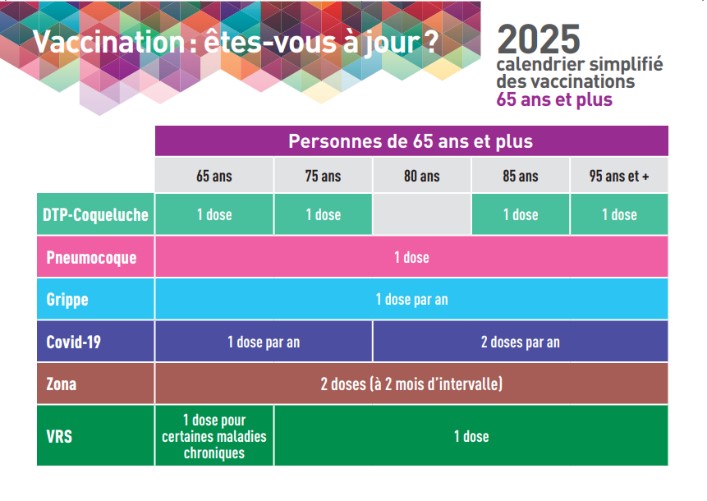
vaccinations against pneumococcus and shingles are now recommended for all individuals aged 65 and older;
vaccination against RSV (respiratory syncytial virus) is now recommended for all individuals aged 75 and older and for those aged 65 to 74 with chronic respiratory and cardiac conditions.
These new vaccinations are in addition to DTP booster shots, the annual flu vaccine, and the COVID-19 vaccine, which remain essential.
A simplified chart of vaccination recommendations for those aged 65 and older is available today for healthcare professionals.
Meningococcal disease: a strengthened vaccination strategy to better protect populations most at risk of meningitis and address the resurgence of these infections.
Invasive meningococcal infections progress very rapidly and require emergency treatment. Vaccination is the most effective way to combat these infections.
Following a particularly sharp increase in invasive meningococcal infections, especially among adolescents and young adults, the vaccination strategy has been strengthened. This change aims to protect the age groups most at risk and address the resurgence of invasive meningococcal infections, which cause particularly severe forms of the disease.
For infants, ACWY and B vaccination has been mandatory since January 1, 2025. This new requirement applies to all infants up to age 2 (24 months), including those who have already been vaccinated against meningococcal C;
For adolescents, ACWY vaccination remains recommended for ages 11 to 14.
In addition, the following is recommended:
A temporary catch-up campaign for children up to age 4 (5th birthday) for vaccinations against meningococcal B and ACWY
An intensified catch-up campaign for vaccination against meningococcal B and ACWY for young people aged 15 to 24
An awareness campaign will be launched in the coming weeks, targeting families, healthcare professionals, and young people, to support the implementation of this enhanced vaccination strategy.
MMR Vaccination: Strengthening Catch-Up Vaccination to Achieve Elimination
Given the current rise in measles cases in France and internationally, it is important to note that while 94.6% of infants born in 2023 received at least one dose of the measles vaccine, the vaccination coverage required to eliminate the disease (95% for two doses) has not yet been achieved. Beyond infant vaccination, efforts to catch up on vaccinations for those who are unvaccinated or under-vaccinated must continue, particularly among healthcare professionals.
HPV Vaccination: Significant Progress to Be Sustained
Launched in the fall of 2027, the HPV vaccination campaign targeting seventh-grade students has made the vaccine free and accessible to a broad audience, while raising awareness among young people and their parents about the importance of this public health measure.
Among adolescents, vaccination coverage for the HPV vaccine continues to rise:
In 2024, 58.4% of 15-year-old girls had received a first dose of the vaccine; this figure was 54.6% in 2023.
In 2024, 36.9% of 15-year-old boys had received a first dose of the vaccine; this figure was 25.9% in 2023.
Vaccination coverage, however, remains below the target of 80% by 2030 (2021–2030 Decade-Long Cancer Control Strategy). Vaccination campaigns in middle schools could help improve these coverage rates. The results of the vaccination campaign currently underway in middle schools (2024–2025 school year) will be available after the summer of 2025.
This upward trend must continue, as vaccination prevents up to 90% of HPV infections that cause various cancers, including cervical cancer.
Stabilization of vaccination uptake at a high level
Santé publique France publishes data on vaccination uptake to guide and develop initiatives aimed at promoting vaccination among healthcare professionals and the general public.
The 2023 edition of the Santé publique France Health Barometer shows that vaccination uptake has stabilized at a high level: 84% of respondents in mainland France report being in favor of vaccination in general, with an upward trend in the proportion of people who are very much in favor of vaccination compared to 2022.
Vaccine acceptance, however, remains lower among those with the lowest levels of education or income, and is trending downward among older adults compared to previous years.
A new “Vaccination and Immunization 2025–2030” strategy
For several years now, simplifying the vaccination process and expanding the range of available vaccines has yielded encouraging results for certain vaccinations. We must continue to pursue a committed and ambitious vaccination policy by strengthening prevention messages—particularly for certain vaccines, such as those against winter viruses or meningococcal infections, and targeting certain vulnerable populations—and by further improving public confidence in vaccines. The new 2025–2030 Vaccination and Immunization Strategy aims to improve vaccination coverage at all stages of life by further simplifying access to vaccines.
It is structured around five key areas: increasing vaccination opportunities throughout life, enhancing the vaccination pathway while making it more transparent, leveraging new digital tools to make vaccination policy more efficient, training healthcare professionals in vaccination promotion, and finally strengthening vaccination promotion as part of efforts to combat health misinformation through information and communication campaigns.
In practical terms, the implementation of this strategy will notably involve making vaccine supplies available to community healthcare providers, strengthening outreach and follow-up efforts to reach the most vulnerable populations and those furthest from healthcare, and establishing a national observatory dedicated to combating misinformation.
Vaccination-info-service.fr: Vaccination information accessible to all to stay informed and take action
Santé publique France’s go-to website on vaccination, Vaccination-info-service.fr—with its “general public” and “healthcare professionals” sections—allows everyone to access factual, practical, and scientifically validated information on vaccination at different stages of life, on specific diseases, on vaccination in general, or on a particular vaccine. Regularly updated and expanded with text and video content—including updates to the vaccination schedule—the two sections aim to answer as many questions as possible through various topics: “Who should get vaccinated and why?”, “Efficacy and impact”, and “Main contraindications”. The site’s “Professional Area” is specifically designed for healthcare professionals—key players in vaccination—and contains more complex and detailed information.
Since 2022, the electronic vaccination record has been included in the digital health portal “My Health Space.” It allows both healthcare professionals and users to record completed vaccinations and view upcoming vaccinations scheduled by age.
Vaccination Information Service
What are vaccines for? How do they work? At what age should children be vaccinated? Vaccination-info-service.fr answers the most frequently asked questions about vaccination. A separate...

Vaccination
thematic dossier
Contagious diseases most often affect children at a very young age. Because children are particularly vulnerable, they are a priority target for vaccination programs.
Our latest news

news
Growing Up with Screens. A special report in *La Santé en action* No. 474,...

news
Seniors, pregnant women, and nursing home staff: What is the status of their...

news












