


Cardiovascular diseases and suicides: the leading causes of maternal deaths in France from 2013 to 2015
CP_Mortalité Maternelle_06012021.pdf
Download (PDF - 529.99 KB)
Press Contacts
Santé publique France
presse@santepubliquefrance.fr
Vanessa Lemoine: 01 55 12 53 36
Marie Delibéros: 01 41 79 69 61
Stéphanie Champion: 01 41 79 67 48
Cynthia Bessarion: 01 71 80 15 66
Inserm
presse@inserm.fr
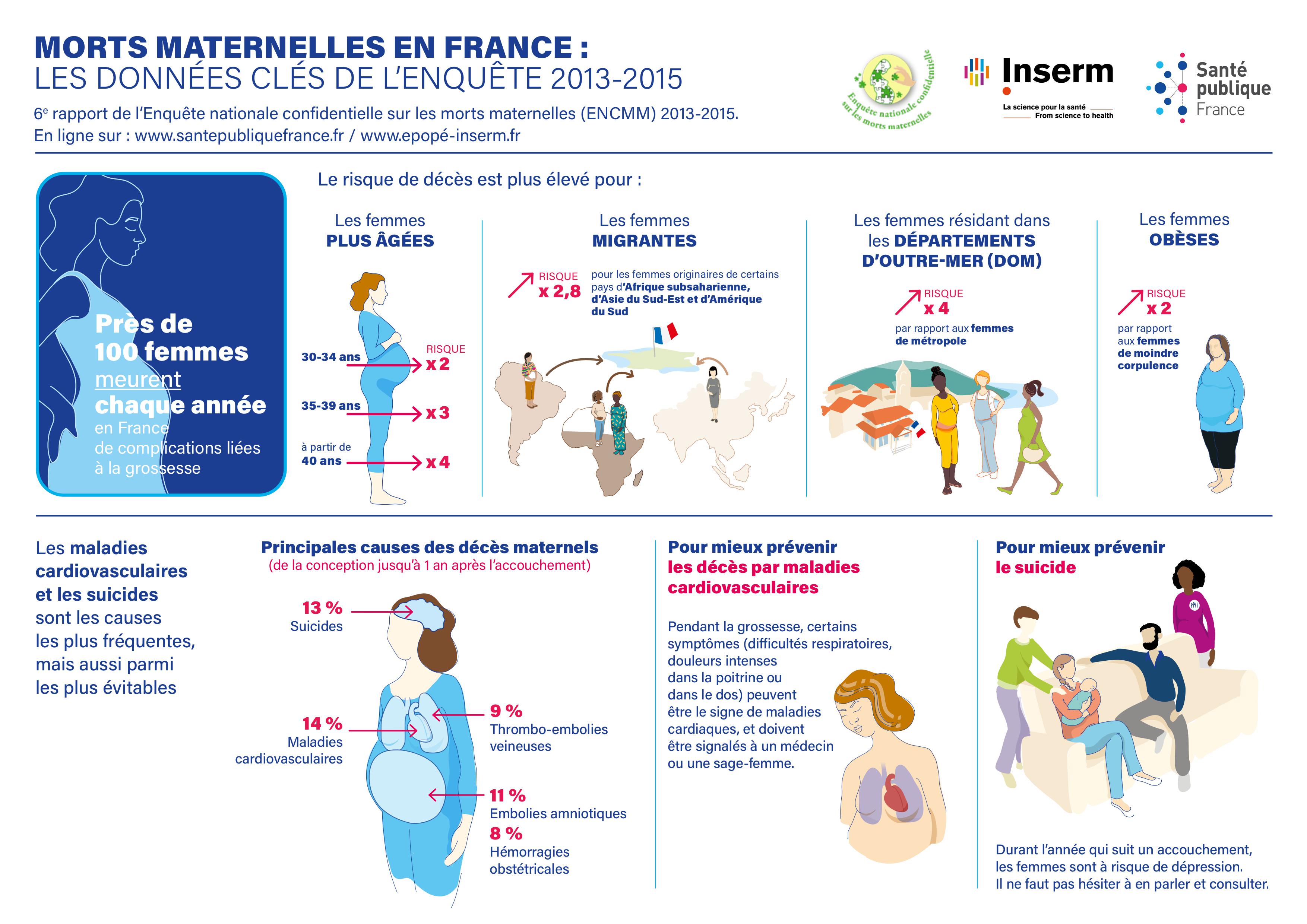
Every year in France, 50 to 100 women die from causes related to pregnancy, childbirth, or the postpartum period—an average of one every four days. Santé publique France and Inserm are releasing today the results of the 6th report from the Confidential National Survey on Maternal Deaths (ENCMM) for the 2013–2015 period. This national survey provides a comprehensive quantitative and qualitative database. It reveals that cardiovascular disease and suicide were the first and second leading causes of maternal deaths in 2013–2015, respectively. The report’s authors emphasize that the majority of these deaths are preventable and outline areas for improvement in the care pathway through 30 key messages.
The Need for a Maternal Mortality Indicator
A maternal death is defined as the death of a woman that occurs during pregnancy or up to one year after childbirth. In France, this event has become rare but is recognized as an indicator for monitoring maternal health and provides information not only on the risks associated with pregnancy and childbirth but also on the performance of the healthcare system. This monitoring is entrusted to the National Committee of Experts on Maternal Mortality (CNEMM), under the scientific leadership of the Epopé team at Inserm. It is composed of obstetrician-gynecologists, anesthesiologists, midwives, internal medicine specialists, and epidemiologists, and has been under the supervision of Santé publique France since 2014.
The data collection and analysis method proposed by the ENCMM makes it possible to assess the circumstances surrounding maternal deaths and to estimate the proportion of preventable deaths over a three-year period. For this edition of the report, the methodology has evolved. The geographic scope of the maternal mortality analysis has been expanded to include Mayotte. In accordance with international recommendations1, suicides have been included among deaths classified as maternal deaths.
More than half of the deaths are considered potentially preventable
262 maternal deaths were identified between 2013 and 2015 in France, representing 87 women who died each year from a cause related to pregnancy, childbirth, or their aftermath—an average of one every four days. The maternal mortality ratio (MMR)—10.8 deaths per 100,000 live births—remains stable compared to the two previous surveillance periods (2010–2012 and 2007–2009) and is in line with the European average.

Cardiovascular diseases and suicides are the two leading causes of mortality: cardiovascular diseases accounted for 36 deaths during the period, or 13.7% of maternal deaths, and suicide has become the second leading cause of maternal mortality, with 35 suicides—about 1 per month—or 13.4% of maternal deaths.
Furthermore, for the first time since the first confidential survey, obstetric hemorrhage is no longer the leading cause of maternal mortality, and the incidence of this cause of death has been reduced by half over 15 years. This major improvement demonstrates that the warning raised by the initial results of the ENCMM, which highlighted the significant contribution of hemorrhage to maternal mortality, enabled an effective mobilization of the entire obstetric community to improve its management. Amniotic fluid embolism is the third leading cause of mortality during this period, accounting for 28 maternal deaths, a figure that has remained stable compared to the previous period.
According to the survey, in 66% of cases, the care provided was suboptimal, and 58% of deaths are considered “preventable” or “possibly preventable” through improvements in prevention, the organization of care, and the care itself.
Risk factors marked by inequalities
The risk of maternal mortality is higher based on:
women’s age: compared to women aged 25–29, the risk is 1.9 times higher for women aged 30–34, 3 times higher for those aged 35–39, and 4 times higher for those aged 40 and older;
the presence of obesity: among maternal deaths, 24.2% occurred among obese women, a proportion twice as high as in the general population of women giving birth.
The survey results also show that there are significant social and regional disparities:
social context: 26.5% of maternal deaths occurred among women meeting at least one criterion of socioeconomic vulnerability; this proportion is approximately 40% for women who died by suicide or from cardiovascular disease;
country of birth: being born outside France is a recognized risk factor for maternal mortality during the 2013–2015 period. Mortality among migrant women is higher than among women born in France, with a particularly marked excess mortality rate for women born in sub-Saharan Africa, whose risk is 2.5 times that of women born in France;
place of residence: two areas stand out for having a higher maternal mortality rate (MMR), a disparity already present in the previous report: the French overseas departments (DOM) and Île-de-France. Women residing in the DOM have a maternal mortality risk 4.0 times higher than those in metropolitan France. In mainland France, the Île-de-France region stands out with an MMR 55% higher than that of all other regions.
These disparities had already been noted in the two previous reports.
Thirty key messages to improve care and prevent deaths
The Expert Committee formulated 30 key messages intended for healthcare professionals, as well as for women, their families, and policymakers, targeting areas for improvement that were consistently identified in the care pathways of women who died. The most general of these include:
the importance of a medical examination of the pregnant woman that goes beyond strictly obstetric concerns, including screening for psychiatric and substance use disorders, as well as social vulnerability;
the assessment of risks of complications before conception and in early pregnancy, which should enable the planning of individualized pregnancy care.
In addition, the Committee recommends the performance of systematic postmortem examinations in cases of maternal death with no identified cause.
1 The WHO’s Application of ICD-10 to Deaths During Pregnancy, Childbirth, and the Puerperium – 2012.
Infographic - Maternal deaths in France: Key findings from the 2013–2015 survey
See also

enquêtes/études
25 January 2021
Maternal Deaths in France: Better Understanding for Better Prevention. 6th Report of the National Confidential Survey on Maternal Deaths (ENCMM) 2013–2015.
surveys/studies
Learn about the Confidential National Survey on Maternal Deaths
The ENCMM (National Confidential Survey on Maternal Deaths) is a survey conducted regularly by Santé publique France through the CNEMM (National Committee of Experts on Maternal Mortality) and...

Vascular disorders of pregnancy
thematic dossier
Cardiovascular and cerebrovascular diseases are the second leading cause of death among women and the leading cause of postpartum maternal mortality in France. Certain pregnancy complications...
Our latest news

news
Growing Up with Screens. A special report in *La Santé en action* No. 474,...

news
Seniors, pregnant women, and nursing home staff: What is the status of their...

news












