


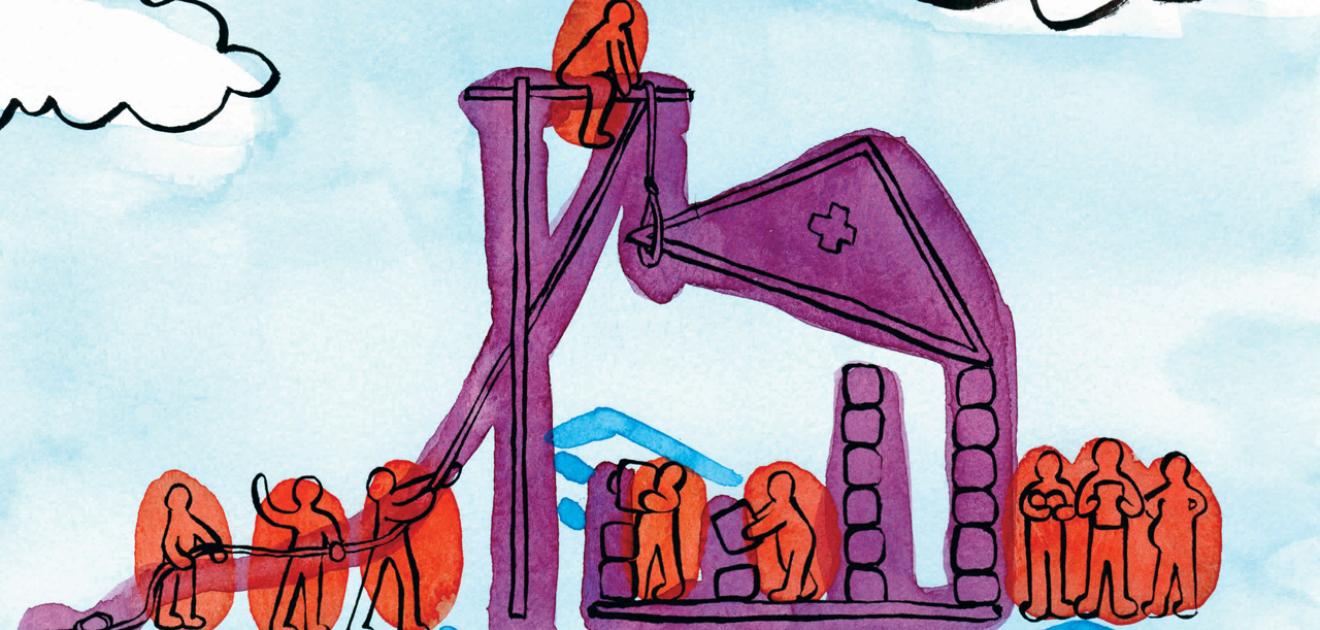
Working with Citizens for Better Health: The Feature Article in *La Santé en Action* No. 469, May 2025
In a new issue of its journal *La Santé en action*, Santé publique France has published a special feature on citizen participation in healthcare.
Subscribe to the magazine
To receive the newsletter via email announcing each new issue and providing free access to the issue
Involving citizens more closely in decisions that affect not only their own physical and mental well-being but also that of the community offers numerous individual and collective benefits. However, designing health policies not just for populations but with them requires time and resources. A key challenge remains: how can we ensure effective and inclusive participation?
From health democracy to democracy in health, this issue of La Santé en action explores how different forms of citizen participation are taking shape today. Much progress has been made since the mobilization of AIDS advocacy groups, with the evocative slogan “Nothing for us without us,” which cemented the affirmation of patients’ rights. User engagement in the healthcare system has thus been formalized since the law of March 2002.
Several articles highlight the benefits of recognizing experiential knowledge. The skills gained through lived experience—whether of illness, disability, or social exclusion—are increasingly utilized in medical and medico-social care. “Patient partners” lead therapeutic education workshops or participate in the training of future doctors at certain universities. “Peer experts” work alongside professionals. In Belgium, “experts with lived experience of poverty” are employed in various institutions (hospitals, mutual health insurance companies, mental health care networks, etc.) to make public services more accessible to vulnerable or socially disadvantaged people.
Building Bridges Between Forms of Knowledge
As this issue highlights, experiential knowledge constitutes a distinct form of knowledge, complementary to academic and professional knowledge. One article sheds light on the concept of “cognitive justice,” developed by Indian anthropologist Shiv Visvanathan: he argues that no single form of knowledge should take precedence over another, since science alone cannot fully account for reality. This paves the way for collaborative research, such as that conducted with formerly homeless individuals and social workers, to better understand the factors driving successful integration into permanent housing.
In the Netherlands, the National Institute for Public Health and the Environment (RIVM) has embraced these participatory approaches, with numerous initiatives to foster dialogue between science, society, and public policy: its prospective study on public health in 2024, for example, was conducted with a citizen committee that served as an advisor and partner to the research team.
At Santé publique France, openness to society is also a priority, in many ways. A few articles provide an idea of this. The Enabee study on children’s mental health was conducted in consultation with teachers, parents, national education unions, healthcare professionals in the sector, and others. The study on Travellers in Nouvelle-Aquitaine was developed with the key stakeholders, resulting in a high response rate to the questionnaires administered in the field thereafter.
An advocacy document on mid-life prevention, aimed at mobilizing local authorities, was drafted with local stakeholders who contributed their in-depth knowledge of regional realities.
Promising innovations
It is undoubtedly in the field of environmental health that citizens are most engaged, demanding both greater transparency regarding study methodologies and an active role in knowledge production. The city of Marseille called upon the National Commission for Public Debate to determine the best way to involve its residents in a study assessing the health impacts of poor air quality. In the Lacq industrial basin (Pyrénées-Atlantiques), the health study conducted by Santé publique France draws on the concerns of local residents and their local knowledge. In the French West Indies, prevention messages regarding chlordecone—a pesticide now banned but which has contaminated the soil for a long time—have been updated through workshops open to residents.
While these initiatives are growing, they remain rare. Several barriers to their expansion have been identified: participatory approaches are seen as time-consuming and require significant human and financial resources. The issue of public inclusion and representation is proving complex to resolve. And these initiatives are sometimes undermined by a lack of concrete feedback on citizen contributions.
Learn more

magazines/revues
12 February 2026
Health in Action, April 2025, No. 469: Working with Citizens to Promote Health

Social and Regional Health Inequalities
thematic dossier
Health inequalities affect the entire population across the country and across the social spectrum, and can emerge at a very young age. Measures that promote equal opportunities for...












