



Mycoplasma pneumoniae Infections in France: Update as of December 19, 2023
Santé publique France has released an update as of December 19, 2023, following the rise in Mycoplasma pneumoniae infections in France, and is reminding the public of the preventive measures to take.
Download
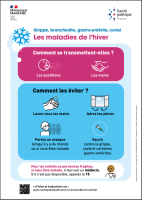
Flu, bronchiolitis, gastroenteritis, COVID-19: winter illnesses—how can you avoid them?
After more than three years of very low circulation levels amid the COVID-19 pandemic, an increase in respiratory infections caused by Mycoplasma pneumoniae has been observed since this fall in France and other countries, particularly in Europe [1] and Southeast Asia [2].
In France, there is no national surveillance system dedicated to Mycoplasma pneumoniae infections. In late November 2023, unusual increases in respiratory infections caused by Mycoplasma pneumoniae were identified, partly through reports of clusters of cases in schools and partly following reports of hospitalized cases by several clinicians. Investigations conducted to analyze this situation mobilized several partners and data sources (clinical, microbiological, epidemiological) in both community settings and hospitals on an ad hoc basis.
Several factors point to an unusually severe outbreak of Mycoplasma pneumoniae pneumonia in France since early October 2023, with a very marked increase beginning in early November. Santé publique France is continuing its investigations in collaboration with its partners to monitor the situation’s evolution.
What is the Mycoplasma pneumoniae bacterium?
Mycoplasma pneumoniae is a bacterium transmitted through respiratory droplets during close contact after an incubation period of one to three weeks. After pneumococcus, it is the most common pathogen involved in acute bacterial pneumonia, particularly in children and young adults. In most cases, the course of the infection is favorable. Complications such as asthma exacerbation or rare manifestations—particularly skin or neurological symptoms—may require hospitalization. Mycoplasma pneumoniae infections are typically seen throughout the year, though they are more common in the summer and early fall. Epidemic outbreaks occur every 3 to 7 years.
Outpatient and Inpatient Consultations for Pneumonia
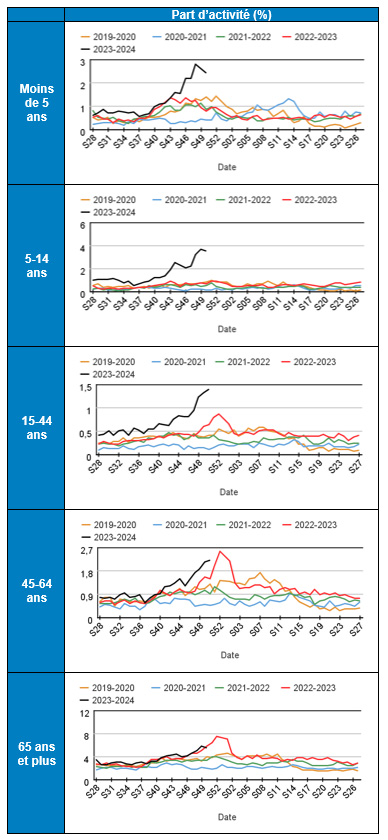
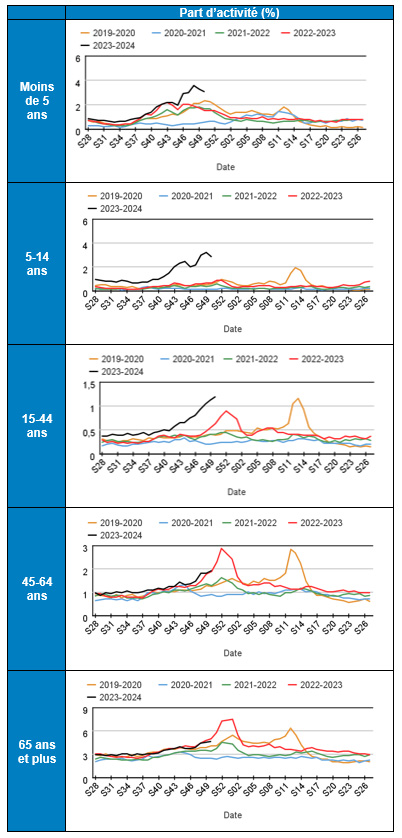
An increase in the use of emergency care for pneumonia (all types combined) was identified in early October 2023 by the SurSaUD® syndromic surveillance system, both in community settings during visits and consultations within the SOS Médecins network [3] (Figure 1) and in hospitals within the Oscour® network’s emergency departments [4] (Figure 2). This increase has been more pronounced since early November (Week 44), continued through Week 48, while a trend toward stabilization began in the following two weeks of early December (Weeks 49 and 50), with disparities by age. Among those aged 5–14 and 15–44, these increases were more pronounced, reaching levels well above those of 2019 before the pandemic. Among 5- to 14-year-olds, indicators continued to rise through week 49 and then appeared to begin declining in week 50, while the increase continued among 15- to 44-year-olds.
However, the proportion attributable to Mycoplasma pneumoniae cannot be precisely estimated from these data because Mycoplasma pneumoniae is not routinely diagnosed during emergency department visits. The data must also be interpreted with caution, given the impact of other respiratory pathogens. Additionally, an analysis of purely bacterial pneumonia will help refine these trends, the interpretation of which must also account for the circulation of other pathogens, particularly in connection with bacterial superinfections of viral infections.
Monitoring of bacterial detection rates in hospitals and the community
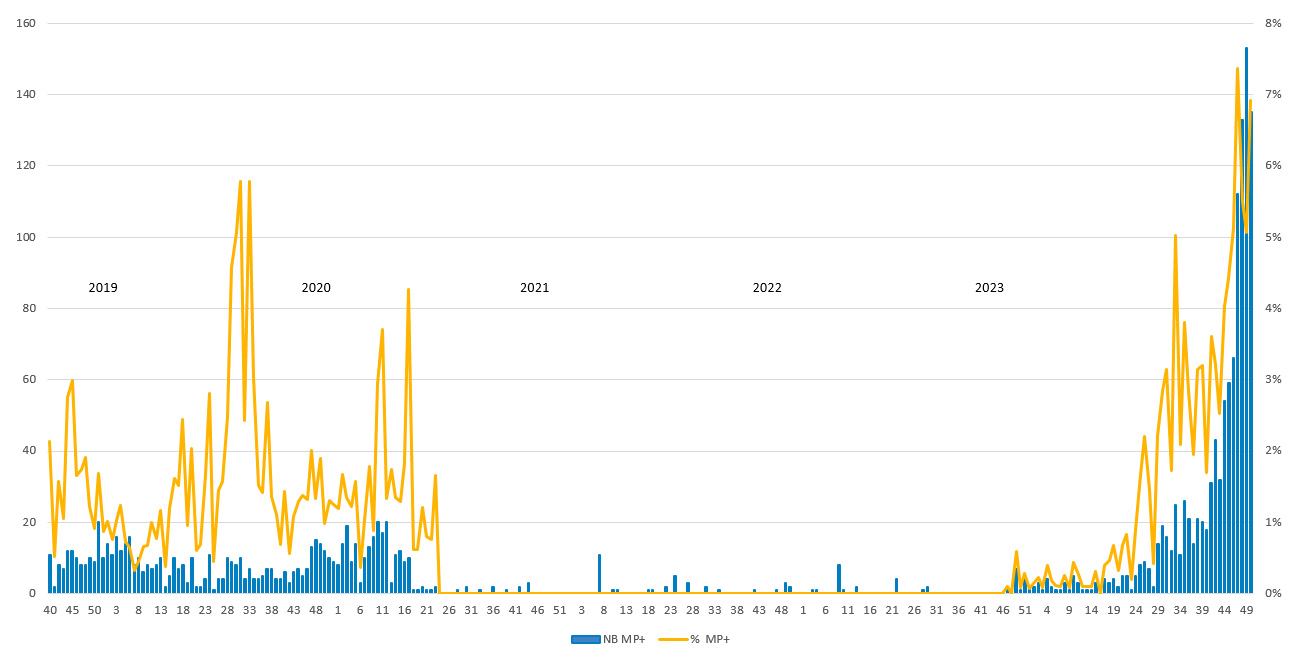
In hospitals, the number of PCR-detected cases of Mycoplasma pneumoniae (RENAL hospital laboratory network [5]) has gradually increased since late July and then more markedly during October 2023, with the positivity rate doubling between the beginning and end of October, rising from 1.7% (W40) to 4.0% (W44) (Figure 3). This increase continued until, by the end of November, the positivity rate was nearly four times higher than that observed during the same period in 2019 (7.4% in W47/23 vs. 1.7% in W47/19). A decline began in week 48 and continued through week 49. An increase in the positivity rate was again observed in week 50 (unconsolidated data).
In urban areas, initial analyses of a portion of the serological data from the 3Labos network [6] show that the positivity rate of IgM tests for Mycoplasma pneumoniae performed in private clinical laboratories, across all age groups, increased during the summer of 2023. A sharp increase was then observed starting in early October, reaching a level by the end of November (Week 47) that was significantly higher than that of 2019 during the same period. This increase was particularly pronounced among children aged 5 to 14, although these trends will need to be confirmed once all data from the 3Labos network (Eurofins-Biomnis and Cerba) has been integrated.
What measures are currently in place to monitor the spread of the epidemic?
In light of this epidemic, Santé publique France continues to monitor the situation in collaboration with its partners. Monitoring of the macrolide resistance profile (first-line treatment against this cell-wall-less bacterium that is not susceptible to beta-lactams) is being conducted by the bacteriology laboratory at the Bordeaux University Hospital (Prof. Bébéar’s team), which provides expertise in the absence of a reference national reference center for this bacterium [7]. Four resistant strains were identified by PCR among the 112 samples amplified since Week 28 (3.6%). Monitoring of antibiotic use has been implemented by the ANSM. A survey on the clinical characteristics of hospitalized cases was launched in mid-December 2023 (Mycado Spilf - Coreb study) [8].
Awareness-raising efforts targeting private and hospital-based healthcare professionals regarding diagnosis and management were launched in November 2023 by the Ministry of Health [9]. It is important to pay particular attention to the diagnosis of this infection in order to initiate appropriate treatment and prevent the development of severe forms of the disease, particularly in individuals at highest risk due to their age or the presence of chronic conditions such as asthma.
Simple precautions to take
To reduce the risk of infection, Santé publique France recommends adopting simple preventive measures:
wear a mask if you have symptoms (cold, fever, sore throat, or cough), in crowded places, and around vulnerable people;
wash your hands frequently with soap and water or with an alcohol-based hand sanitizer;
ventilate your home regularly;
sneeze into your elbow (rather than into your hands);
use a disposable tissue.
[1] European Centre for Disease Prevention and Control. Communicable Disease Threats Report. Weekly Report 49/2023.
[2] World Health Organization. Surge in respiratory illnesses among children—Northern China. Disease Outbreak News. November 23, 2023.
[3] SurSaUD® syndromic surveillance. Bulletin from the SOS Médecins® / Santé publique France network dated 12/18/23.
[4] SurSaUD® syndromic surveillance. OSCOUR® / Santé publique France network bulletin dated 12/19/23.
[5] Institut Pasteur. Network of Hospital Laboratories (RENAL).
[6] Santé publique France – Surveillance of infectious diseases based on laboratory data: 3labos projects.
[7] Bordeaux University Hospital. Bacteriology Laboratory. Request for testing for Mycoplasma pneumoniae and/or macrolide resistance in Mycoplasma pneumoniae.
[8] Spilf – Coreb. Mycado Study – Mycoplasma Infections in Hospitalized Adults.
[9] Directorate General for Health. DGS-URGENT No. 2023_23 dated November 24, 2023.












