Learn more





Santé publique France has released its annual data on organized colorectal cancer screening in France for the 2021–2022 period, which is also available as open data on Géodes. The data show that program participation rates have remained stable compared to the previous period but are still below the European standard.

thematic dossier
Find the latest news and key information about colorectal cancer here.
When detected at an early stage, colorectal cancer is curable in 9 out of 10 cases
As the third most common cancer, colorectal cancer affects 43,300 people and causes 17,100 deaths each year. Santé publique France monitors trends in colorectal cancer in France and is responsible for evaluating the national screening program, whose participation data are published annually. This program, offered every two years to people aged 50 to 74, helps detect polyps or adenomas before they develop into cancer or identifies colorectal cancer at an early stage. The results of the evaluation conducted for the 2021–2022 period show that just over one-third of those eligible underwent a screening test. However, thanks to a simple and effective at-home screening test, this cancer can be detected at an early stage and cured in 9 out of 10 cases.
Santé publique France emphasizes the importance of continuing to raise public awareness about the importance of screening to encourage participation and reduce cancer-related mortality rates. Every year in March, the National Cancer Institute conducts an information campaign as part of Colorectal Cancer Awareness Month.
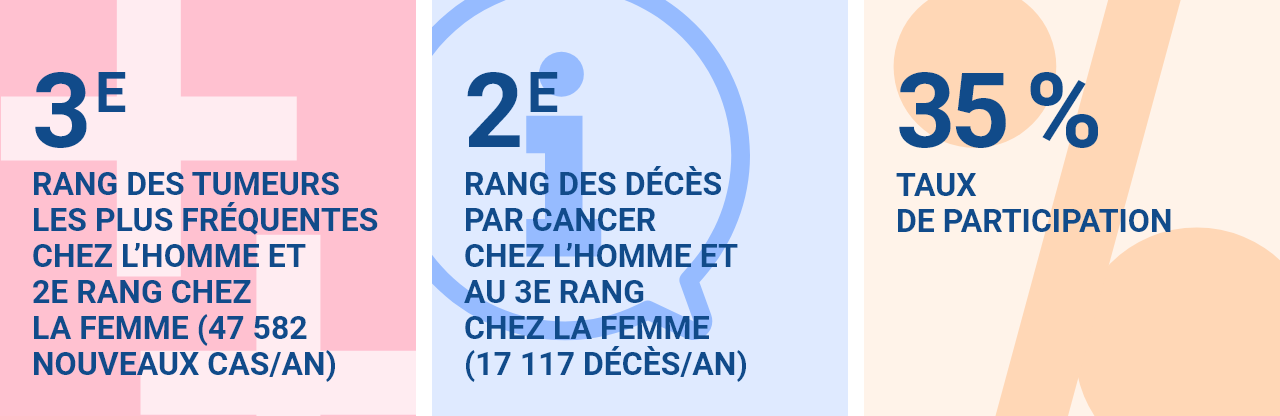
Of the 17.7 million eligible people, 6.1 million underwent colorectal cancer screening in 2021–2022, representing a participation rate of 34.3% versus 34.6% in 2020–2021. Although stable, these are the highest participation rates observed for these two reference periods in over 10 years.
The participation rate is higher among women (35.3%) than among men (33.2%), increases with age, and varies by department:
among men: from 32.6% among those aged 50–54 to 38.7% among those aged 70–74;
among women: from 34.4% among those aged 50–54 to 38.4% among those aged 70–74;
the lowest rates are observed in French Guiana (8.3%), Corsica (18.2%), and Guadeloupe (21.4%);
the highest rates are observed in Ille-et-Vilaine (45.3%), Maine-et-Loire (44.4%), Haut-Rhin (44.4%), and Bas-Rhin (44.1%);
Proportion of positive tests: 3.5% (213,599 people tested positive), higher among men (4.2%) than among women (2.9%), increasing with age and varying by department:
among men: from 3.5% among those aged 50–54 to 5.5% among those aged 70–74;
among women: from 2.7% among those aged 50–54 to 3.7% among those aged 70–74;
it also varies by department from 3.0% to 4.3%.
Learn more
To make it easier and more convenient to access the screening test, new measures have been implemented.
Since March 1, 2022, men and women aged 50 to 74 who have received an invitation to participate in the organized colorectal cancer screening program can order the test online to have it delivered to their home: monkit.depistage-colorectal.fr.
Monkit.depistage-colorectal.fr is a website of the Ministry of Health and Solidarity, the National Health Insurance, and the National Cancer Institute.
referenceIt is now possible for men and women aged 50 to 74 to pick up their screening kit at a pharmacy: the pharmacist, who has received specific training, ensures that the test is appropriate for the person requesting it and, if applicable, provides them with a screening test. It is also possible to obtain it through a doctor.
Colorectal cancer develops from the cells that line the inner wall of the colon or rectum. Most often, these malignant tumors originate from a benign tumor that grows slowly and eventually becomes cancerous.
Colorectal cancer can be detected at an early stage through screening for occult blood in the stool. In France, an organized screening program is offered every two years to people aged 50 to 74, inviting them to take a screening test. People with a positive test result are invited to undergo a colonoscopy to detect the possible presence of precancerous lesions or cancer.
Several modifiable risk factors related to lifestyle (alcohol consumption, smoking, a sedentary lifestyle, physical inactivity, being overweight or obese, and a diet low in fiber and high in red meat or processed meats) have been identified, and these cancers are therefore partly preventable.
Monitoring the epidemiological trends of colorectal cancer
Evaluating the national organized screening program at the national, regional, and departmental levels
Promoting efforts to combat preventable risk factors
View data for your region on participation in the colorectal cancer screening program.












