




Data
The surveillance system for hypercholesterolemia established by Santé publique France makes it possible to study its prevalence and trends over time.
A similar proportion of adults with high LDL cholesterol among men and women
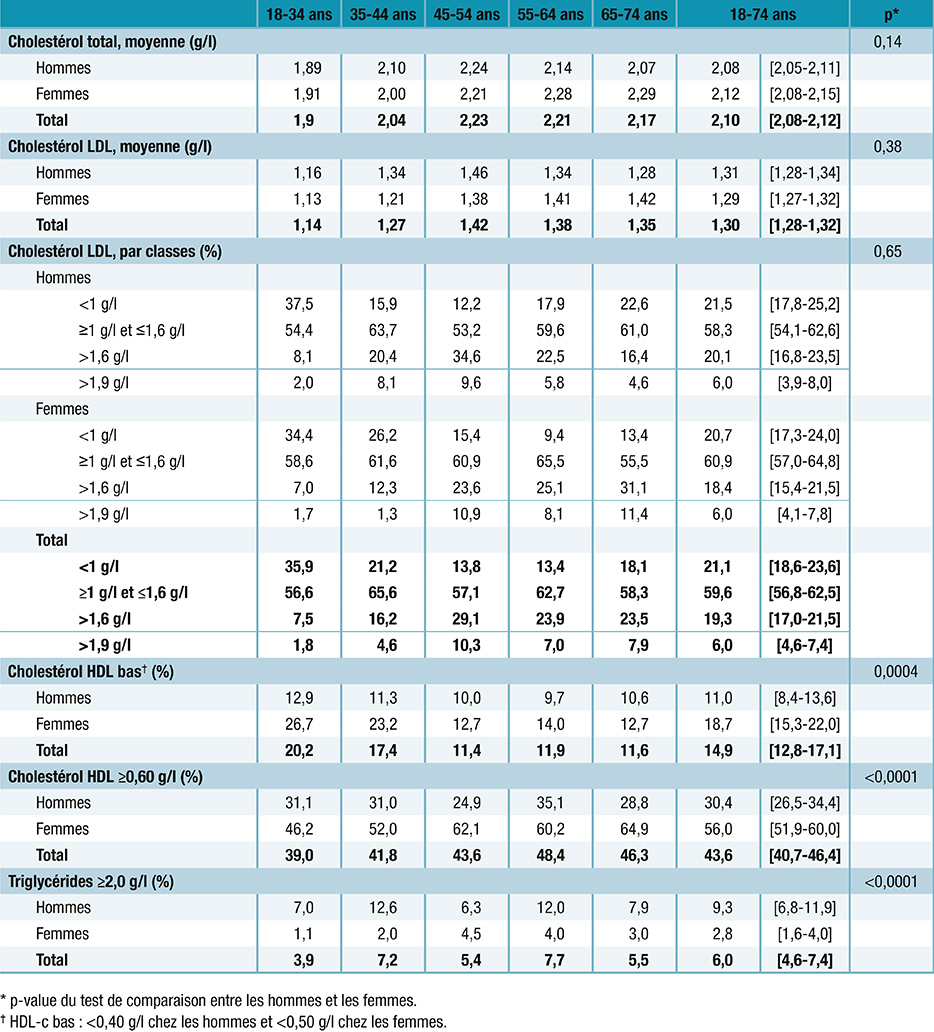
Nearly one in five adults (19.3% [17.0–21.5]) had LDL-C >1.6 g/L, and 6.0% [4.6–7.4] had LDL-C >1.9 g/L. The mean LDL-c was similar in men and women (p=0.38), as was the distribution of LDL-c values across categories (p=0.65).
The proportion of adults with LDL-C >1.9 g/L increased with age up to 45–54 years (10.3%) and then stabilized at around 7–8%.
Lipid parameters in adults aged 18 to 74. Esteban Study, mainland France (excluding Corsica), 2015
Men are more likely to be on lipid-lowering medication
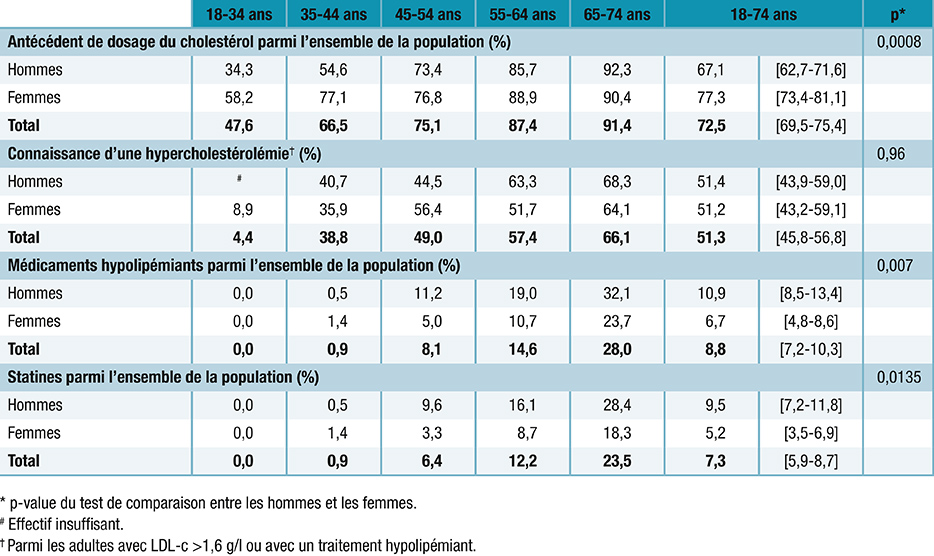
Among all adults, 8.8% received at least one prescription for lipid-lowering medication during the year preceding the health examination. This proportion increased with age (nearly zero among the youngest vs. 28.0% among those aged 65–74) and was significantly higher among men (10.9%) than among women (6.7%).
Adults receiving lipid-lowering therapy were on average 62.0 years old (vs. 45.5 years for those not receiving treatment) and were more often men (60.8% vs. 47.5%).
LDL cholesterol: screening, awareness, and treatment among adults aged 18 to 74. The Esteban Study, mainland France (excluding Corsica), 2015
The prevalence of hypercholesterolemia has remained unchanged since 2006, but screening rates have declined
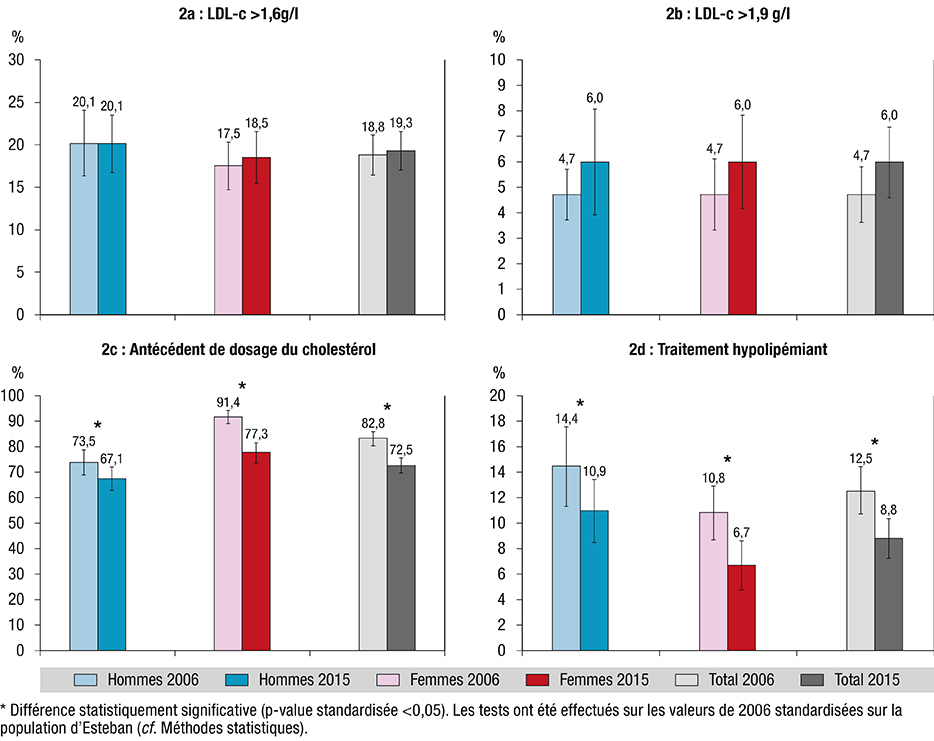
Between 2006 and 2015, the average LDL cholesterol level and the proportion of adults with LDL-C >1.6 g/L and >1.9 g/L did not change significantly (p-values = 0.09, 0.63, and 0.16, respectively).
Compared to 2006, the proportion of adults who reported having had their cholesterol tested decreased significantly by 8.7% among men (p=0.002) and by 15.5% among women (p<0.0001). This decline affected all age groups except those aged 18–34, for whom this proportion remained stable (p = 0.06).
A proportion of adults on lipid-lowering medication that has decreased since 2006
The proportion of adults receiving lipid-lowering therapy among the general population decreased significantly by 29.6% (p=0.0001). The average LDL cholesterol level remained stable among adults receiving treatment (1.21 g/L) and among those not receiving treatment (1.31 g/L). The type of treatment (statins, fibrates, others) did not change significantly over the period considered (p=0.14).
Changes, by sex, in the proportion of adults aged 18–74 with: a) LDL-C >1.6 g/L, b) LDL-C >1.9 g/L, c) a history of cholesterol testing, and d) lipid-lowering therapy, between ENNS-2006 and Esteban-2015. Mainland France
Regional disparities in the proportion of patients treated with lipid-lowering drugs
The proportion of patients treated with lipid-lowering drugs was not uniform across France in 2014. The highest rates were observed in the Hauts-de-France (14.4%), Grand Est (12.6%), Normandy (12.9%), and Centre-Val de Loire (12.2%) regions. These high rates could be explained by obesity rates above the national average and difficult socioeconomic conditions, particularly in the Hauts-de-France, Grand Est, and Normandy regions.
In contrast, all overseas departments as well as the Auvergne-Rhône-Alpes region had prevalence rates more than 10% below the national rate.

article
6 September 2019
LDL cholesterol among adults in mainland France: average levels, awareness, and treatment in 2015, and trends since 2006

The Health of the Population in France – 2017 Report
In relation to

Myocardial infarction
thematic dossier
A heart attack is caused by a blockage in a coronary artery that supplies the heart with blood and, consequently, oxygen. This deprivation leads to heart failure and eventually cardiac arrest.

Stroke
thematic dossier
A stroke is a serious condition that causes neurological deficits resulting from vascular brain damage. Strokes can be ischemic or hemorrhagic.

Nutrition and Physical Activity
thematic dossier
Nutrition and physical activity are two major determinants of health that contribute to improving the health of the population and are key priorities in public health policy.











