



The disease
Chickenpox: The Disease
Chickenpox: Severity Increases with Age
Chickenpox is a highly contagious viral disease, usually mild, that most commonly occurs during childhood. It is caused by a herpes virus (Varicella-Zoster Virus or VZV).
Chickenpox is the primary infection with VZV. Since the chickenpox virus persists within the nerve ganglia after infection, it can reactivate when cellular immunity is compromised, causing shingles.
The lifetime risk of contracting chickenpox is very high (about 95%), and the risk of experiencing at least one reactivation of the virus (shingles) is around 15 to 20%.
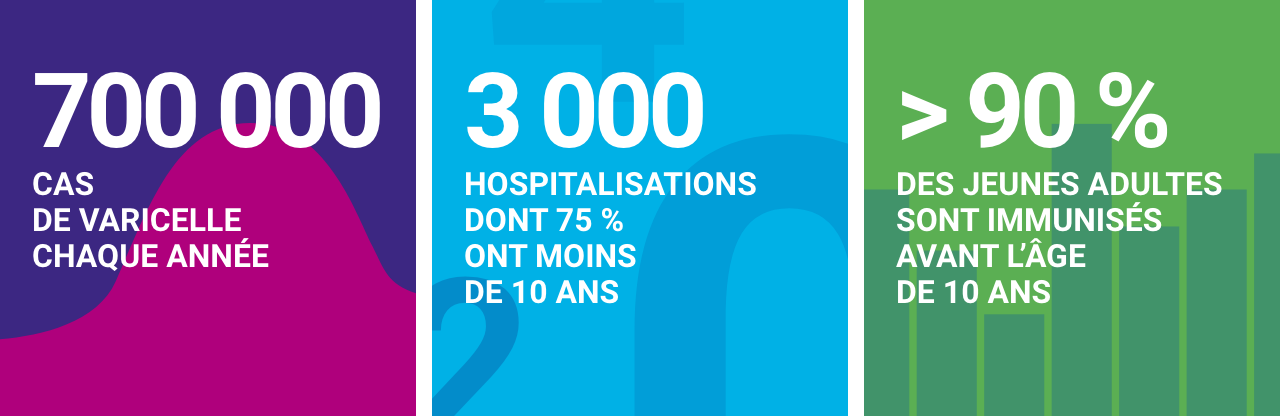
Each year, there are approximately 700,000 cases of chickenpox (90% are under 10 years old), 3,000 hospitalizations (75% are under 10 years old), and 20 deaths (30% are under 10 years old). These figures reflect the common and generally mild nature of the disease. However, the severity of chickenpox increases with age. Although the disease is generally mild in healthy children, it can lead to serious, even life-threatening complications, especially in unvaccinated adults, immunocompromised individuals, pregnant women, and newborns.
The risk of severe chickenpox is estimated at 30% in immunocompromised patients, with a risk of death of approximately 10%. Non-immune adults may also experience a more severe illness upon infection with VZV. Approximately 3% of chickenpox cases develop early complications such as: bacterial skin superinfections, bronchopneumonias, neurological involvement, Reye’s syndrome, cytolytic hepatitis (most often mild), and thrombocytopenia.
The challenge is therefore to prevent this risk of infection among adolescents and unvaccinated adults.
Key facts about chickenpox
Airborne transmission
The chickenpox virus is transmitted through the respiratory tract, by inhaling droplets of saliva emitted by an infected person or through direct contact with their skin lesions.
Contagiousness begins 2 to 4 days before the onset of the disease and continues until the scab stage (on average 5 to 7 days after the rash appears). Contagiousness is very high: the intrafamilial attack rate for chickenpox is as high as 86.6%.
The reservoir for chickenpox is strictly human. The virus can also be transmitted indirectly via contaminated inanimate objects or surfaces. It survives for 1 to 2 hours on surfaces in the open air and for 3 to 4 hours in nasopharyngeal aspirates, or even in sputum. It is also sensitive to many disinfectants: bleach, 70% ethanol, glutaraldehyde, and formaldehyde (formol). It can be inactivated by moist heat and dry heat.
The varicella virus primarily spreads through seasonal outbreaks that occur in late winter and spring.
Specific symptoms
The incubation period is 10 to 21 days, with an average of 14 days. The first clinical signs of the disease are a moderate fever that rises to 38°C and a maculopapular rash that lasts for a few hours (raised red spots on the skin), followed by a vesicular rash. The rash is preceded by general malaise and fever a few hours earlier.
The first clinical signs are therefore a moderate fever up to 38°C and a maculopapular rash that later becomes vesicular and itchy. The vesicles dry out within a few days and form scabs that fall off after a week. The rash may occur in several waves (1 to 7 days), with different types of lesions coexisting (papule/vesicle/scab). Since skin lesions appear in successive waves, they generally start first on the scalp, then on the trunk and mucous membranes. The limbs and face are affected next. It is therefore possible to observe skin lesions at different stages in the same patient.
Shingles is a late complication of chickenpox resulting from the reactivation of the VZV virus, which remains latent in the sensory nerve ganglia of the spinal cord.
Chickenpox generally resolves spontaneously within 10 to 15 days in immunocompetent individuals.
Although the disease is usually benign, secondary skin infections, neurological, or pulmonary complications may occur. The frequency of these complications increases with age in immunocompetent individuals. Newborns and immunocompromised individuals are also at risk for severe disease. There is also a risk of fetal pathology and neonatal chickenpox when a pregnant woman is infected.
The clinical diagnosis of chickenpox is straightforward, but it should be noted that 5% of patients may be asymptomatic.
Laboratory testing is only necessary in cases of atypical presentation or in high-risk situations requiring definitive diagnosis (immunocompromised individuals, pregnant women). Rapid diagnosis can be achieved by examining vesicular cells: detection of viral antigen via immunofluorescence using a monoclonal antibody or detection of the viral genome by PCR. There is no reference laboratory for chickenpox.
Treatment and Management
No specific treatment (except in special cases) is recommended beyond preventive hygiene measures to avoid secondary skin infections and the use of analgesics and antipyretics (excluding NSAIDs and aspirin).
In immunocompetent individuals, treatment is therefore symptomatic.
Treatment of uncomplicated cases therefore consists of relieving itching when present. For severe or complicated cases, or in individuals at risk for severe or complicated disease (immunocompromised individuals, pregnant women), antiviral treatments may be prescribed.
Vaccination for adolescents and unvaccinated adults
In France, widespread vaccination against chickenpox for children over 12 months of age is not recommended. Current vaccination recommendations apply to individuals with no history of chickenpox (or whose history is uncertain) in the following circumstances: adolescents aged 12–18, women of childbearing age, post-exposure vaccination, healthcare professionals and professionals working with young children, individuals in close contact with immunocompromised individuals, and children who are candidates for solid organ transplantation.
In cases of chickenpox, prophylaxis for the patient’s contacts must be implemented: this involves either post-exposure vaccination or immunoglobulin prophylaxis.
Vaccine-based prophylaxis involves post-exposure vaccination (Varilrix® or Varivax®) within 3 days of exposure to a patient with a rash, for individuals aged 18 or older who are immunocompetent and have no history of chickenpox (or whose history is uncertain). A serological test prior to vaccination may (or must, depending on the circumstances) be performed. Any vaccination in a young woman of childbearing age must be preceded by a negative pregnancy test, and, according to the marketing authorization data, effective contraception is recommended for three months following each vaccine dose.
As for prophylaxis with immunoglobulins, it is possible through hospital administration of specific anti-VZV immunoglobulins via a named ATU. They are recommended within 96 hours of contact with a case of chickenpox, in immunocompromised children and adults, unimmunized pregnant women, newborns whose mothers had chickenpox within 5 days before or 2 days after birth, preterm infants (excluding maternal transmission) who must remain in the hospital for an extended period, and preterm infants <28 weeks or with a birth weight <1 kg, regardless of whether the mother has a history of chickenpox.
What to Do in the Event of a Chickenpox Case
It is recommended to inform the staff of the school attended by the patient (or other settings, if applicable) and the parents of the presence of cases in the community. As soon as a case of chickenpox is identified in the community, immunocompromised children, pregnant women, and adults who have not had the disease and have been in contact with the sick child are advised to consult their primary care physician promptly.
Reference materials
Vaccination recommendations for chickenpox. Reassessment of recommendations regarding chickenpox vaccination following the introduction of quadrivalent measles-mumps-rubella-chickenpox vaccines. Report of the Working Group of the Technical Committee on Vaccinations (meeting of July 5, 2007).
Opinion of the French Higher Council for Public Health, Communicable Diseases Section, regarding varicella vaccination (meeting of March 19, 2004).
In relation to

Vaccination
thematic dossier
Contagious diseases most often affect children at a very young age. Because children are particularly vulnerable, they are a priority target for vaccination programs.












