



The disease
Psychotic disorders are severe, chronic mental disorders that cause significant distress for the person affected and those around them. According to the World Health Organization’s (WHO) International Classification of Diseases, 10th Revision (ICD-10), psychotic disorders include schizophrenia, schizoaffective disorders, persistent delusional disorders, brief psychotic episodes, schizophreniform disorder, and substance-induced psychotic disorders.
Schizophrenia is the most common of the psychotic disorders. Data available in the international scientific literature indicate a lifetime prevalence of schizophrenia estimated at around 4 per 1,000 people (Saha et al., 2005), which is slightly lower than the WHO figures, and an estimated incidence of 0.15 per 1,000 (McGrath et al., 2004).
Key statistics on psychotic disorders
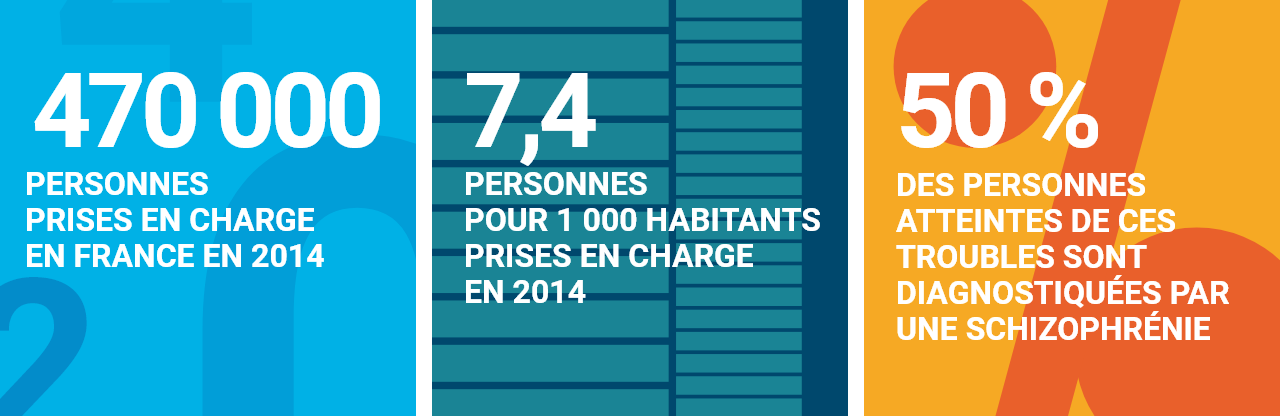
Psychotic Disorders: Highly Variable Clinical Presentations
Psychotic disorders are characterized by variable clinical presentations that often begin in late adolescence or early adulthood. This psychiatric condition affects men slightly more than women, and the first symptoms are observed earlier in men. Due to the age at which it occurs, this condition hinders the acquisition and development of personal autonomy, very often leading to dependence on family and societal support. In addition to this risk of social, occupational, and family disengagement, these severe disorders carry a significant risk of suicide (around 5%) and of physical, iatrogenic, or comorbid conditions associated with mood, anxiety, or behavioral disorders. The risk of premature death is 2 to 3 times higher for people with schizophrenia than in the general population. Premature deaths are often due to preventable diseases, such as cardiovascular, metabolic, or infectious diseases, or cancers.
People with psychotic disorders are often victims of stigma, discrimination, and even violations of their fundamental rights.
Schizophrenia: A Condition That Is Often Difficult to Diagnose
Schizophrenia manifests as a distorted perception of reality, hallucinations—often auditory (such as hearing voices) but also visual, olfactory, or gustatory—delusions, as well as so-called negative symptoms, such as emotional and social withdrawal, corresponding to an emotional and affective impoverishment. The person appears detached and indifferent. This emotional blunting is common and highly suggestive of schizophrenia. Finally, there are symptoms of disorganization in thought, emotions, and behavior.
The course of the illness is often episodic, with periods of decompensation and negative symptoms between these episodes. This course leads to a progressive or episodic worsening, with episodes occurring at varying intervals and the intervals between episodes being more or less symptomatic.
Schizophrenia is a condition for which there are currently no specific symptoms or paraclinical markers. A paraclinical evaluation is nevertheless required before diagnosing schizophrenia, as a schizophrenic presentation can be a manifestation of various causes, including non-psychiatric ones. Furthermore, the boundaries with other psychotic disorders and the delusional forms of certain episodes of bipolar disorder are sometimes unclear. The diagnosis is generally made based on the clinical course and in the absence of any other identifiable cause. It is not uncommon for the diagnosis to be made after several years of the disease’s progression.
An etiology that remains poorly understood
The etiology of schizophrenia remains poorly understood. There is currently a consensus in favor of a multifactorial origin and gene-environment interaction, combining genetic vulnerability with environmental factors. It is now well established that the use of psychoactive substances, particularly cannabis, plays a precipitating role in the onset of psychosis. The effect is more pronounced with heavy use and when use begins before age 15, as adolescence is a period particularly sensitive to the harmful effects of cannabis (Krebs et al., 2013). Recent studies have also shown that users who are most sensitive to the psychotic effects of cannabis exhibit specific genetic variants (Krebs et al., 2019).
The Importance of Early and Appropriate Care in Improving the Prognosis of the Disease
Antipsychotic medications combined with high-quality psychosocial support, assistance with daily living, housing support, and supported employment are effective strategies for managing psychotic disorders, helping those affected integrate into society and improve their quality of life as well as that of their loved ones. The prognosis of the illness varies depending on the characteristics of the illness and the timeliness of care. Indeed, appropriate and early care reduces the risk of entering a chronic phase of the illness and improves the chances of remission. The prognosis also depends on the patient’s commitment to their care.
In France, care and treatment for psychotic disorders may be covered at 100% under the Long-Term Illness (ALD) exemption program, following the establishment of a care plan with the attending physician.
For the management of schizophrenia, the HAS (French National Authority for Health) has developed guidelines that can be viewed and downloaded by clicking here.
International classifications currently in use
ICD-10 (International Classification of Diseases, 10th Revision, WHO, 1993)
This group includes schizophrenia, the largest category within this group, schizotypal disorder, persistent delusional disorders, and a fairly broad group of acute and transient psychotic disorders. Schizoaffective disorders have been retained in this group, although their nature remains controversial.
Psychotic disorders, ICD-10 codes (1993)
| F20-29 | Schizophrenia, schizotypal disorder, and delusional disorders |
|---|---|
| F20 | Schizophrenia |
| F21 | Schizotypal disorder |
| F22 | Persistent delusional disorders |
| F23 | Acute and transient psychotic disorders |
| F24 | Induced delusional disorder |
| F25 | Schizoaffective disorders |
| F28 | Other nonorganic psychotic disorders |
| F29 | Nonorganic psychosis, unspecified |
The DSM-5 (Diagnostic and Statistical Manual of Mental Disorders of the American Psychiatric Association, 5th edition, 2013)
The DSM-5 groups these disorders under the chapter titled “Schizophrenia Spectrum and Other Psychotic Disorders,” which includes schizophrenia, other psychotic disorders, and schizotypal personality disorder. In the DSM-5, schizoaffective disorder is not included in this spectrum.
Psychotic Disorders, DSM-5 Codes (2013) with ICD-10 Correspondence
| Schizophrenia Spectrum and Other Psychotic Disorders (according to a psychopathological continuum) |
ICD-10 correspondence | |
|---|---|---|
| 301.22 | Schizotypal personality | F21 |
| 297.1 | Delusional disorder | F22.0 |
| 298.8 | Brief psychotic disorder | F23.8 |
| 295.40 | Schizophreniform disorder | F20.8 |
| 295.xx | Schizophrenia | F20 |
| 297.3 | Shared psychotic disorder (DSM-5) / Induced delusional disorder (ICD-10) | F24 |
| 298.9 | Unspecified psychotic disorder | F29 |
295.70 |
Schizoaffective disorder, specify type |
F25 |
| Psychotic disorder induced by a substance/medication: refer to substance-related disorders for specific codes for each substance | F1x.5 | |
293.xx |
Psychotic disorder due to another medical |
|
| Additional codes to add if | ||
| 293.89 | Catatonia associated with another mental disorder | F06.1 |
Learn more:












