


Leading causes of death in France: trends and regional disparities in 2023
cp_mortalite2023_20250708.pdf
Download (PDF - 203.42 KB)
Press Contacts
DREES
DREES-PRESSE@sante.gouv.fr
Inserm
presse@inserm.fr
Public Health Press
presse@santepubliquefrance.fr
The Directorate for Research, Studies, and Statistical Evaluation (DREES), the Inserm Center for Epidemiology of Medical Causes of Death (CépiDc-Inserm), and Santé Publique France are analyzing the medical causes of death among residents who died in France in 2023.
Two complementary studies presenting these findings have been published simultaneously in the *Bulletin épidémiologique hebdomadaire* (Santé publique France) and in *Études et Résultats* (DREES). They are based on national statistics on causes of death produced by Inserm’s CépiDc using a comprehensive collection and analysis of the medical sections of death certificates.
Among the population residing in France, 637,082 people died in 2023 within the country, representing 36,000 fewer deaths than in 2022. The age-standardized mortality rate, which accounts for population aging, is 828.3 deaths per 100,000 inhabitants. It has decreased by nearly 60 deaths per 100,000 inhabitants compared to 2022 and has fallen below the 2019 level. This historically low mortality rate in 2023 is observed in the vast majority of European countries. However, mortality in France remains higher than would have been expected had the downward trend observed during the 2015–2019 period continued through 2023.
Mortality reached a historic low in 2023, driven primarily by a decline in Covid-19-related deaths
More than 60% of the decline in mortality in 2023 is attributable to the decline in Covid-19-related mortality. Smaller declines are also observed for most major causes. There are two notable exceptions: mortality from respiratory diseases and mortality from infectious and parasitic diseases are slightly higher.
Tumors are the leading cause of death among both men and women, ahead of cardiovascular and cerebrovascular diseases
In 2023, tumors—that is, cancers—were the leading cause of death, accounting for more than a quarter of all deaths (27%). Deaths from tumors occurred among people who were, on average, younger than those from all causes combined. Mortality from tumors continues to decline, with the exception of pancreatic cancer, which is trending upward, and lung, bronchial, and tracheal cancers among women.
Leading causes of death in France in 2023
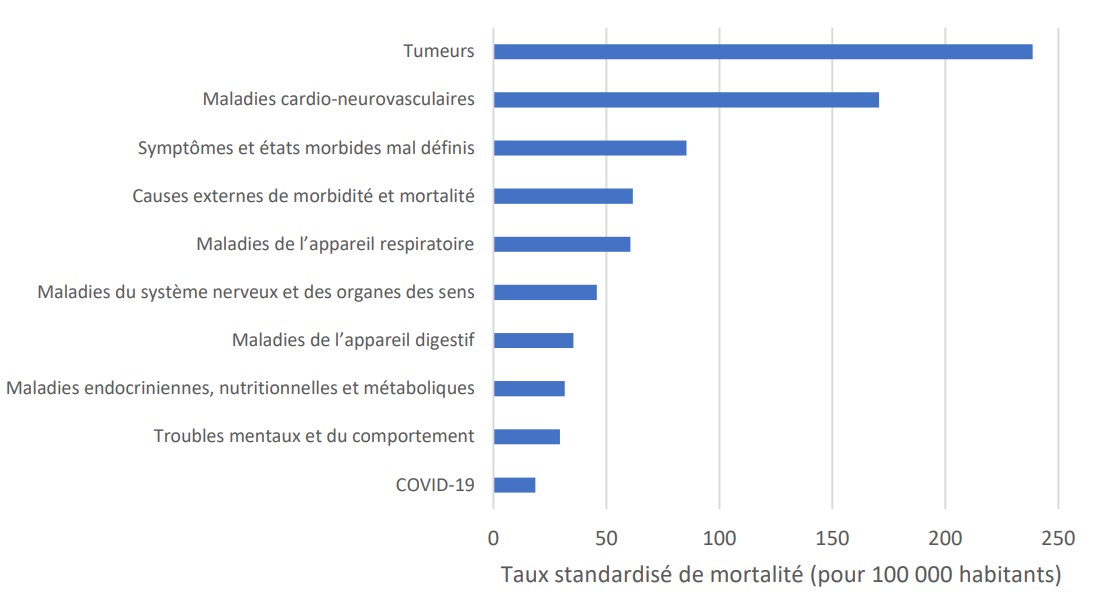
Cardiovascular and cerebrovascular diseases (such as myocardial infarction, stroke, and heart failure) accounted for more than one-fifth of all deaths (21.4%). They remain the second leading cause of death, despite a slight decline compared to the previous year.
In 2024, according to a preliminary estimate that is still provisional, mortality rates associated with these two major causes of death are expected to decline slightly. However, the number of deaths from these diseases is projected to rise or remain stable, driven by the growing number of baby boomers reaching advanced ages.
Higher mortality rates than pre-pandemic trends for certain causes
In 2023, mortality rates from cardiovascular and cerebrovascular diseases, endocrine, nutritional, and metabolic diseases, diseases of the digestive system, genitourinary diseases, and external causes (accidental falls, accidents of daily life) remain higher than what would have been expected based on the continuation of pre-COVID-19 trends.
Cancers, the second leading cause of death among children aged 1 to 14
Among children under 1 year of age, the mortality rate is 397.6 per 100,000 children, and 10.8 per 100,000 among children aged 1 to 14.
More than half of deaths among children under 1 year of age are due to conditions originating in the perinatal period, and nearly one in five is due to a congenital malformation or chromosomal abnormality.
The two leading causes of death among children aged 1 to 14 are, first, external causes (30% of deaths), three-quarters of which are accidents in daily life and transportation; and second, tumors (17% of deaths).
Higher mortality rates in the overseas departments and regions (DROM), northern, and eastern parts of metropolitan France
The number of deaths is higher than expected in the overseas departments and regions (DROMs), assuming mortality rates were the same as for mainland France as a whole in 2023, particularly in Mayotte (+89%) and French Guiana (+37%). This is also the case, to a lesser extent, in northern and eastern mainland France, notably with a 17% increase in Hauts-de-France. In contrast, the figure is significantly lower in Île-de-France (15% below the national average).
These regional disparities are more pronounced for cardio-neurovascular diseases than for tumors.
In particular, there are more deaths from cardio-neurovascular diseases and fewer from tumors in the DROMs than in metropolitan France (except in Mayotte).
Significant regional and departmental disparities are also observed for infectious, endocrine, and respiratory diseases, as well as COVID-19. Conversely, the number of deaths from nervous system diseases is similar across all regions.
Nearly a quarter of deaths occur at home, 30% of which are during home hospitalization
More than half of deaths (53%) occur in healthcare facilities (public or private) and nearly a quarter at home (24%), proportions comparable to those in 2022. Nearly 30% of deaths at home involve individuals receiving home hospitalization (HAD), a proportion that has increased compared to 2022.
Two complementary studies to better document the leading causes of death in 2023 and trends in these causes
The BEH article analyzes the leading causes of death in 2023 and their trends compared to the 2015–2019 period and since 2020. The Études et Résultats publication, meanwhile, details regional disparities in mortality by cause in 2023. Finally, it presents an initial estimate of causes of death in 2024.
View the publications and related data:
About DREES
Established by the decree of November 30, 1998, the Directorate for Research, Studies, Evaluation, and Statistics (DREES) is part of the Public Statistical Service (SSP), alongside INSEE and other ministerial statistical agencies. Its role is to provide reliable information and analyses in the fields of social affairs and health. For over 20 years, DREES’s work has been guided by an ethical commitment whose principles—codified and shared at the European level—are professional independence, a commitment to quality, respect for statistical confidentiality, impartiality, and objectivity. DREES is also a ministerial statistical service whose primary mission is to support and evaluate public social and health policies.
About Inserm and CépiDc
Founded in 1964, the French National Institute of Health and Medical Research (Inserm) is a public scientific and technological institution under the joint supervision of the Ministry of Health and the Ministry of Research. Dedicated to biological, medical, and human health research, it spans the entire spectrum from the research laboratory to the patient’s bedside.
The Center for Epidemiology of Medical Causes of Death (CépiDc) is the Inserm unit responsible for fulfilling France’s legal and regulatory mandate to produce national statistics on medical causes of death. These statistics are compiled from information provided by physicians on the medical sections of death certificates. At the same time, CépiDc has developed expertise in the statistical analysis of French and international data on causes of death for public health purposes.
About Santé publique France
Santé publique France is France’s leading center of expertise in public health. Grounded in the continuum between knowledge and action, our mission is to protect and improve the health of the population. Our work addresses major public health challenges over the long term: from protection against threats (including infectious risks, environmental risks, health determinants, etc.) to improving health (prevention, health promotion aimed at reducing the burden of disease and social and regional inequalities, etc.). Santé publique France is a public institution under the supervision of the Ministry of Health.
Our latest news

news
Growing Up with Screens. A special report in *La Santé en action* No. 474,...

news
Seniors, pregnant women, and nursing home staff: What is the status of their...

news












