


COVID-19 Epidemiological Update for September 30, 2021: The epidemiological situation continues to improve, except in French Guiana, where the situation is very concerning
CP_pe_covid_300921.pdf
Download (PDF - 183.49 KB)
Press Contacts
Santé publique France
presse@santepubliquefrance.fr
Stéphanie Champion: 01 41 79 67 48
Marie Delibéros: 01 41 79 69 61
Camille Le Hyaric: 01 41 79 68 64
In week 38 (September 20–26), the situation continued to improve, with epidemiological indicators continuing to decline across all regions except French Guiana.
With low vaccination rates (30.9% of those aged 12 and older having received two doses) and slow progress, the epidemic in French Guiana continued to worsen, placing a heavy strain on hospital capacity and leading to excess mortality. Nationwide, as of September 28, 2021, 74.9% of the population had received at least one dose of the vaccine, and 72.2% were fully vaccinated. Against the backdrop of declining adherence to preventive measures, vaccination combined with other preventive measures (adherence to preventive measures, limiting high-risk contacts, and self-isolation in the event of symptoms, a confirmed infection, or contact with a confirmed case) remains essential to maintaining the current favorable epidemic trend.
Epidemiological and hospital indicators continue to decline
Nationally, the incidence rate continued to decline (-22%) in week 38, reaching 57 per 100,000 inhabitants, corresponding to an average of 5,484 diagnosed cases per day. It was decreasing across all age groups. It was highest among adults under 50 and children. The testing rate, including antigen and PCR tests (excluding self-tests), remained very high at 4,702 per 100,000 inhabitants (-7%). It was decreasing among adults. Among 3- to 5-year-olds and 6- to 10-year-olds, the testing rate had risen very sharply in weeks 36 and 37 and stabilized in week 38. The positivity rate was 1.2%, down 0.2 percentage points, with a more pronounced decline among children under 10, against a backdrop of stable testing rates in this age group.
In hospitals, the decline in the number of new admissions continued, with 1,495 new hospitalizations (-32%) and 405 new admissions to intensive care (-30%). As of September 28, there were 7,862 COVID-19 patients currently hospitalized, including 1,537 in intensive care.
The situation remains very concerning in French Guiana
In week 38, the incidence rate in French Guiana had increased by 8% compared to the previous week, with 537 cases per 100,000 inhabitants. Viral circulation had accelerated particularly in the West, with a 23% increase (674 per 100,000). The recent increase in transmission in the Maroni region continues in several municipalities along the river. The Savanes region also saw a sharp resurgence: 22% (711 per 100,000), and as in the West, incidence rates exceeded those of previous waves. The incidence rate for the Island of Cayenne and Montsinéry-Tonnegrande remained high (609/100,000; +5%).
Hospitalization rates were rising to levels higher than those observed at the peak of the third wave. Rates of critical care admissions and deaths were also increasing, reaching levels higher than those observed since March 2020.
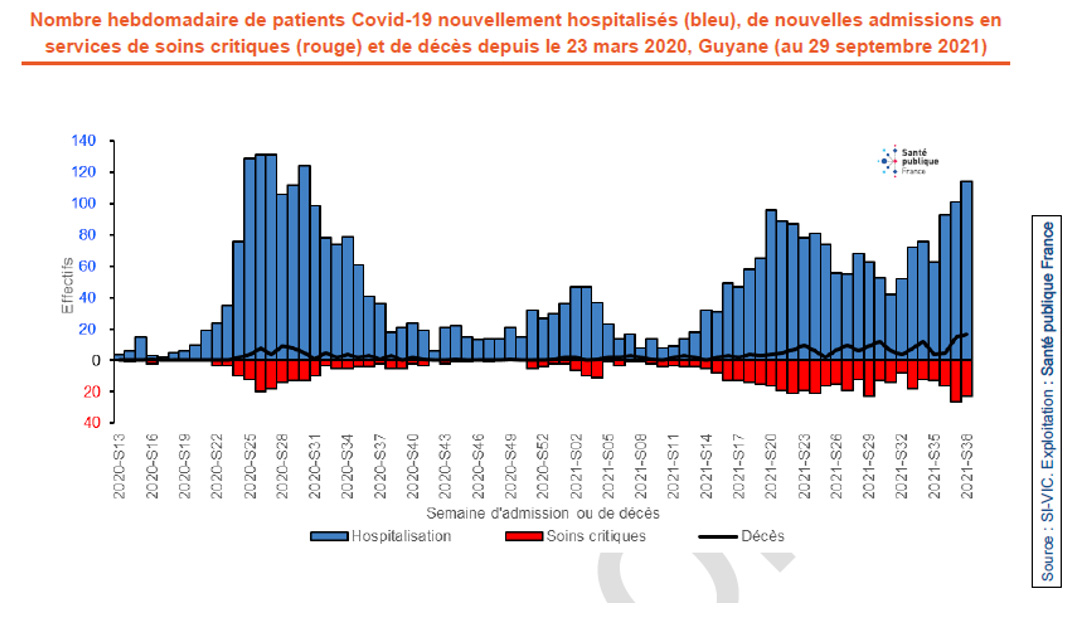
These unfavorable epidemiological indicators occurred against the backdrop of the Delta variant being the dominant strain and very insufficient full vaccination coverage that was progressing slowly. As of September 29, it stood at only 30.9% among those aged 12 and older.
Increase in the proportion of cases previously identified as close contacts
In week 38, the decline in the number of new cases and new contacts recorded in the ContactCovid database continued (down 22% and 19%, respectively). After increasing for 5 weeks, the average number of contacts identified per case appears to be stabilizing at 2.2. The proportion of cases previously known as contacts was rising to 21.7%, although the number of unknown transmission chains remains significant. The proportion of contacts aged 12 and older who have been fully vaccinated increased from 55% to 58%, which could be explained by the progress of vaccination and/or improved identification of vaccinated contacts.
The number of cases reporting school attendance is decreasing, but the number of cases having participated in a workplace gathering is slightly increasing (+7% between W37 and W38), as are those having participated in a cultural activity or event (+6% between W37 and W38).
Nearly 75% of the population has received at least one vaccine dose
On September 28, the estimated vaccination coverage in France based on Vaccin Covid was 74.9% (50,239,233) for at least one dose and 72.2% (48,424,745) for full vaccination. Among those aged 12 and older, 50,219,566 had received at least one dose (87.1%) and 48,411,809 (83.9%) were fully vaccinated.
As of September 28, 93.3% of residents in nursing homes (residential care facilities for dependent elderly individuals) or long-term care units had received at least one dose of the vaccine (91.2% for full vaccination). Vaccination coverage is high among healthcare professionals: data is available in the latest "Le Point sur" report on COVID-19 vaccination coverage among healthcare professionals, as of September 20, 2021.
Download

bulletin national
30 September 2021
COVID-19: Epidemiological Update as of September 30, 2021
Stay informed about the COVID-19 pandemic in France and around the world
Updates, Q&As, expert interviews... everything you need to know about the novel coronavirus (SARS-CoV-2) and COVID-19 in France and around the world
Coronavirus: Circulation of SARS-CoV-2 Variants
Many variants of SARS-CoV-2 are circulating in France, and new variants carrying mutations are regularly identified. How are they monitored and classified? Learn all about the...
Our latest news

news
Shamonda Virus: First Human Case Detected in France—What Do We Know?

news
Call for Nominations for the Renewal of the Scientific Advisory Board of the...

news












