


Summer Risks: Some Precautions to Take
Accidental drowning, sun-related risks, mosquito-borne diseases, extreme heat…: summer isn’t without its risks. Santé publique France offers some tips to help you enjoy a worry-free summer.
Heat waves
During the summer, temperatures can rise significantly.
Exposure to extreme heat affects our bodies, and the health risks are numerous. Seniors, infants, children, adults, pregnant women, workers, athletes… we’re all at risk! It’s important to protect yourself, even when the heat is short-lived.
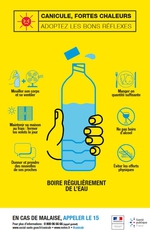
To prepare for heat waves, Santé publique France reminds everyone of these simple tips to follow.
Drink water regularly without waiting until you’re thirsty;
Cool off and wet your body (at least your face and forearms) several times a day;
Eat enough and avoid alcohol;
Avoid going outside during the hottest hours of the day and spend several hours a day in a cool place (movie theater, public library, supermarket, museum, etc.);
Avoid physical exertion;
Keep your home cool (close windows and shutters during the day; open them in the evening and at night if it’s cooler);
Be sure to check in with your loved ones regularly and, whenever necessary, don’t hesitate to ask for help;
Check the Météo-France website regularly for updates.
When driving and on long trips:
Remember to bring water and a spray bottle with you on car trips;
Stop regularly to rest and cool off;
At some highway rest areas, water fountains or misting stations are available for your use;
If possible, schedule your trip for cooler times of day;
Never leave anyone alone in a car, especially a child, as the temperature inside the vehicle can rise very quickly
For real-time weather updates, you can consult the Météo-France weather advisory map, which is updated at least twice a day at 6 a.m. and 4 p.m. on the following website: http://vigilance.meteofrance.com.
For more information:
Heat and health. Report on the monitoring system.
Infographics on summer risks. Ministry of Health.
Sun-related risks: Enjoying the sun safely
Whether at the beach, in the mountains, in the countryside, or even in the city, protect yourself from the sun.
In mainland France, solar radiation is most intense between May and August. We all enjoy the sun and know its benefits: it boosts our mood and helps produce vitamin D. However, we sometimes forget that it can also pose risks. The use of protective measures is far from systematic, and it’s important to remind people: avoid sun exposure between noon and 4 p.m., wear a hat and sunglasses, apply sunscreen every two hours, and provide even more protection for children, who are particularly vulnerable.
For all your outdoor activities—whether you’re in your garden, at a café terrace, at the beach, in the mountains, or in the countryside; when you’re exercising or simply taking a walk—protect yourself so that the sun remains a pleasure.
Exposure to ultraviolet (UV) radiation, whether natural or artificial, remains the leading cause of skin cancers, including melanoma. The number of new cases of skin melanoma has been rising over the past 30 years, with an estimated 11,176 new cases in France in 2012*.
* Source: Estimates of cancer incidence and mortality in mainland France between 1980 and 2012 – Solid tumors.
For more information:
Poster 'Sun Risks: 4 Simple Steps'
Drowning, swimming: Stay vigilant at all ages and in all swimming areas
Whether at the ocean, a river, a lake, or a pool, summer is the perfect time for swimming and water activities. But every summer, drowning claims many accidental lives, among children, adults, and seniors alike. Learning to swim and following basic safety guidelines—such as having an adult supervise children, assessing one’s physical fitness before swimming, and staying within designated swimming areas—can help prevent these accidents. To enjoy the water safely, the Directorate General for Health and Santé publique France remind the public of the right precautions to take.
During the summer of 2015, the NOYADES* survey recorded 1,219 accidental drownings, including 436 deaths—nearly 4 deaths per day: 49% at sea, 24% in swimming pools, and 13% in rivers.
For more information:
"Swimming Safely" brochure
Poster '3 Safety Tips for Swimming'
Report on drowning surveillance
Report on drowning prevention / swimming safety
Diseases transmitted by mosquitoes
Mosquitoes can transmit various diseases. They can bite both day and night, and some species, such as Aedes albopictus (also known as the tiger mosquito), can transmit diseases like chikungunya, dengue, or Zika.
The best way to combat disease transmission is to protect yourself from bites. Take the right steps to limit mosquito breeding in your environment.
Learn more:
Chikungunya: Information and Prevention Resources
Zika virus: information and prevention resources
Report on chikungunya surveillance
Report on dengue surveillance
Report on Zika virus surveillance
Prevention guide on mosquito-borne diseases
Lyme disease
Summer is often a great time for outdoor activities and outings. For those who enjoy walks and hikes in the forest, campers… Be careful of ticks, which can transmit Lyme disease or Lyme borreliosis to humans through the bite of an infected tick. Ticks are widespread throughout France and live in wooded and damp areas, tall grass in meadows, and forest and urban parks. They are most active between April and November.
To avoid being bitten by a tick, the best prevention is to protect yourself by wearing long, close-fitting, light-colored clothing and a hat. Whether you’re a professional or an amateur, make sure you’re properly equipped!
In France, in 2015, an estimated 33,202 people were affected by the disease (Sentinelles network). The East and the Center are the regions with the highest estimated number of cases; the West and the Mediterranean South have the lowest.
For more information:
Vector-borne diseases: know them to protect yourself. 2016 brochure.
Report on the surveillance of Lyme disease












