



Sedentary behavior at work: effective interventions exist to improve employee health
Santé publique France has published a literature review on the effectiveness of interventions aimed at reducing sedentary behavior in office settings and the most promising strategies currently in use.
Eat and Move
Visit mangerbouger.fr for comprehensive information on nutrition, tools and tips to help you eat better and be more active, as well as a wide variety of recipes.
Professionals in the service sector, particularly those working in an office or remotely—a trend that has grown significantly in recent years—spend long, uninterrupted periods of time sitting. This high level of sedentary behavior increases certain health risks, such as cardiovascular disease, type 2 diabetes, certain cancers, depression, and anxiety. As a result, a growing body of literature has emerged on the implementation and effectiveness of interventions and intervention strategies aimed at reducing and interrupting sedentary behavior, particularly in office settings.
Santé publique France has therefore conducted a review of the scientific literature on the effectiveness of these interventions and the most promising strategies used. It aims to provide employers and other workplace stakeholders, decision-makers, and public health actors with an overview of existing studies on the effects of these interventions on sedentary behavior, workers’ health, and their productivity. The most promising intervention strategies to prioritize are also presented. Subsequently, a simplified document, illustrated with examples of French interventions that have utilized the levers identified in this literature review, will be distributed to employers, notably via the employeurspourlasante.fr platform. This platform, designed by Santé publique France, provides employers with data and tools for prevention and health promotion.
Reducing Sedentary Behavior: A Public Health Challenge
Reducing sedentary behavior is a major public health issue and a key focus of Santé publique France’s health promotion and prevention program. In this context, the agency is implementing numerous initiatives to meet the objectives of the National Nutrition and Health Program, one of which is to reduce sedentary behavior across all stages of life.
To combat sedentary lifestyles and limit time spent sitting or in front of screens, simple tips and recommendations are available on the mangerbouger.fr website.
Furthermore, to develop its health promotion and prevention initiatives or to provide tools for frontline workers, Santé publique France relies on scientific studies evaluating the effectiveness of interventions. This literature review is part of this approach. It helps identify effective intervention strategies against sedentary behavior in the workplace—a setting where adults spend a significant amount of time and where some experience high levels of sedentary behavior.
Sedentary Behavior at Work: Major Health Effects That Are Still Underrecognized
Sitting for prolonged, uninterrupted periods poses significant health risks that are difficult to offset through physical activity, even for physically active individuals.
Sedentary behavior thus leads to an increased risk of mortality, cardiovascular disease, colon, lung, and endometrial cancers, and type 2 diabetes, and can increase anxiety, depression, and musculoskeletal disorders.
Conversely, frequent breaks from sitting have been shown to have beneficial effects on health, particularly on cardiovascular health.
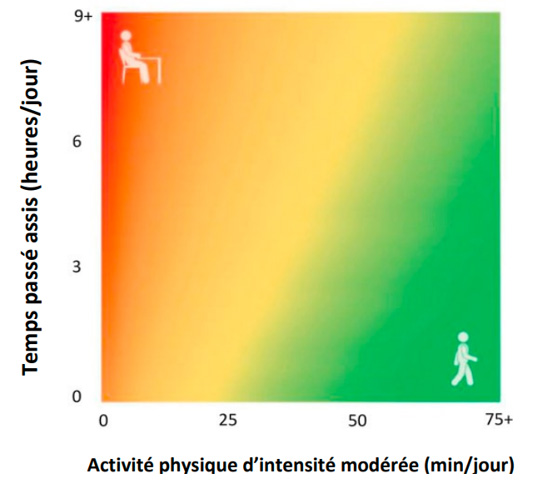
The harmful effects of sitting time on health are more pronounced in people who are also physically inactive, whereas they can be mitigated by engaging in significant amounts of daily physical activity. For example, a person who sits for 9 hours a day should engage in 1 hour and 25 minutes of moderate-to-vigorous physical activity daily to "offset" the increased risk of cardiovascular disease mortality associated with this prolonged sitting.
Heat map illustrating the relationship between physical activity, time spent sitting, and mortality (green indicates a lower risk of mortality and red a higher risk)
Three intervention strategies to combat sedentary behavior at work
In the interventions against sedentary behavior that were evaluated, several strategies were identified in the context of office work:
a change in company policy (organizational changes, managerial support, manager ambassadors, implementation of standing meetings and active break times);
changes to the workplace environment (introduction of “active furniture” such as sit-stand desks, pedal-powered desks, treadmill desks, etc.);
strategies based on informing and motivating individuals (educational sessions, information via posters, flyers, computer messages, alerts to interrupt sitting time, behavior tracking, motivational interviews, etc.).
Active furniture: the most effective way to reduce time spent sitting
Compared to using a traditional desk, a sit-stand desk can reduce time spent sitting by up to 3 hours and 36 minutes per day and increase time spent standing by up to 3 hours and 6 minutes per day.
The implementation of active furniture in the workplace, particularly individual sit-stand desks, promotes freedom of movement, thereby reducing time spent sitting. This is the most effective strategy compared to other strategies.
Strategies based on informing or motivating individuals in the workplace are highly diverse, and their effectiveness varies depending on the duration of the intervention. While some interventions, such as simply providing information, have not proven effective in reducing time spent sitting, others—such as computer-based prompts to stand up—have been effective after several months of implementation.
Some of these strategies, among the most promising, could also be implemented at low cost in the workplace and in telework settings. Studies also show that implementing all of these interventions, particularly active furniture, does not reduce worker productivity.
Download

rapport/synthèse
6 July 2023












