



Whooping Cough in France: 2020–2021 Data
Santé publique France has released pertussis surveillance data from the RENACOQ network in France for 2021. The annual number of reported cases has varied depending on the cycles and the magnitude of the peaks. The disease remains present, even though the number of reported cases was low in 2020 and 2021 during the COVID-19 pandemic.

Whooping cough
thematic dossier
Whooping cough is a highly contagious bacterial respiratory infection with a prolonged course; a vaccine is available to prevent the disease and, in particular, to prevent its transmission to...
Pertussis is a highly contagious bacterial respiratory infection with a prolonged course of illness; a vaccine is available to prevent the disease and, in particular, to prevent its transmission to infants who are at high risk. However, the bacterium continues to circulate because vaccination does not provide lifelong protection against infection. Two bacteria of the genus Bordetella are primarily responsible for pertussis-like syndromes in humans: Bordetella pertussis and Bordetella parapertussis. The affected populations include infants too young to be vaccinated, as well as adolescents and adults who have lost the protection conferred by the vaccine or the disease.
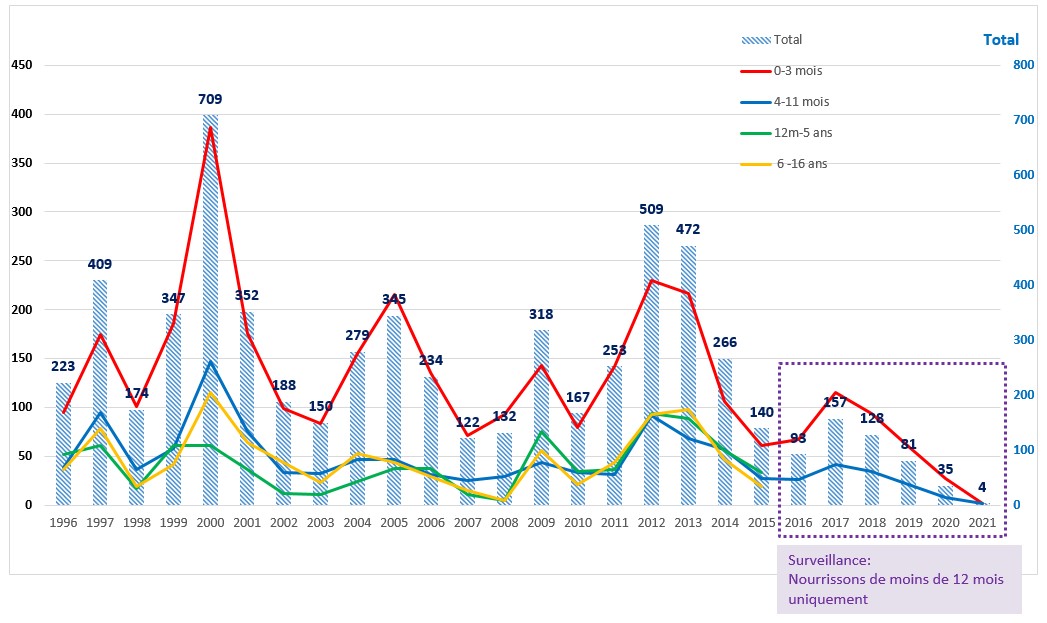
In France, data collected since the start of surveillance show that a total of six epidemic peaks have occurred: in 1997, 2000, 2005, 2009, 2012–2013, and 2017. The years 2020–2021, marked by the COVID-19 pandemic, show some of the lowest numbers of pertussis cases since 1996, particularly among infants. The pertussis surveillance system, RENACOQ, established by Santé publique France, enables the study of epidemiological trends for this vaccine-preventable disease and the characteristics of cases. In each of the 42 participating hospitals, the bacteriology and pediatrics departments contribute to this surveillance.
The number of pertussis cases reported in infants in 2020–2021 is the lowest since 1996
Since the last peak in pertussis in 2017, the number of cases reported annually by the RENACOQ network has continued to decline among infants under 12 months of age: there were 35 cases of pertussis in 2020 and 4 cases in 2021.
These figures have never been this low among this population, which remains the group at highest risk, particularly those aged 0 to 5 months—the age group most affected compared to infants aged 6 to 11 months.
In the general population, the Sentinelles network also reports a low number of pertussis cases in outpatient settings (visits to general practitioners): 11 cases in 2020 and only 1 case in 2021.
Number of hospitalized pertussis cases among children under 17, by age group and reporting year, in France, from 1996 to 2021, data reported by the RENACOQ network.
Link to Sentinelles annual reports: Sentinelles Network > France > Publications (sentiweb.fr)
A Possible Link Between a Very Low Number of Pertussis Cases and the Public Health Measures Implemented During the COVID-19 Pandemic
The exceptional circumstances and public health measures implemented in response to the COVID-19 pandemic likely had a positive impact on the epidemiology of pertussis. Indeed, a low number of reported cases has been observed since the start of the pandemic, and this is not linked to lower participation rates among hospitals in the surveillance network or to reporting bias.
This decline in cases was confirmed by three pertussis surveillance systems: the RENACOQ network (the hospital-based pertussis surveillance network), the Sentinelles network (the research and surveillance network for primary care—general practice and pediatrics—in metropolitan France), and the National Reference Center for Pertussis and Other Bordetellae. The latter confirmed that in 2019, few samples (isolates) were received, reflecting a lull between two natural epidemic cycles of the disease, but also that 2020 was marked by a significant decrease in the number of isolates received by the CNR.
Furthermore, a French study published in 2022, which applied regression models to 8 years of data (2013 to 2020), concluded that interventions aimed at mitigating the COVID-19 pandemic had a positive impact on the epidemiology of pertussis.
The Importance of Pertussis Vaccination for Pregnant Women and Infants
The pertussis vaccination policy is based on several strategies:
mandatory vaccination of infants starting at 2 months of age,
vaccination of people in the infant’s immediate circle, when the mother was not vaccinated during pregnancy or was vaccinated less than one month before delivery,
and various booster shots to be administered during childhood and adulthood.
This vaccination strategy was expanded in 2022 to include vaccination of pregnant women, following the publication of the opinion by the French National Authority for Health (HAS) on April 12, 2022.
This vaccination is recommended starting in the second trimester of pregnancy, with priority given to the period between 20 and 36 weeks of amenorrhea.
Vaccination Information Service
What are vaccines for? How do they work? At what age should children be vaccinated? Vaccination-info-service.fr answers the most frequently asked questions about vaccination. A separate...

Vaccination
thematic dossier
Contagious diseases most often affect children at a very young age. Because children are particularly vulnerable, they are a priority target for vaccination programs.












