Key Statistics on Lyme Disease in France
The number of new cases diagnosed each year has been rising over the past two decades
In 2021, it is estimated that nearly 47,000 cases were diagnosed in primary care, representing an incidence of 71 cases per 100,000 inhabitants in France. Since 2009, the estimated number of Lyme disease cases diagnosed in primary care has fluctuated between 25,000 and 68,530 cases per year. The annual incidence rate fluctuated around an estimated average of 62 cases per 100,000 inhabitants, ranging from 41 per 100,000 inhabitants (2011) to 104 per 100,000 inhabitants (2018) in metropolitan France.
Furthermore, approximately 810 cases are hospitalized for Lyme borreliosis each year. In more than half of these cases, hospitalized patients present with neurological symptoms.
Although cases of Lyme borreliosis are reported every year, the majority are diagnosed in primary care and in hospitals between June and October, which corresponds to the peak tick activity season in France. People over the age of 60 appear to be most affected by the disease, but cases are reported across all age groups.
The Eastern and Central regions are particularly affected
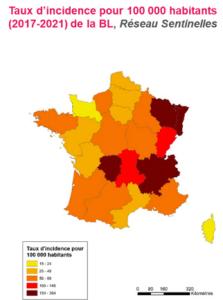
Lyme disease is present throughout mainland France but is unevenly distributed.
The eastern and central regions have the highest incidence rates (>100 cases per 100,000 inhabitants), while the western and southeastern Mediterranean regions have the lowest rates (<50 cases per 100,000 inhabitants).
This distribution is linked, among other factors, to regional characteristics such as vegetation types, varying climates, and interactions between the disease’s hosts and vectors, as well as between vectors and humans.