



Invasive meningococcal infections: a surge in cases in France in 2023
Santé publique France has released its annual surveillance data on invasive meningococcal infections for 2023, which show an increase in the number of reported cases and varying trends across different serogroups and age groups.

Invasive meningococcal infections
thematic dossier
Invasive meningococcal infections are associated with significant morbidity and mortality. Reporting and surveillance of these infections are intended to strengthen prevention efforts against this...
Invasive meningococcal disease (IMD) refers to bacterial infections caused by meningococci. These infections are very serious and can lead to meningitis or sepsis. Santé publique France monitors the epidemiological situation in France and publishes an annual report on this surveillance, which is essential for detecting any unusual trends.
The 2023 report shows a resurgence of cases with a sharp increase in W and Y IIM to levels never seen before, marking significant changes in the epidemiology of IIM following the COVID-19 pandemic. These results identify the age groups most at risk of infection and underscore the importance of achieving high vaccination coverage in the groups targeted by meningococcal vaccination recommendations.
Data from this surveillance were useful for the work of the French National Authority for Health (HAS) on revising the meningococcal vaccination strategy.
An early peak in the number of invasive meningococcal infections during the winter of 2022–2023
After several years of low incidence, the 2022-2023 winter season was marked by an early and very high peak in IIM cases (including 89 cases in December 2022 and 80 cases in January 2023). The monthly number of cases remained at high levels throughout the first half of 2023 before returning to levels comparable to pre-pandemic years starting in the second half of the year.
In 2023, 560 cases of invasive meningococcal disease were reported, representing a 72% increase compared to 2022. Of these, 44% were linked to serogroup B, 29% to serogroup W, and 24% to serogroup Y. Purpura fulminans was reported in 18% of IIM cases (23% for IIM B, 16% for IIM W, and 11% for IIM Y).
Infants and young children remained at the highest risk for IIM B. IIM W affected both infants and adults across different age groups, while IIM Y was more common among older adults but also affected younger adults.
Incidence rates of reported cases varied by region of residence.
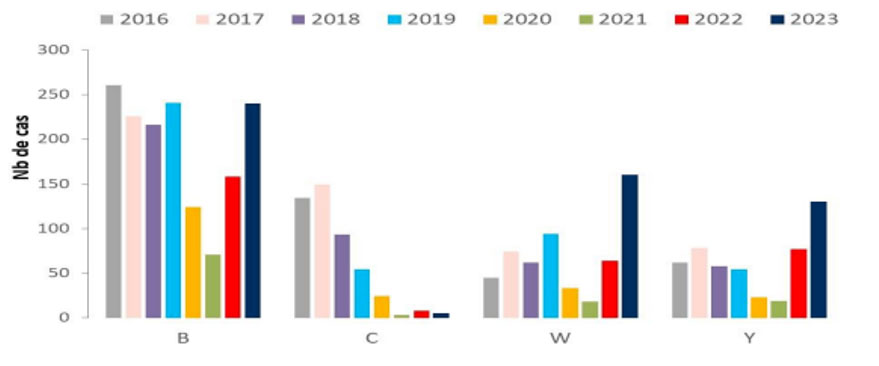
Number of cases of invasive meningococcal disease by major serogroup, France, 2016–2023
Mixed trends for certain types of invasive meningococcal infections
Among the four existing serogroups, IIM B accounts for the highest number of cases with 240 cases in 2023, followed by IIM W (160) and IIM Y (130), while IIM C has become rare (5).
Sharp increase in IIM W and IIM Y to levels never seen before
For serogroups B/W/Y, the number of cases of invasive meningococcal disease rose sharply among adults aged 25 and older, whereas the resurgence in 2022 had initially been observed among young adults aged 15–24. The increase in 2023 was particularly marked among people aged 60 and older. W-serogroup IIMs were associated with a high case-fatality rate (19%, with 31 deaths) compared to other serogroups (7% for B-serogroup IIMs and 8% for Y-serogroup IIMs).
Among infants under 1 year of age and children aged 1 to 4 years, IIM B remained the most common, accounting for nearly 60% of cases but slightly lower than in 2022 (67%), while IIM Y and W accounted for a growing share of cases, with 41% of cases among children under 5 (vs. 30% in 2022). Among those over 15 years of age, IIM W and Y increased with age. Older adults were the most affected by IIM Y.
This post-COVID-19 resurgence could be explained by reduced immunity in the population that was less exposed to meningococci during the pandemic, but also by the return of respiratory viruses (particularly influenza) that may promote invasive bacterial infections. Furthermore, the differing trends by age may reflect a reintroduction of meningococci that initially affected young adults—among whom carriage is more common—followed by transmission to older age groups.
Vaccination and Evolution of the Meningococcal Vaccination Strategy
Vaccination against serogroup C meningococcal infections has been recommended since 2010 for infants and as a catch-up vaccination up to age 24. Vaccination against invasive serogroup B meningococcal infections has been recommended since 2022 for all infants. There are also specific recommendations for at-risk individuals or specific situations.
As part of its review of the meningococcal vaccination strategy and following the latest data published by Santé publique France, the Haute Autorité de Santé has issued several recommendations:
Regarding vaccination against serogroups A, C, W, and Y: mandatory vaccination for all infants under one year of age, replacing the vaccination targeting only serogroup C, according to a two-dose schedule. For adolescents and young adults: a tetravalent vaccine administered as a single dose between the ages of 11 and 14, regardless of whether they have already been vaccinated, as well as catch-up vaccination for those aged 15–24.
Regarding serogroup B: mandatory vaccination for infants under one year of age.
Learn more about: vaccination recommendations from the French National Authority for Health
Learn more

bulletin national
2 May 2024
Invasive meningococcal infections in France in 2023

Vaccination
thematic dossier
Contagious diseases most often affect children at a very young age. Because children are particularly vulnerable, they are a priority target for vaccination programs.
Vaccination Information Service
What are vaccines for? How do they work? At what age should children be vaccinated? Vaccination-info-service.fr answers the most frequently asked questions about vaccination. A separate...












