



Health Status of People with Diabetes in France: Initial Findings from the Entred 3 Study in Metropolitan France
To mark World Diabetes Day on November 14, Santé publique France is releasing the initial findings of the Entred 3 study. Conducted in mainland France in 2019, this study aims to improve our understanding of the health status of people with diabetes in France.
Tobacco Information Service
The tabac-info-service website is open to everyone and offers personalized, effective support to help anyone quit smoking
Every year, diabetes continues to rise and represents a major public health burden. It affects more than 3.6 million people in France and is expected to affect more than 783 million adults worldwide by 2045. The surveillance program developed by Santé publique France produces indicators on the prevalence, severity, and trends of diabetes in France. To mark World Diabetes Day, Santé publique France is publishing the initial results of the Entred 3 study conducted in mainland France in 2019, which describes the characteristics and health status of people with diabetes in France, and is updating the diabetes surveillance indicators for 2021, available as open data on Géodes (prevalence, complications, frequency of recommended follow-up tests). The Agency reminds the public that smoking increases the risk of developing type 2 diabetes and is also a risk factor for major diabetes complications.
Health Status of People with Diabetes in Metropolitan France: Initial Results of the Entred 3 Study

In 2019, Santé publique France, the Health Insurance Fund, the Social Security for the Self-Employed, the National Agency for Medicines and Health Products Safety (ANSM), and the High Authority for Health (HAS) launched the third edition of the national diabetes study Entred to better understand the health status, quality of life, healthcare utilization, and healthcare costs among people treated for diabetes, and to track trends over time. This third edition provides more detailed data on people with type 1 diabetes than previous editions.
A study of more than 3,000 people in mainland France
Data collection via questionnaire took place from March 2019 to October 2020 among randomly selected people with diabetes in mainland France and their doctors. Among those who responded to the survey, 94.1% were classified as having type 2 diabetes (T2D), 5.1% as having type 1 diabetes (T1D), and 0.8% had another type of diabetes or an undetermined type.
Different characteristics and health status depending on the type of diabetes
The published data show that people with T2D were 67.6 years old on average (an increase of 2 years compared to 2007), 55.3% were men (unchanged from 2007), with a median duration of diabetes of 10.7 years. In 70% of cases, their diabetes was discovered following a screening, and in 11.7% of cases, it was discovered due to a complication.
People with T1D were 47 years old on average, 57% were men, and 55.6% had been diagnosed with diabetes for more than 20 years. The socioeconomic status of people with T1D was higher than that of people with T2D (57.6% had completed high school or higher education versus 28.1% of those with T2D), an increase compared to 2007 likely reflecting a generational effect.
Risk factors for complications were common and relatively stable since 2007 among people with T2D (overweight/obesity (80.1%), treated hypertension (77.6%), treated dyslipidemia (63.8%), smoking (13.4%), and high or heavy alcohol consumption (7%)). These risk factors were also common among people with T1D, particularly overweight/obesity (49.9%), smoking (25.3%), and alcohol consumption (11.3%).
Macrovascular complications were more frequently self-reported among people with T2D: coronary complications (18.6%), stroke (7.8%). These proportions were 11.5% and 3.3%, respectively, among people with T1D. Microvascular complications were more frequently reported by people with T1D: vision loss in one eye (3.7%), active or previous plantar neuropathy (12.9%). These proportions were 3.2% and 6.7%, respectively, among people with T2D.
These initial results from Entred 3 confirm that demographic and socioeconomic characteristics vary greatly between T1D and T2D. The slight decrease observed, compared to 2007, in the frequency of microvascular and macrovascular complications self-reported by people with T2D and the high frequency of microvascular complications self-reported by people with T1D will need to be confirmed by in-depth studies, particularly those focusing on information collected from physicians.
Further analyses are also planned to provide insights into quality of life, healthcare utilization, use of new connected devices and tools, acute complications, treatment adherence, and the professional, family, and social impact of diabetes, as well as health literacy...
A description of the health status of people with diabetes living in the overseas departments will also be provided based on data collected from more than 2,300 individuals.
All of this information will help inform public policy regarding guidelines for the prevention, support, and management of people with diabetes.
Learn more

magazines/revues
7 November 2022
Weekly Epidemiological Bulletin, November 8, 2022, No. 22 World Diabetes Day, November 14, 2022
Diabetes Surveillance in 2021: Diabetes-Related Complications Remain Very Common, at Levels Close to Those Observed in 2019
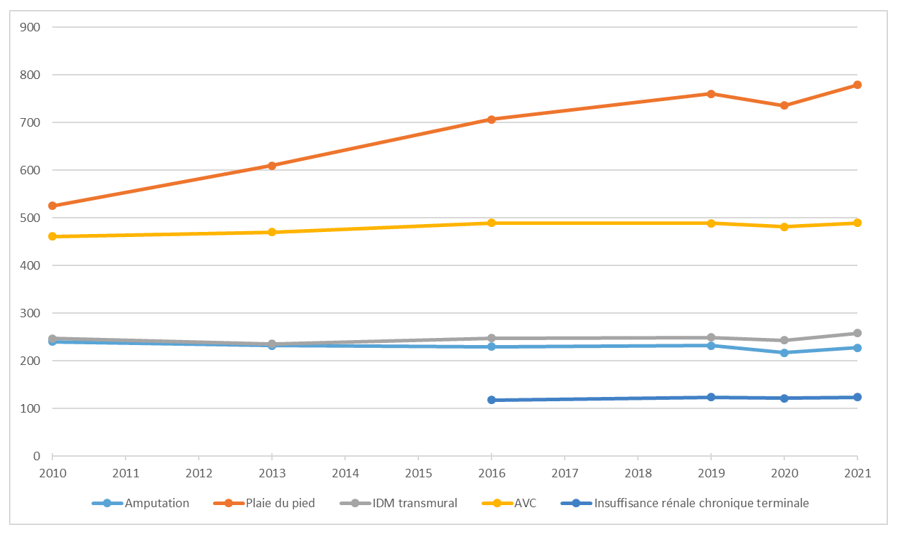
In 2021, hospitalizations for chronic diabetes-related complications rose to a level close to that observed before the health crisis. In fact, in 2020, these hospitalizations had decreased, primarily those for foot ulcers and strokes, whereas over the 2010–2019 period, an increase in these hospitalization rates had been observed.
Trends in the incidence of hospitalizations (per 100,000 people with diabetes) for diabetes-related complications in France between 2010 and 2021
Diabetes Complications: Smoking as a Risk Factor for Mortality
Epidemiological studies show a clear link between smoking (active or passive) and the risk of developing type 2 diabetes (T2D). Smoking increases all-cause mortality as well as the risk of macro- and microangiopathic complications (nephropathy in T2D patients, retinopathy and neuropathy in type 1 diabetics); it contributes to glycemic imbalance and promotes gestational diabetes in women who smoke. The combination of smoking, obesity, and T2D is also responsible for the alarming increase in the incidence of coronary heart disease among women. According to the results of ENTRED 3, smoking rates remain high among people with type 1 and type 2 diabetes.
Preventing smoking among individuals at risk for T2D and promoting smoking cessation among T2D patients are therefore a public health priority, according to a recent expert consensus published by the Francophone Society of Tobacco Control (SFT) and the Francophone Diabetes Society (SFD). Smoking cessation must be combined with enhanced lifestyle and dietary measures, particularly during the first few years of follow-up. Committed to the fight against smoking since its inception, Santé publique France offers numerous tools to help people quit smoking, such as Tabac Info Service, and has also just launched the 7th edition of Mois Sans tabac.
Smoke-Free Month: Launch of the 7th Edition to Encourage Smokers to Join Forces

Every year, this initiative invites smokers to take on a collective challenge to quit smoking for one month. Being smoke-free for a month increases your chances of quitting for good by five times. It’s not too late to sign up and join the movement!
Tabac Info Service, an effective resource for quitting smoking:
the website tabac-info-service.fr
3989, a toll-free phone number
Learn more:
The use of recommended tests for diabetes monitoring has returned to pre-pandemic levels
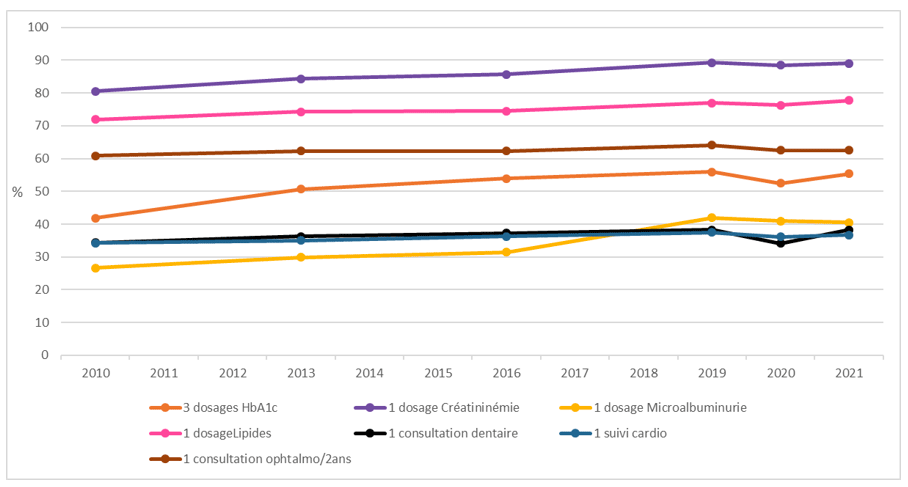
Clinical monitoring of people with diabetes is guided by the care pathway recommendations established by the French National Authority for Health (HAS). In 2020, adherence to all recommended tests had declined modestly. The sharpest decreases were seen in the three HbA1c tests (a marker of glycemic control) and dental visits. In 2021, the use of these two tests increased, returning to the level observed before the health crisis. Only microalbuminuria testing, as well as cardiological and ophthalmological follow-up, have not returned to 2019 levels.
Percentage of recommended annual screenings performed, 2010–2021
Resources to Help Prevent Type 2 Diabetes and Its Complications
Santé Publique France provides the general public with several websites offering health and dietary advice to help prevent type 2 diabetes. These sites promote a varied and balanced diet, regular physical activity, reducing sedentary behavior, as well as limiting alcohol consumption and quitting smoking.
To support healthcare professionals in the prevention of type 2 diabetes, dedicated sections are available on various websites created by Santé publique France:
mangerbouger.fr: professional section
alcool-info-service.fr: professional section

Diabetes
thematic dossier
Diabetes mellitus is a metabolic disorder characterized by chronic hyperglycemia resulting from a deficiency in either insulin secretion, insulin action, or both.
GEODES
Track the trends in diabetes in France and in your region












