



Bronchiolitis: Summary of the 2022–2023 Winter Surveillance
Santé publique France has released the annual report on the 2022–2023 winter surveillance of bronchiolitis in France, which was marked this winter by a very high incidence, particularly in terms of emergency room visits and hospitalizations.

Bronchiolitis
thematic dossier
Acute bronchiolitis is a viral respiratory illness that primarily affects children under the age of 2 during seasonal winter outbreaks.
Bronchiolitis is highly contagious and affects many infants under the age of 2 every winter. Although the risk of hospitalization and death remains low, the infection can be serious in young children. In France, surveillance of bronchiolitis cases in children is conducted by Santé publique France in collaboration with its partners. As part of this effort, the Agency publishes an annual report on cases reported in France. The epidemic context this winter, marked by early circulation of the virus and occurring concurrently with influenza and COVID-19 outbreaks, led the Ministry of Health and Prevention to activate the ORSAN EPI-CLIM Plan to organize the healthcare system’s response and streamline pediatric care.
The 2022–2023 bronchiolitis epidemic was intense and prolonged
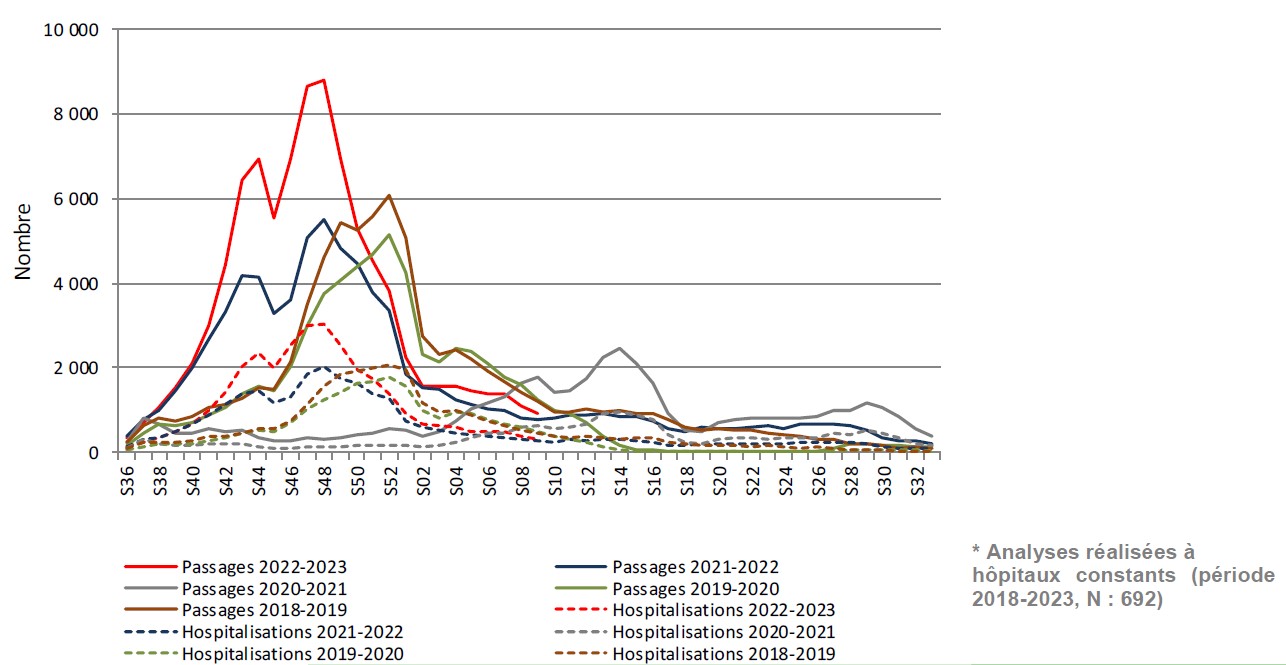
The bronchiolitis epidemic in mainland France began in the first week of October 2022. The peak was reached in week 48 of 2022 (November 28–December 4, 2022), and the epidemic ended in week 3 of 2023 (January 16–22, 2023). As in the previous season, the outbreak began early (6 weeks earlier than the average observed over the 2015–2020 period) and lasted longer (16 weeks vs. 12 weeks on average over the 2015–2020 period).
This season, the outbreak was characterized by very high intensity, nearly twice the average values of reference outbreaks, particularly in terms of emergency department visits and hospitalizations following emergency department visits for bronchiolitis among children under 2 years of age. The proportion of hospitalizations for bronchiolitis among children under 2 years of age following an emergency department visit, however, remained comparable to that of seasons preceding the circulation of SARS-CoV-2 (2015–2020), indicating that the epidemic was not particularly severe.
Key figures to note for the 2022–2023 season:
73,262 emergency room visits (OSCOUR®) for bronchiolitis
26,104 hospitalizations following emergency room visits for bronchiolitis (OSCOUR®)
10,801 SOS Médecins calls for bronchiolitis
Figure - Visits and hospitalizations following emergency department visits for bronchiolitis in mainland France, children under 2 years of age, 2018–2023
Download

bulletin national
19 July 2023
Bronchiolitis Epidemiological Bulletin. Summary of Surveillance Data for 2022–2023.
See also:
Bronchiolitis in the French overseas departments and territories: the Antilles, French Guiana, Mayotte, and Réunion.
Since the emergence of SARS-CoV-2, bronchiolitis outbreaks have changed. The 2020–2021 season was characterized by a delayed outbreak of low intensity. As in many countries, the circulation of RSV was disrupted by the implementation of COVID-19 control measures (lockdowns, preventive measures, social distancing, etc.). The 2021–2022 season, however, saw an early and intense outbreak.
Where do the bronchiolitis surveillance data come from?
Surveillance of bronchiolitis in children under 2 years of age is based on data from outpatient care (SOS Médecins), emergency departments (OSCOUR®), as well as hospital-based virological analyses (RENAL network) and outpatient virological analyses (Sentinelles Network) in collaboration with the National Reference Center (CNR) for Respiratory Infections. This data is then analyzed by Santé publique France.
During the bronchiolitis epidemic season, weekly bulletins on trends in the number of cases in France are produced and published on the website to inform healthcare professionals in particular.
This surveillance also enables Santé publique France to alert health authorities and implement preventive measures to better inform the general public and parents about the steps to take to limit the risk of transmission.
To access our epidemiological bulletins on bronchiolitis:

Winter viruses
thematic dossier
Every year, winter viruses cause outbreaks of the flu, gastroenteritis, and bronchiolitis. Simple preventive measures can reduce the risk of infection.












