


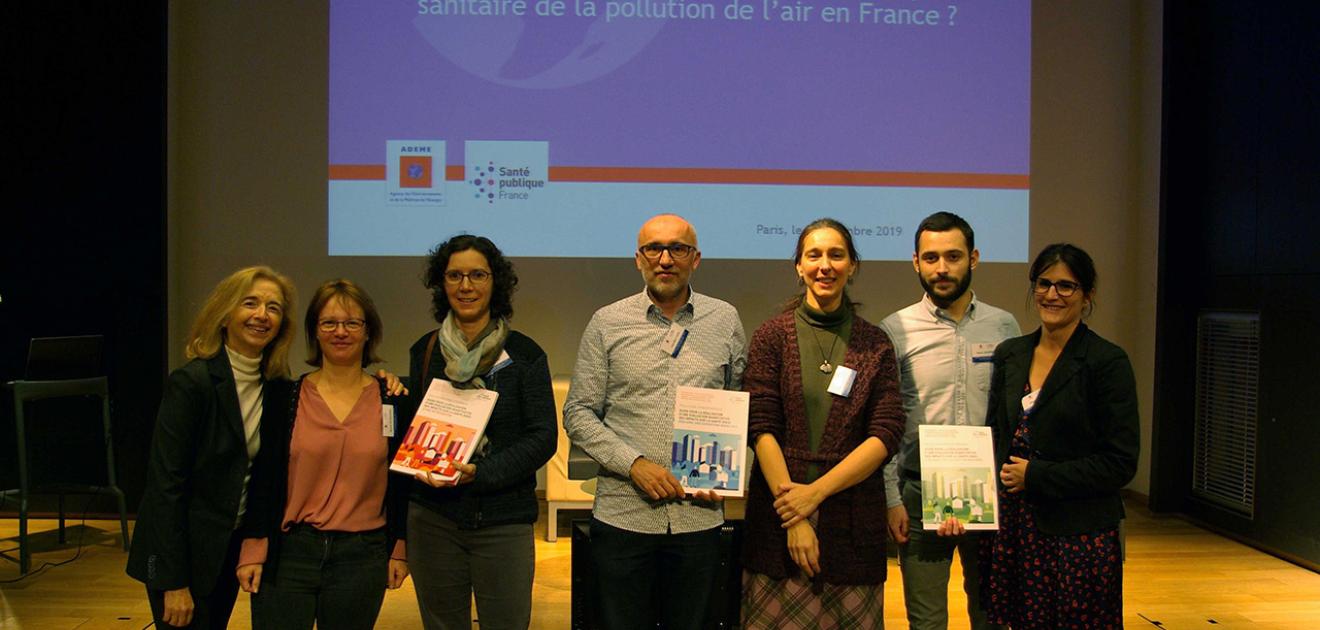
Assessing the Health Impacts of Air Pollution: A Look Back at November 6, 2019
On November 6, 2019, Santé publique France and ADEME hosted a conference titled “Assessing the Health Impact of Air Pollution.” A look back at the event.

Air
thematic dossier
Air pollution affects the entire population. The levels of pollutants found in the atmosphere are linked to health risks, and any reduction in exposure to these pollutants would be beneficial.
The event “Assessing the Health Impact of Air Pollution” was attended by Maria Neira, Director of the Department of Public Health, Social and Environmental Determinants of Health at the World Health Organization (WHO), as well as a delegation from WHO Europe, Arnaud Leroy, President of ADEME, Olivier David from the Ministry for Ecological and Solidarity Transition, and Elisabeth Toutut-Picard, President of the Health and Environment Group.
More than 150 people from local authorities, government agencies, AASQAs, ORSs, consulting firms, and other entities registered for the event
Geneviève Chêne, Director General of Santé publique France, emphasized in her opening remarks the value of quantitative health impact assessments (EQIS) in supporting public policies on air quality and in fostering ownership of air pollution issues among various stakeholders.
Session 1 – Air Pollution and Health: An International and European Overview
Maria Neira spoke about the role of the WHO and the need to place health at the center of environmental and political decision-making processes to drive action. She also addressed the need for urgent measures to tackle the problem of air pollution and climate change. Dorota Jarosinska provided an overview of the work of the WHO European Centre for Environment and Health, including the update of the WHO’s global air quality guidelines. Francesco Forastiere then presented the latest findings on the links between outdoor air pollution and health, highlighting the major role of pollution in the development of chronic diseases. Finally, Michal Krzyzanowski discussed the development of the EQIS methodology for air pollution in Europe, highlighting the potential of EQIS, which, in addition to supporting public policy, provides a framework for close collaboration between epidemiologists and atmospheric scientists to promote prevention.
Session 2 – What tools are available to assess the health impacts of air pollution in France?
This session addressed new tools and guidelines for quantifying the health impacts and benefits of air quality initiatives in France. Arnaud Leroy emphasized the key role of local authorities in promoting air quality and highlighted ADEME’s efforts to support stakeholders at the local level. In this context, he presented the joint initiative by ADEME and Santé publique France with local authorities willing to test, in its first French version, the AirQ+ software developed by the WHO to conduct EQIS in a given region. Sylvia Medina then presented Santé publique France’s efforts in developing EQIS since the creation of the Air and Health Monitoring Program, with the most recent initiative being the production of new EQIS methodological guides for local stakeholders. Subsequently, Pierpaolo Mudu presented the AirQ+ tool and demonstrated its use, and two local authorities, Douaisis and Caen La Mer, shared their experiences using AirQ+.
Olivier David reiterated the driving role of EQIS. He highlighted the role of local authorities in implementing air quality initiatives and the need for tools made available to them, notably AirQ+ and the guides, as well as the strategic air quality maps developed by the AASQAs and the new ATMO index. He thanked the WHO European Office for developing the tool, as well as Santé publique France and ADEME, particularly for the new EQIS guide presented. He outlined the main actions of the PREPA and also emphasized the need to continue supporting local authorities in adopting the tool within the current context of litigation, and he highlighted the measures implemented by the government.
Elisabeth Toutut-Picard put the day’s key takeaways into perspective in relation to the work of PNSE3 and 4, commending the cross-cutting approach and the sharing of the actions presented, as well as the need to adapt the tools to the needs of small municipalities.
Learn more
Program for November 6, 2019: “Assessing the Health Impact of Air Pollution”
Testing AIRQ+, a tool for quantitatively assessing the health impacts of air pollution












