



Antibiotic Use and the Prevention of Antibiotic Resistance in France in 2021: Where Do We Stand?
To mark World Antimicrobial Awareness Week and European Antibiotic Awareness Day, Santé publique France and its partners are releasing annual data on antibiotic use and resistance, along with recommendations for future action based on a “One Health” approach.

Antibiotic resistance
thematic dossier
Antibiotic resistance renders one or more antibiotics ineffective against a bacterial infection. This phenomenon can make it difficult, or even impossible, to treat certain infections.
Every year, on the occasion of European Antibiotic Awareness Day on November 18, stakeholders committed to preventing bacterial resistance to antibiotics (or antibiotic resistance) publish a report on the current state of antibiotic use and antibiotic resistance in human and animal health, as well as in the environment, in France.
This summary puts antibiotic consumption in human and animal health into perspective and tracks its trends. Thus, we observe a steady decline in prescriptions in human health alongside a reduction in animals’ exposure to antibiotics. In both human and animal health, key indicators of antibiotic consumption are on the decline.
Regarding bacterial resistance to antibiotics, the common indicator of resistance of Escherichia coli strains to cephalosporins is decreasing in human health—in urban areas, in long-term care facilities, and in healthcare settings—as well as in animal health.
Actions to prevent bacterial resistance to antibiotics are developed according to the “One Health” approach. The 2022–2025 national strategy for infection prevention and antibiotic resistance in human health further strengthens actions for the proper use of antibiotics, as well as infection prevention and control. It defines priority indicators and target values for human health to be achieved by 2025.
Over the years, successes have been recorded—more notably in animal health—but these must be sustained. Initiatives are also being developed in the environmental sector.
Mapping all antibiotic resistance surveillance systems, analyzing the barriers and drivers for establishing these collaborations, and evaluating them have identified areas for improvement with a view toward integrated “One Health” surveillance. A dozen recommendations put forward by ANSES and Santé publique France have thus been issued and will be published in 2023.
Download

rapport/synthèse
6 June 2023
Preventing Antibiotic Resistance: A "One Health" Approach
Two reports are also being released today on antibiotic use and bacterial resistance in healthcare facilities (Spares Mission), as well as in outpatient care and long-term care facilities (Primo Mission). These findings complement recent data on antibiotic use in the outpatient sector for the period 2011–2021.
Download:
Antibiotic Use and Bacterial Antibiotic Resistance in France: Key Findings for 2021
In human healthcare, 93% of antibiotics were dispensed in private practice and 7% in healthcare facilities; among those dispensed in private practice, approximately 15% were based on a hospital prescription.
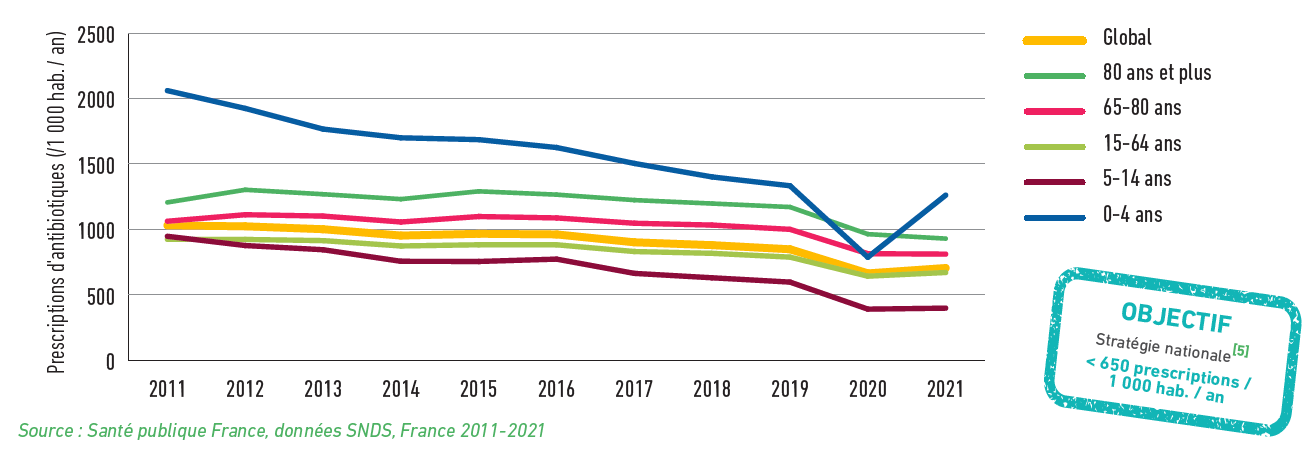
Antibiotic consumption in the outpatient sector saw a 5% increase in Defined Daily Doses (DDD) and a 6% increase in the number of prescriptions in 2021 compared to 2020, coinciding with the gradual lifting of public health measures, the resurgence of common winter infections, and an uptick in medical consultations.
France remains among the European countries with the highest antibiotic consumption (4th place since 2018) according to ESAC-Net surveillance data. It is therefore essential to continue promoting and expanding initiatives to ensure the proper use of antibiotics among all stakeholders: citizens, patients, human and animal healthcare professionals, and policymakers.
Bacterial resistance in Enterobacteriaceae, particularly in Escherichia coli, appears to be declining in 2021 with regard to resistance to third-generation cephalosporins, but the trend has fluctuated over several years. This underscores the importance of maintaining a high level of prevention against resistant bacterial infections in the three healthcare sectors: community care, long-term care facilities (Ehpad), and healthcare institutions (ES).
Antimicrobial Resistance in Human Health: What Is the Current Situation Following the COVID-19 Pandemic?
After a decline in 2020, antibiotic prescriptions in community practice are on the rise
Despite a steady decline in antibiotic consumption in primary care over the past 10 years, France remains the fourth-highest consumer in Europe, behind Greece, Romania, and Bulgaria.
Following a sharp decline in prescriptions and consumption in 2020, coinciding with measures to manage the COVID-19 pandemic (lockdowns, adoption of preventive measures, and a drop in medical consultations), 2021 saw a resurgence of common winter illnesses, medical consultations, and antibiotic prescriptions, particularly in the fourth quarter.
As is customary, approximately 80% of antibiotic prescriptions were issued in outpatient settings, with a peak at the end of the year due to the return of winter illnesses.
This resurgence affects all age groups up to age 64, but the most significant increase in antibiotic prescriptions and consumption is observed among children aged 0 to 4: they have risen to nearly the same level as in 2019, before the COVID-19 pandemic.
Fig. - Antibiotic prescriptions by age group and for the entire population. France, human health, 2011–2021
But antibiotic use continued to decline in 2021 among residents of nursing homes without an on-site pharmacy
For the first time, data regarding residents in nursing homes without an on-site pharmacy (PUI) who are eligible for individual reimbursement by the Health Insurance program (consumption and length of stay) have been extracted. This data enabled the production of indicators specific to residents in nursing homes without an on-site pharmacy (84% in 2015) for the period 2015–2021.
Between 2015 and 2021, antibiotic consumption in nursing homes without an in-house pharmacy trended downward, and, as in the community sector, a very sharp decrease was observed in 2020.
Consumption continued to decline in 2021 (10.3% in daily doses and -9.6% in prescriptions). The protocols put in place to ensure the protection of residents were only relaxed in May and then in August 2021, and all preventive measures continued to be followed, particularly the wearing of masks indoors.
Antibiotic consumption in healthcare facilities: an increase in broad-spectrum antibiotics
In healthcare facilities (HCFs), where nearly 20% of antibiotics are prescribed, antibiotic consumption (expressed in DDDs) as measured by the SPARES survey is lower than in 2020, with notably lower consumption of macrolides and fluoroquinolones. However, the use of other antibiotics considered broad-spectrum by the European Centre for Disease Prevention and Control (ECDC)—such as third-generation cephalosporins, carbapenems, and antibiotics active against methicillin-resistant staphylococci—has increased.
Antibiotic-resistant Enterobacteriaceae Infections: Vigilance Must Be Maintained
Regarding Enterobacteriaceae found in urinary tract infections among community-dwelling patients and those residing in long-term care facilities, the results reported by the Primo mission are mixed.
In home-based patients
For E. coli strains isolated from urine samples in patients living at home, resistance to third-generation cephalosporins has been decreasing since 2015, but resistance to fluoroquinolones has been increasing since 2019. In 2021, these trends continue.
Among nursing home residents
For E. coli strains isolated from urine samples in nursing home residents, resistance is generally higher than in patients living at home. Resistance to third-generation cephalosporins has fluctuated since 2011. In 2021, it is decreasing compared to 2020 and 2019, but remains higher than in 2011. Resistance to fluoroquinolones had been decreasing to varying degrees since 2013. In 2021, it is increasing.
In healthcare facilities
In 2021, antibiotic resistance measured by the SPARES survey, particularly among Enterobacteriaceae, returned to a level similar to that of 2019. Nevertheless, the number of external reports of infections/colonizations caused by emerging highly resistant bacteria (EHRB) remains lower than it was in 2019, raising concerns about underreporting and a decline in screening efforts during the pandemic, with a risk of these bacteria spreading quietly within hospitals.

Promise
This year, Santé publique France is joining Promise. Promise is a meta-network currently being established, bringing together professionals working to combat antibiotic resistance in human and animal health and the environment. Its goal is to foster synergies by creating a "One Health" community that enables academic networks and teams to share best practices and expertise, and to coordinate their efforts.
Preventing Bacterial Antibiotic Resistance: Tools and Resources Available to the General Public and Healthcare Professionals
In human health, a range of tools is available to healthcare professionals for infection prevention and the appropriate use of antibiotics. As part of the 2022–2025 national strategy for infection prevention and the fight against antibiotic resistance, Santé publique France, in collaboration with the French Health Insurance System, has launched the campaign “Antibiotics: Treating Yourself Right Means Using Them Right.” Its goal: to remind the public that antibiotics are effective only against bacterial infections and should be taken only under medical supervision.
In animal health, prevention efforts are driven by the Écoantibio plans, which combine regulatory changes with the development of tools and initiatives to support professionals’ commitment. The European Joint Action on Antimicrobial Resistance and Healthcare-Associated Infections (EU-JAMRAI) and the establishment of the Promise meta-network led by Inserm support the development of “One Health” initiatives.
Examples of available support tools
Among the many tools available, the proper use of antibiotics is supported by prescribing aids such as “Antibioclic,” “Antibiogarde,” and “ePopi.”
The “Antibio’Malin” thematic module aims to provide information and practical advice for everyone on infections, the proper use of antibiotics, and antibiotic resistance. It is available on the Santé.fr website.
The e-Bug educational project offers fun, free tools to facilitate teaching about microorganisms, transmission, prevention, and treatment of infections, and antibiotic resistance to students through high school.
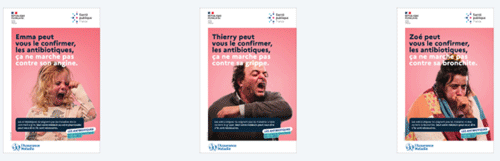
Prevention posters that can be downloaded or ordered are also available.
Track trends in antibiotic resistance indicators with our Géodes observatory
Indicators on antibiotic use and antibiotic resistance in community settings and healthcare facilities are available via our Géodes platform. They enable better monitoring and understanding of trends in antibiotic resistance indicators in France through interactive, region-specific visualizations.
Access our indicators
See also
Learn more about antibiotic resistance in France
Santé publique France: Special Report on Antibiotic Resistance
RéPias (Network for the Prevention of Healthcare-Associated Infections)
ANSES:
High Authority for Health: overview of the HAS’s main publications on Antibiotic Resistance
Health Insurance: via a search using the term “Antibiotics”
Inserm:
Ministry of Solidarity and Health:
Ministry of Agriculture and Food: thematic dossier “Ecoantibio”
Ministry of Ecological and Solidarity Transition: thematic dossier “Antibiotic Resistance”
Learn more about antibiotic resistance in Europe and around the world
Links to the websites of organizations and institutions involved in the fight against and prevention of antibiotic resistance in Europe and around the world.
European Antibiotic Awareness Day (European Centre for Disease Prevention and Control)
World Antimicrobial Awareness Week (World Health Organization):












