


Summary of Legionnaires' disease cases reported in France in 2018
Number of reported cases and incidence
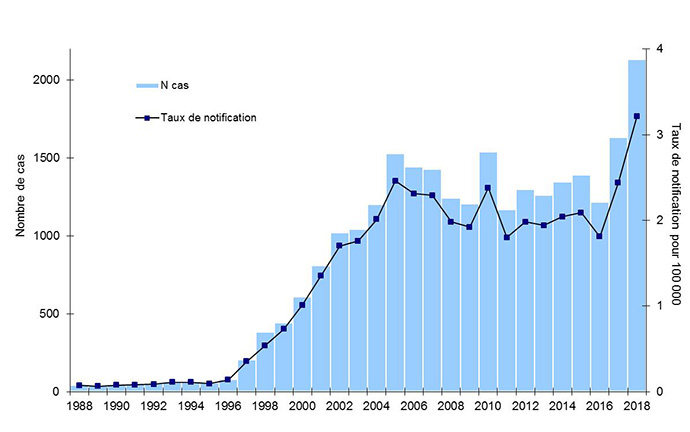
In 2018, 2,133 cases of Legionnaires’ disease were reported in France through the mandatory reporting system. Of these, 20 cases involved residents of the French overseas departments (15 in Réunion, 3 in Guadeloupe, 1 in Martinique, and 1 in French Guiana), and 26 involved foreign nationals diagnosed in France. The incidence rate of reported cases of Legionnaires’ disease in mainland France was 3.2 per 100,000 inhabitants.
The number of Legionnaires’ disease cases reported in 2018 was significantly higher than in 2017 (+31%), a year in which 1,630 cases were reported (incidence of 2.4 per 100,000 inhabitants) (Figure 1). The upward trend observed in 2017 continued in 2018, with a record number of cases since surveillance began in 1988.
Figure 1. Trends in the annual number and incidence rate of reported cases of Legionnaires’ disease in France, 1988–2018.
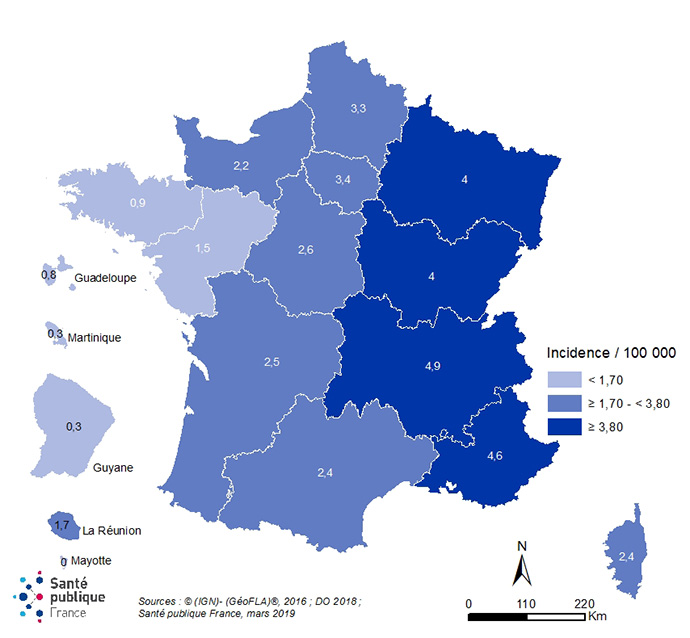
The west-to-east geographic gradient in the incidence rate of reported cases of legionellosis was pronounced, as observed in previous years, with the incidence ranging from 0.9 per 100,000 inhabitants in Brittany to 4.9 per 100,000 inhabitants in Auvergne-Rhône-Alpes (Figure 2).The incidence rate of reported cases in Réunion is 1.7 per 100,000, in Guadeloupe 0.8 per 100,000 inhabitants, and 0.3 in Martinique and French Guiana.
Figure 2. Distribution of the age-standardized incidence rate* of Legionnaires' disease by region of residence in mainland France, 2018
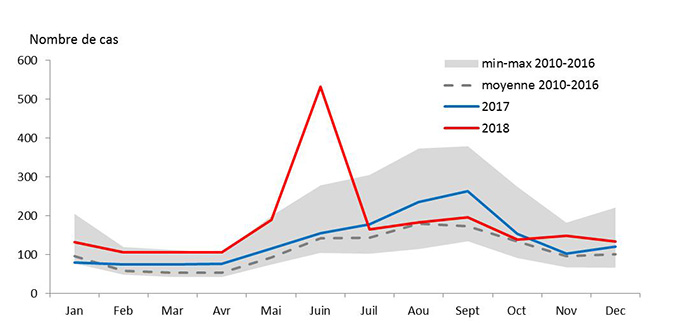
The monthly number of cases exceeded the monthly average of reported cases from 2010 to 2016 and was higher than the number observed in the first half of 2017, as well as in November and December. This increase was particularly significant in June, with 21% of the cases for the year 2018 reported in just three weeks (weeks 23–25) (Figure 3). The increase was observed in nearly all metropolitan regions, with the exception of Brittany, and was particularly pronounced in Île-de-France, Auvergne-Rhône-Alpes, and to a lesser extent in Centre-Val de Loire, Nouvelle-Aquitaine, Pays-de-la-Loire, and Provence-Alpes-Côte d’Azur.
Figure 3. Monthly number of reported cases of Legionnaires' disease in France by onset date, 2010–2018.
Case characteristics
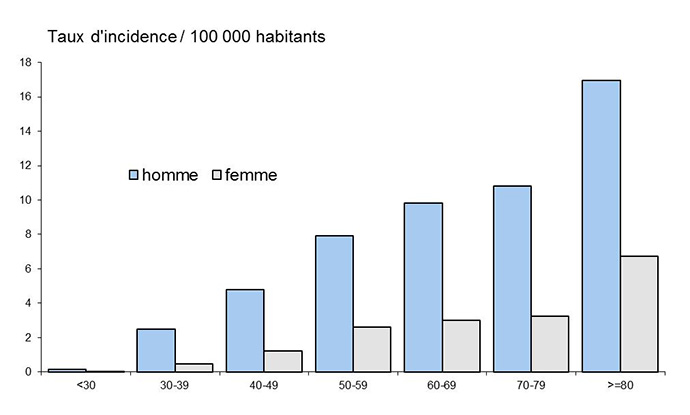
The median age of cases was 64 years [min-max: 15–100 years], and the male-to-female ratio was 2.7 (1,551 men and 582 women). Incidence increased with age, and the highest incidence rates were observed among people over 80 years of age (10.4 per 100,000) (Figure 4). Only 34 cases (out of 2,133 cases, 1.6%) were not hospitalized.
Figure 4. Incidence rates by age group and sex for cases of Legionnaires' disease reported in France in 2018.
Of the 2,133 cases, 73% had at least one known risk factor (Table 1). In 34% of cases, smoking was the only risk factor (10% had an additional risk factor).
Table 1. Frequency of risk factors for reported cases of Legionnaires' disease in France, 2016–2018
| 2016 (1,218) |
2017 (1,630) |
2018 (2,133) |
||||
|---|---|---|---|---|---|---|
| Contributing factors* | N | % | N | % | N | % |
| Cancer / blood disorder | 156 | 13 | 171 | 10 | 225 | 11 |
| Corticosteroid therapy / immunosuppressants | 136 | 11 | 168 | 10 | 195 | 9 |
| Diabetes | 223 | 18 | 303 | 19 | 391 | 18 |
| Smoking | 533 | 44 | 640 | 39 | 943 | 44 |
| Others | 213 | 17 | 300 | 18 | 376 | 18 |
| At least one factor | 938 | 77 | 1,191 | 73 | 1,561 | 73 |
*not mutually exclusive
The disease progression was known for 97% of cases (2,075/2,133), and the case fatality rate (167 deaths) was comparable to that observed in 2017 (8.0% versus 8.9%).
The median time between the onset of initial clinical symptoms and the date of notification to the Regional Health Agency (ARS) was 6 days (interquartile range [4–8]); 84% of cases were reported within 10 days of the onset of their first clinical signs, and 95% within 20 days. These annual indicators have remained stable since 2010.
Microbiological Information
Of the 2,133 cases, 2,094 (98%) were confirmed cases, and detection of soluble urinary antigens was the primary diagnostic method used (2,048 cases, 96%). Genomic amplification (via Polymerase Chain Reaction—PCR) was positive in 169 cases (8%), and for 39 (1.8%) of these, PCR was the sole biological diagnostic method. The proportion of cases diagnosed by PCR has not increased in recent years (31 cases, 1.9% in 2017). A few cases were diagnosed solely by culture (13 cases) or by serology (8 cases) (Figure 5).
The majority of Legionnaires’ disease cases were caused by Legionella pneumophila serogroup 1 (Lp1) (2,065/2,133).
Figure 5. Distribution of diagnostic methods* for cases of Legionnaires' disease, France, 1988–2018
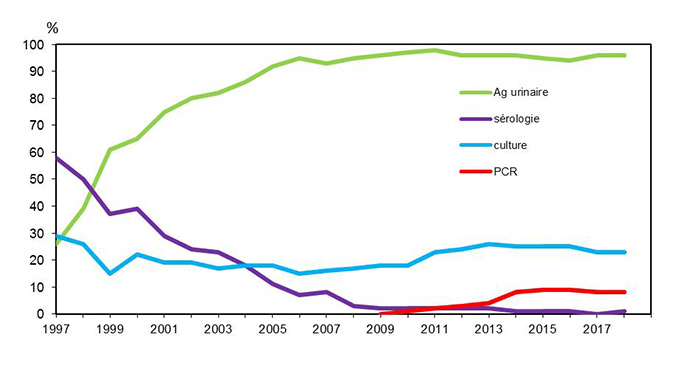
In 22.9% of cases (n=489), a strain was isolated; this percentage was comparable to that of 2017 (23.1%). The majority (478/489, 98%) of the isolated strains were of the species Legionella pneumophila, including 456 from serogroup Lp1 and 22 from other serogroups. All these strains were analyzed using various molecular methods depending on the context (sequence-based typing or whole-genome sequencing (WGS)) at the National Legionella Reference Center.
Among the 482 cases for which a sequence type (ST) was available, 59% were associated with 11 STs: ST1, ST9, ST20, ST23, ST47, ST62, ST146, ST259, ST224, and ST70; the most prevalent were ST23 (76 cases, or 16%), ST1 (37 cases, or 8%), and ST47 (35 cases, or 7%). It should be noted that in the absence of strain isolation, a complete ST could be determined directly from a respiratory specimen for 4 cases (10 cases in 2017).
For 62 cases (13%), the human strain could be compared to environmental strains isolated from one or more locations frequented by the patient, and for 43 of the 63 (68%) comparisons (1 case with 2 comparisons), the STs of the clinical and environmental strains were found to be identical. Among these cases, environmental and microbiological investigations determined that the potable water systems were the most likely source of contamination in 12 healthcare facilities, 11 homes, 5 tourism establishments, 4 nursing homes, and 11 other facilities (swimming pools, stadiums, etc.). It should be noted that the results of the 10 comparisons involving cooling towers revealed different STs for clinical and environmental strains.
Risk Exposures
Risk exposure during the incubation period (2–10 days) was reported for 724 cases, a lower proportion than in 2017 (34% versus 39%, p<0.002) (Table 2). The proportion of cases that had stayed in a hospital during the incubation period in 2018 was lower than in 2017 (5% versus 7%, p=0.01). Among these cases, 54% (60/111) were classified as definitely linked to the hospital stay (had stayed throughout the presumed exposure period). The most frequently reported mode of exposure was travel (387 cases, or 18%). Among these cases, 273 cases met the reporting criteria of the European Legionnaires’ Disease Surveillance Network (ELDSNet) and were reported at the European level: the majority (78%) of them had stayed in hotels or campgrounds, while 22% had stayed in vacation rentals, guesthouses, or accommodations booked online. Of the 387 cases for which travel history was reported, most had traveled within France (248/387, or 65%) and 18% within Europe. In the “other exposures” category, 10 patients were using a continuous positive airway pressure (CPAP) device for sleep apnea (8 cases in 2017).
Table 2. Risk exposures among cases of Legionnaires’ disease occurring in France, 2016–2018
| Exposures* | 2016 (1,218) |
2017 (1,630) |
2018 (2,133) |
|||
|---|---|---|---|---|---|---|
| n | % | n | % | n | % | |
| Hospital | 84 | 7 | 118 | 7 | 111 | 5 |
| Retirement home | 54 | 4 | 87 | 5 | 75 | 4 |
| Spa | 14 | 1 | 13 | 1 | 6 | <1 |
| Travel | 219 | 18 | 299 | 18 | 387 | 18 |
| Campground hotel | 141 | 12 | 189 | 11 | 234 | 11 |
| Temporary residence a | 36 | 3 | 83 | 5 | 86 | 4 |
| Other types of travel b* | 42 | 3 | 27 | 2 | 67 | 3 |
| Other c | 89 | 7 | 116 | 8 | 145 | 7 |
| Total cases with at least one exposure | 460 | 38 | 633 | 39 | 724 | 34 |
* Relative to the total number of cases
a Rental property, bed-and-breakfast, vacation rental, second home, staying with friends or family,
b Location and type of housing not specified
c Public facilities (swimming pool, stadium, etc.), occupational exposure, sleep apnea device, etc.
In 2018, the European ELDSNet network reported 62 additional cases to Santé publique France, in addition to those reported through mandatory reporting. These were cases occurring among foreign nationals who had stayed at a tourist facility in France within 10 days prior to the onset of symptoms and were diagnosed in a foreign country.
In total, based on notifications of French and foreign cases, 248 French establishments were reported by ELDSNet (234 in 2017), 219 for isolated cases and 29 for cluster cases (defined by ELDSNet as at least two cases having stayed in the same establishment over a two-year period). In these 29 facilities, an investigation involving water samples from the potable water system revealed the presence of Legionella above the regulatory threshold in 43% (12/28) of them.
In 2018, several investigations of clustered cases over time and space were conducted by the ARS in collaboration with the regional units of Santé publique France, but they did not identify any common sources of contamination. Among the 6 investigations reported to national health authorities: one investigation concerned recurring cases, dating back to 2013, linked to a stay at a hospital in Alsace; one involved 4 community cases in a town in Ardèche; and 4 were related to an unusual increase in cases: one involved 8 cases occurring between January and April on Réunion Island, and the other 3 occurred during the peak in June in Auvergne-Rhône-Alpes (2 independent situations) and in Île-de-France.
During the peak in reporting observed in June 2018 (weeks 23 to 25), during which 21% (n=441) of annual cases were reported, the characteristics of the cases differed from those typically described. Compared with other cases occurring outside the peak in 2018, multivariate analysis showed that cases during the peak were more often men (83% versus 70%, p<0.001), they were younger (mean age of 60 years versus 65 years, p=0.002) with more risk factors, primarily smoking alone (48% versus 31%, p=0.001), and most often they were community-acquired cases without specific exposure (74% versus 64%, p=0.002). This increase in cases was observed in the majority of regions. The regions most affected were Auvergne-Rhône-Alpes and Île-de-France, where several clusters of cases were investigated without identifying a common link between the cases (different clinical strains and no common source of infection).
Discussion - Conclusion
In 2018, the number of Legionnaires’ disease cases reported to Santé publique France was significantly higher than in 2017 (+31%) and much higher than in 2016 (+75%). The incidence rate of reported cases in metropolitan France (3.2/100,000) reached an all-time high; the highest rates were those of 2005 at 2.5/100,000 and 2017 at 2.4/100,000 inhabitants. This rate is significantly higher than the European reporting rate, which was 2.2/100,000 in 2018. However, six European countries have a higher reporting rate than France, including Slovenia (7.7/100,000), which has the highest rate; Italy, which recorded the most cases (2,962 cases: 4.9/100,000); and Spain with 1,513 cases (3.3/100,000) [2]. The increase in France is mainly due to the surge in cases observed in June, during which 21% of the 2018 cases occurred. This one-time increase in cases was observed in 2018 only in France. During this period, no changes in diagnostic testing practices were observed, and the results of diagnostic confirmations by the CNR did not detect any changes in test characteristics (sensitivity, specificity). No predominance of a particular strain type was identified during the peak. No new types of facilities or industrial practices that could be the source of contaminated water aerosol dispersion were identified.
One hypothesis to explain this increase is the influence of meteorological factors on the occurrence of Legionnaires’ disease cases, particularly temperature, precipitation, and humidity, which, according to various studies conducted in recent years, appear to be key variables in the survival and dispersal of Legionella in the environment. The multifactorial study conducted by Santé publique France on French data from 2008 to 2015, which included meteorological factors, showed that humidity and temperature are linked to the occurrence of Legionnaires’ disease cases but do not explain the west-to-east gradient in reporting rates observed for many years in France [3]. Similar studies using data from 2008–2018 are currently underway to document the possible influence of meteorological factors on the increase in cases observed in June 2018.
Analysis of the characteristics of all Legionnaires’ disease cases occurring in 2018 shows results comparable to those of previous years: the majority of cases present known risk factors, whether age or a predisposing factor for Legionnaires’ disease. No cases in children under the age of 15 have been reported nationally since 2015. The proportion of cases for which risk exposure was documented is lower than in 2017. This observation is likely due to the characteristics of the cases occurring in June 2018, the majority of which did not report specific exposure. However, the proportion of exposures related to travel remains comparable to previous years.
The percentage of strains isolated since 2011 has remained stable, and the proportion of PCR-based diagnoses has not increased in recent years. It is important to promote PCR-based diagnosis, which allows for the identification of Legionnaires’ disease cases not caused by serogroup Lp1 and therefore not detected by urinary antigen tests—which are currently the most widely used method for diagnosing Legionnaires’ disease.
Comparative results between clinical and environmental strains showed that the sources of contamination for the investigated cases were water systems in public establishments and residential water systems. Further studies could be conducted to explore the potential role of household contamination in the sources of infection for these cases, particularly for sporadic cases, which account for the majority of cases.
None of the investigations into clusters of cases that were conducted identified a common source of contamination. During the peak in June 2018, the STs of the cases were found to be different within each cluster investigation. These findings support the notion of sporadic cases occurring concurrently. In any case, all suspected clusters must be investigated methodically and without delay to identify any potential source of contamination that could be responsible for multiple cases. It is therefore essential to maintain the responsiveness of all local partners to conduct these investigations as quickly as possible and to continue promoting the systematic collection of respiratory specimens, in order to obtain strains that allow for the documentation of clustered cases and, through comparison with environmental strains, to identify probable sources of contamination.
[1] Summary of Legionnaires’ disease cases in France in 2017
[2] European Centre for Disease Prevention and Control. Surveillance atlas of infectious diseases–Legionnaires’ disease. [Internet]. Stockholm: ECDC; 2018.
[3] Camille Pelat, Christine Campese, Daniel Lévy-Bruhl, Didier Che. Spatiotemporal disparities in Legionnaires’ disease incidence in France: what role does climate play? ESCMID Study Group for Legionella Infections (ESGLI) 2018 Conference, August 28–30, Lyon, France
Surveillance protocols and all epidemiological data are available on the Santé publique France website












