CoviPrev: Detailed Results for Waves 1–15 (March 23–September 23, 2020)
Find the detailed results of the first rounds of surveys on mental health and the adoption of preventive measures.
CoviPrev Survey
Everything you need to know about the survey and the latest results
Mental health
The results presented cover the following rounds: Round 1 (March 23–25), Round 2 (March 30–April 1), Round 3 (April 14–16), Round 4 (April 20–22), Round 5 (April 28–30), Round 6 (May 4–6), wave 7 (May 13–15), wave 8 (May 18–20), wave 9 (May 27–29), wave 10 (June 8–10), wave 11 (June 22–24), wave 12 (July 6–8) and wave 13 (July 20–22), wave 14 (August 24–26), wave 15 (September 21–23)
The mental health of the French population, which deteriorated at the start of the lockdown, has since improved significantly across all indicators except for sleep problems experienced over the past 8 days. These have generally increased since the start of lockdown (+4.5 points) and remain at a high level when compared to national prevalence data observed in the Santé publique France Barometer. For all indicators measured, no change was observed compared to the previous survey wave (Wave 14: August 24–26).
Changes in mental health indicators:
Current life satisfaction has gradually improved since the second week of lockdown (wave 2), with a significant improvement observed when lockdown restrictions were lifted (wave 7). It has since stabilized.
Anxiety levels decreased significantly during the first weeks of lockdown (waves 2 and 3). They have since remained stable.
Depressive symptoms, after an increase observed between waves 3 and 4, decreased significantly following the lifting of lockdown (wave 7). Prevalence continued to decrease significantly between waves 7 and 15.
Sleep problems, despite some fluctuations, remained at a high level (over 60% vs. 49% in the 2017 Santé publique France Barometer) and changed significantly between waves 2 and 15.
Population profiles with poorer mental health:
Individuals reporting being in a very difficult financial situation or having a history of psychological disorders for the three indicators analyzed (anxiety, depression, sleep problems).
Women, those aged 18–34, and the economically inactive for anxiety symptoms.
Women, those aged 18–24, the economically inactive, and lower socioeconomic categories (CSP-) for sleep problems.
People aged 50–64, lower socioeconomic categories (CSP-), and those at risk of developing severe COVID-19 for depressive symptoms.
Cognitive determinants (perception of the epidemic situation and preventive measures) associated with poorer mental health:
Perceiving COVID-19 as serious for all three indicators (anxiety, depression, sleep problems).
Feeling vulnerable to the risk of SARS-CoV-2 infection for anxiety and depression.
Perceiving prevention measures as ineffective for depressive symptoms.
Conclusion:
The data confirm the impact of economic factors on mental health and underscore the importance of supporting, particularly during this pandemic, individuals with psychological vulnerability (those reporting a history of psychological disorders).
To limit the impact of the pandemic on mental health while encouraging the continuation of preventive behaviors, our data suggest communicating about the effectiveness of measures rather than the perceived severity of COVID-19. The latter is strongly associated with anxiety, depression, and sleep problems, and is not associated with the adoption of preventive measures.
Prevalence and Trends by Indicator
- Prevalence and trends in mental health indicators during the COVID-19 pandemic (% ; weighted data)
Current
life satisfaction - Prevalence and trends in current life
satisfaction by sociodemographic profiles (% ; weighted data) - Prevalence and trends in current life satisfaction by living conditions related to the COVID-19 pandemic (% ; weighted data)
Positive outlook on the future
—Prevalence and trends in positive outlook on the future by sociodemographic profiles (% ; weighted data)
—Prevalence and trends in positive outlook on the future by living conditions related to the COVID-19 pandemic (% ; weighted data)
Anxiety
—Prevalence and trends in anxiety by sociodemographic profiles (%; weighted data)
- Prevalence and trends of anxiety by living conditions related to the COVID-19 pandemic (% ; weighted data)
- Cognitive and affective determinants among individuals experiencing anxiety during the post-lockdown period (% ; mean, associations ; weighted data)
Depression-
Prevalence and trends in depression by sociodemographic profiles (% ; weighted data)
- Prevalence and trends in depression by living conditions related to the COVID-19 pandemic (% ; weighted data)
Use of psychotropic
medications- Prevalence and trends in the use of psychotropic medications by sociodemographic profiles (% ; weighted data)
- Prevalence and trends in the use of psychotropic medications by living conditions related to the COVID-19 pandemic (% ; weighted data)
Sleep problems
—Prevalence and trends in sleep problems by sociodemographic profiles (%; weighted data)
—Prevalence and trends in sleep problems by living conditions related to the COVID-19 pandemic (%; weighted data)
Implementation of preventive measures during the COVID-19 pandemic
The results presented cover the following rounds: Round 1 (March 23–25), Round 2 (March 30–April 1), Round 3 (April 14–16), Round 4 (April 20–22), Round 5 (April 28–30), Round 6 (May 4–6), wave 7 (May 13–15), wave 8 (May 18–20), wave 9 (May 27–29), wave 10 (June 8–10), wave 11 (June 22–24), Wave 12 (July 6–8) and Wave 13 (July 20–22), Wave 14 (August 24–26), Wave 15 (September 21–23) adoption archive.
Changes in preventive behaviors compared to the previous wave
In wave 15, the consistent adoption of preventive measures—“washing hands regularly,” “using disposable tissues,” “coughing into one’s elbow,” “maintaining a distance of at least one meter,” and “avoiding gatherings and face-to-face meetings”—remained stable compared to wave 14.
In Wave 15, we noted an increase in the consistent adoption of the measures “wearing a mask in public” and “greeting others without shaking hands and refraining from hugging” compared to Wave 14: increases of 5 percentage points and approximately 4 percentage points, respectively.
The measure “avoid festive gatherings” decreased by more than 4 percentage points between Wave 14 and Wave 15: 51.7% versus 48.5%.
Trends since the lifting of lockdown
The systematic adoption of the measure “avoid gatherings and face-to-face meetings” has declined sharply since the lifting of lockdown (-40 points): 71.9% in wave 7 and 32.3% in wave 15. It has remained stable since wave 13.
Systematic adherence to the measure “greeting without shaking hands and avoiding hugs” has decreased since the lifting of lockdown (-18 points); systematic adherence to the measure “maintaining a distance of at least one meter” has remained stable since Wave 12.
The hygiene measures “washing hands regularly” and “coughing into one’s elbow” have been followed consistently slightly less often since the lifting of lockdown (down 5 and 4 points, respectively), but overall their adoption has remained stable since Wave 11.
Population profiles less likely to adopt preventive behaviors
Five indicators were analyzed: 1/ percentage of people consistently maintaining a physical distance of 1 meter; 2/ percentage of people consistently wearing a mask in public; 3/ number of hygiene measures consistently adopted among the 4 recommended (washing hands regularly; greeting others without shaking hands and refraining from hugging; coughing into one’s elbow; using a disposable tissue); 4/ percentage of people consistently avoiding gatherings and in-person meetings; 5/ percentage of people consistently avoiding festive gatherings.
People aged 25 to 34 for all 5 preventive measures.
Men for the number of hygiene measures consistently adopted and the consistent wearing of masks in public.
Young people aged 18 to 24 for the consistent adoption of physical distancing measures such as maintaining a distance of at least one meter, avoiding face-to-face gatherings, and avoiding festive gatherings.
People with low literacy levels for the number of hygiene measures consistently adopted, consistently maintaining a distance of at least one meter, and consistently wearing masks in public.
Individuals not at risk of developing a severe form of COVID-19 regarding the consistent adoption of wearing masks in public, maintaining a distance of at least one meter, avoiding face-to-face gatherings, and avoiding festive gatherings.
Cognitive determinants of the adoption of preventive behaviors
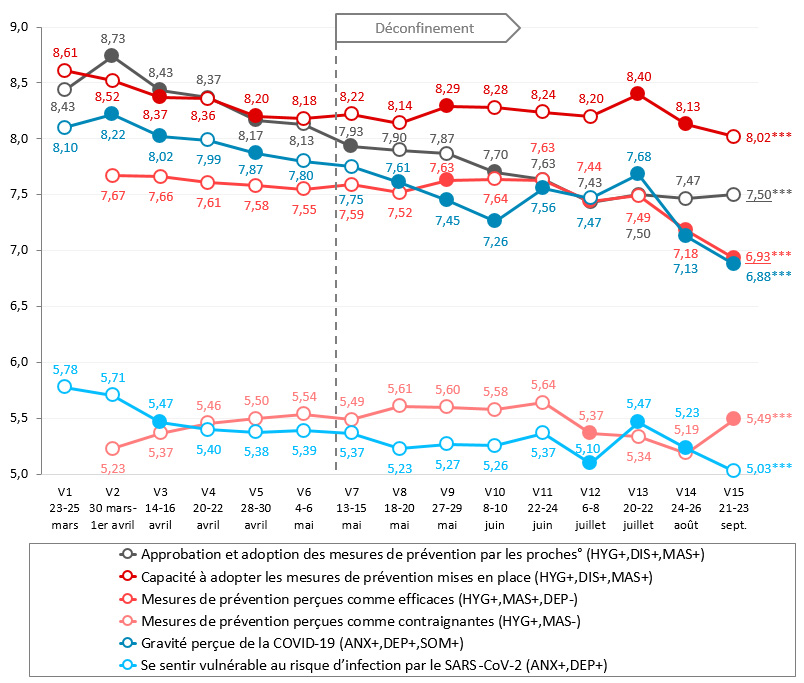
The factors determining the consistent adoption of preventive behaviors across all indicators (number of hygiene measures, maintaining a distance of at least one meter, wearing a mask in public, avoiding face-to-face gatherings and meetings, and avoiding festive gatherings) are:
Perceived social norms (approval and adoption of preventive measures by close contacts).
Feeling capable of adopting preventive measures.
Feeling concerned about the SARS-CoV-2 pandemic is associated with consistently maintaining a distance of at least one meter and wearing a mask in public.
Perceiving preventive measures as effective and not overly restrictive is associated with the number of hygiene measures consistently adopted and the consistent wearing of masks in public.
Conclusion
Each of the preventive measures is adopted consistently or frequently by more than 8 out of 10 people.
However, the consistent adoption of preventive measures has decreased since the lifting of lockdown restrictions. The same is true for the proportion of people reporting that they consistently or frequently adopt preventive measures.
A significant decline has been observed in particular for the measures “avoiding gatherings and face-to-face meetings,” “maintaining a distance of at least one meter,” and “greeting without shaking hands and refraining from hugging.”
The consistent wearing of masks in public has increased since July and has risen by 27 percentage points since the lifting of lockdown restrictions.
In the absence of a treatment or vaccine, the only effective preventive measures remain behavioral (hygiene, distancing, mask-wearing, etc.). The main factors influencing the public’s adoption of preventive measures are social norms (approval and adoption of preventive measures by those around them) and the perceived ease of implementing them: it is therefore crucial for controlling the epidemic, particularly as people return to their daily routines (resuming work and school), to maintain and promote a positive norm of protecting others and to facilitate the adoption of all prevention measures mandated or recommended in various settings (school, transportation, work).
Adoption of preventive measures by indicator
- Prevalence, averages, and trends in indicators of consistent adoption of preventive measures during lockdown (%, averages; weighted data)
Adoption of 4 hygiene measures and 3 physical distancing measures recommended by public authorities
- Prevalence and trends in the systematic adoption of 4 hygiene measures during lockdown by sociodemographic profile (%; weighted data)
- Prevalence and trends in the consistent adoption of 4 hygiene measures by living conditions related to the COVID-19 pandemic and lockdown (%; weighted data)
- Prevalence and trends in the consistent adoption of 3 physical distancing measures by sociodemographic profiles (%; weighted data)
- Prevalence and trends in the consistent adoption of 3 physical distancing measures according to living conditions related to the COVID-19 pandemic and lockdown (% ; weighted data)
Number of prevention measures systematically adopted (among 7 hygiene and physical distancing measures recommended by public authorities)
- Number of prevention measures (among 7) systematically adopted during lockdown and trends by sociodemographic profiles (means; weighted data)
- Number of preventive measures (out of 7) consistently adopted and trends according to living conditions related to the COVID-19 pandemic and lockdown (means; weighted data)
- Cognitive and affective determinants of the number of preventive measures consistently adopted during lockdown and trends (%, means, associations; weighted data)
Adoption of preventive measures by indicator
- Frequency, averages, and trends in indicators of preventive measure adoption during the post-lockdown period (%, averages; weighted data)
Number of hygiene measures adopted systematically (among 4 measures recommended by public authorities)
- Number of hygiene measures adopted systematically during the post-lockdown period and trends by sociodemographic profiles (averages; weighted data)
- Number of hygiene measures adopted systematically during the post-lockdown period and trends according to living conditions related to the COVID-19 pandemic (averages; weighted data)
Systematic adoption of the measure “Maintain a distance of at least 1 meter”
—Prevalence and trends in the systematic adoption of the measure “Maintain a distance of at least 1 meter” during the post-lockdown period by sociodemographic profile (%; weighted data)
- Prevalence and trends in the consistent adoption of the measure "maintain a distance of at least 1 meter" during the post-lockdown period by living conditions related to the COVID-19 pandemic (% ; weighted data)
Consistent wearing of masks in
public - Prevalence and trends in the consistent wearing of masks in public during the post-lockdown period by sociodemographic profiles (% ; weighted data)
- Prevalence and trends in the consistent wearing of masks in public during the post-lockdown period according to living conditions related to the COVID-19 pandemic (% ; weighted data)
Cognitive and affective variables associated with the adoption of preventive
measures- Changes in cognitive and affective variables during the post-lockdown period (%, means; weighted data)
- Cognitive and affective determinants of the three indicators of preventive measure adoption during the post-lockdown period (associations; weighted data)
Changes in cognitive factors associated with indicators of adherence to preventive measures, mental health indicators, and sleep problems during the pandemic (averages; weighted data). CoviPrev Survey, mainland France, 2020