

The Disease
The Different Types of Diabetes
Diabetes mellitus is a disease that prevents the body from properly regulating blood sugar (glucose) levels. Normally, insulin helps control these levels. In diabetes, the body either does not produce enough insulin, the insulin does not work properly, or both, resulting in excess sugar in the blood. There are several types of diabetes.
Type 2 diabetes
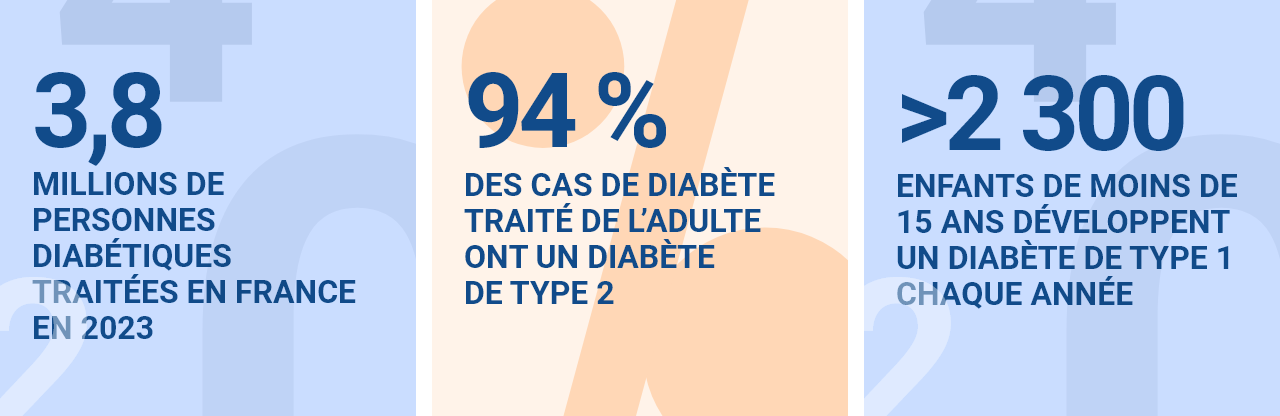
This is the most common form of diabetes (about 94% of diabetes cases among adults in France). It primarily affects middle-aged adults, but can also affect younger people, including teenagers.
Why?
- The body becomes resistant to insulin and/or
- The pancreas does not produce enough insulin to compensate
Type 1 Diabetes
Much less common (about 5% of cases), it mainly affects children and young adults, but can also develop later in adulthood; in such cases, it is referred to as latent autoimmune diabetes in adults (LADA).
Why?
The immune system attacks and destroys the beta cells in the pancreas that produce insulin, and the body can no longer produce insulin. It is therefore vital for people with type 1 diabetes to receive insulin injections.
Gestational Diabetes
Gestational diabetes is a form of glucose intolerance in pregnant women. This type of diabetes begins and is diagnosed for the first time during pregnancy.
Other Types of Diabetes
Other forms of diabetes exist and are caused by specific, less common factors, including:
Monogenic diabetes: such as neonatal diabetes and maturity-onset diabetes of the young (MODY),
pancreatic disorders (such as cystic fibrosis and pancreatitis),
diabetes induced by medications or chemicals (such as glucocorticoids, HIV treatments, or following an organ transplant).
Risk Factors for Diabetes
Type 2 diabetes
Several factors increase the risk of developing type 2 diabetes:
age,
being overweight or obese,
a sedentary lifestyle (lack of physical activity),
medical history:
prediabetes (fasting blood glucose level between 1.10 g/L (6.1 mmol/L) and 1.26 g/L (7.0 mmol/L)),
family history: having a close relative with type 2 diabetes,
environmental factors, particularly exposure to air pollution.
Type 1 diabetes
The causes of type 1 diabetes are still not well understood and are thought to be linked to a combination of genetic predisposition and environmental factors.
Numerous factors have been studied in the international literature, including:
- viral infections,
- nutritional factors,
- stressful family living conditions,
- lack of breastfeeding,
- vitamin D deficiency,
- insufficient exposure to microbes (hygiene hypothesis),
- environmental factors, such as air pollution or endocrine disruptors.
Key Statistics on Diabetes
How is type 2 diabetes diagnosed?
Diagnosing type 2 diabetes is simple and involves a blood test:
- No symptoms: Diabetes is confirmed if the blood sugar level (fasting venous blood glucose, measured after at least 8 hours without eating) is higher than 1.26 g/L (7 mmol/L) on two separate occasions.
- If typical symptoms of diabetes are present: if the person shows signs of excessive thirst, frequent urination, and unexplained weight loss, a single venous blood glucose reading above 2 g/L (11.1 mmol/L) is sufficient for diagnosis.
When should screening be performed?
Regular screening (every one to three years) is recommended for people over 45 who have at least one of the following risk factors:
- indicators of metabolic syndrome (overweight, high blood pressure, dyslipidemia);
- a family history of diabetes (a parent, brother, or sister with diabetes);
- transient diabetes (e.g., caused by medication);
- non-Caucasian and/or immigrant background;
- in women: diabetes during pregnancy (gestational diabetes) or birth of a baby weighing more than 4 kg.
Other Diagnostic Methods
In 2009, an international committee of experts proposed using the glycated hemoglobin (HbA1c) level to diagnose diabetes. However, this method is not recommended in France for making a diagnosis.
Learn more:
- Bergman A, Heindel JJ, Jobling S, Kidd KA, Zoeller RT (2012) State of the science of endocrine-disrupting chemicals—2012; Eze IC, Hemkens LG, Bucher HC, Hoffmann B, Schindler C, Kunzli N, Schikowski T, Probst-Hensch NM (2015) Association between ambient air pollution and diabetes mellitus in Europe and North America: systematic review and meta-analysis. Environmental Health Perspectives 123 (5):381–389. doi:10.1289/ehp.1307823.
- Screening for Type 2 Diabetes: Update on Screening Eligibility Criteria (Guidance Note) | Haute Autorité de santé
Managing Diabetes: Where to Start?
Type 2 Diabetes: A Personalized Approach
Treatment for type 2 diabetes varies from person to person, depending on their health status and medical history. The goals of this management are to:
control blood sugar levels,
prevent macrovascular and microvascular complications,
maintain a good quality of life.
The first step is to adopt lifestyle and dietary changes:
engaging in physical activity to combat a sedentary lifestyle,
a balanced diet,
therapeutic education to learn how to manage the condition on a daily basis.
These measures should be reassessed regularly and combined with appropriate medical follow-up.
If necessary, medication should be added as a supplement.
Type 1 Diabetes: Essential Treatment
Type 1 diabetes requires insulin injections to compensate for the body’s inability to produce insulin.
To assist patients and healthcare professionals, the French National Authority for Health (HAS) has published recommendations on the treatment strategy for patients living with type 2 diabetes.
See also
- Treatment Strategy for Patients Living with Type 2 Diabetes: Recommendations | Haute Autorité de Santé
Complications with a Significant Impact on Quality of Life
Uncontrolled diabetes can lead to short-term or long-term complications that significantly impact quality of life.
Short-term complications: acute conditions may occur
- diabetic ketoacidosis: a buildup of acidic substances in the blood due to a lack of insulin,
- hyperosmolar coma: severe dehydration and extremely high blood sugar levels,
- hypoglycemia: blood sugar levels that are too low, which can cause dizziness, lightheadedness, or even loss of consciousness.
Long-term complications: Over time, uncontrolled diabetes can damage various organs
- Macrovascular complications: damage to the large blood vessels supplying the heart and brain, which can lead to a heart attack or stroke
- Microvascular complications: damage to small blood vessels, the peripheral nervous system, the kidneys, and the retina, which can lead to lower limb amputation, dialysis, and blindness.
Good diabetes control through appropriate treatment, a balanced diet, and a healthy lifestyle can prevent or significantly reduce these risks.
In relation to

Nutrition and Physical Activity
thematic dossier
Nutrition and physical activity are two major determinants of health that contribute to improving the health of the population and are key priorities in public health policy.

Alcohol
thematic dossier
Alcohol is deeply rooted in French culture. Its consumption remains a major cause of death and illness in France.

Tobacco
thematic dossier
Despite a slight decrease compared to 2015, tobacco remains responsible for more than 68,000 premature deaths in 2023—accounting for 11% of total mortality—making it still the leading cause of...