


Other epidemiological data
Prevalence
The prevalence of markers of HBV infection is best estimated through surveys of the general population. In 2004, a national survey on the prevalence of hepatitis B virus (HBV) infection was conducted among the adult population of metropolitan France. This survey estimated the prevalence of HBs antigen at 0.65% (95% CI: 0.45–0.93), corresponding to 280,821 people (95% CI: 179,730–381,913) who were chronic carriers of HBs antigen. Among these individuals, 45% (95% CI: 23–69) were aware of their HBs antigen-positive status. The prevalence of anti-HBc antibodies was 7.3% (95% CI: 6.5–8.2), indicating that 3.1 million people (95% CI: 2.8–3.5) had had prior exposure to HBV. Factors found to be significantly associated with anti-HBc antibody positivity were: intravenous drug use, homosexuality, precarious living conditions, an educational level below the high school diploma, a stay of at least three months in institutions, a country of birth where the prevalence of HBs antigen is greater than 2%, a place of residence located in the Northeast, Southeast, or the Île-de-France region, being male, and being over 29 years of age.An analysis of data from the Program for the Medicalization of Information Systems in Medicine, Surgery, Obstetrics, and Home Hospitalization (PMSI MCO - HAD) calculated the hospital prevalence of hepatitis B over the 2004–2011 period.
Prevalence of Hepatitis B and C in France in 2004. Saint Maurice: Institute for Health Surveillance, 2006. 176 p.
Septfons A, Gautier A, Brouard C, Bernillon P, Nicolau J, Larsen C. Prevalence, morbidity, and mortality associated with chronic hepatitis B and C in the hospitalized population in France, 2004–2011. Bull Epidemiol Hebd 2014,12:202–9.
Care: Data on Long-Term Conditions
Individuals with chronic hepatitis B and C virus infections may, under certain conditions, be eligible for the Long-Term Conditions (ALD) program under the health insurance schemes under ALD6 (active chronic liver diseases and cirrhosis). This program allows, upon request by the attending physician and within the framework of a treatment protocol, exemption from the copayment for procedures and services required for the treatment of the condition.
Chronic viral hepatitis B cases that test positive for HBsAg and exhibit:
signs of active viral replication: HBV DNA > 2,000 IU/ml or even an occasional elevation in transaminase levels,
the need for antiviral treatment or long-term follow-up.
The exemption is granted for an initial period of two years, renewable if the patient receives antiviral treatment. The onset of serious sequelae, where a causal link to the treatment is established, leads to the reinstatement of the copayment exemption. (HAS, Procedures and Services for Long-Term Conditions No. 6, Chronic Hepatitis B, May 2016)
Analyses of the number of people eligible for ALD 6 for chronic hepatitis B (codes B180, B181) as of December 31 of a given year are based on individual data from the SNIIRAM SNDS. The 2016 data cover all insurance schemes and the whole of France. The data allowing for historical comparisons (2010 to 2016) concern the following schemes: the general scheme, BDF (Banque de France Health Insurance Fund and Reserve Fund for Banque de France Employees), CAMIEG (Health Insurance Fund for the Electricity and Gas Industries), CAVIMAC (Old Age, Disability, and Health Insurance Fund for Religious Workers), CNMSS (National Military Social Security Fund), CRPCEN (Pension and Welfare Fund for Clerks and Employees of Notaries), and local mutual insurance sections throughout France.
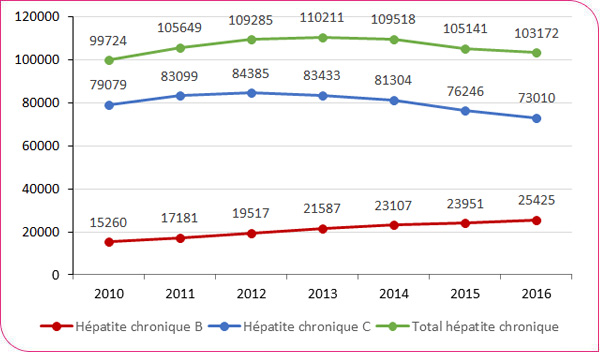
According to SNIIRAM SNDS data covering all schemes throughout France, the number of people with ALD 6 for chronic hepatitis B was 27,328 in 2016. Available historical data (general scheme data, local mutual insurance sections, BDF, CAMIEG, CNMSS, CRPCEN) show an annual increase ranging from 3.7% to 10.6% since 2012.
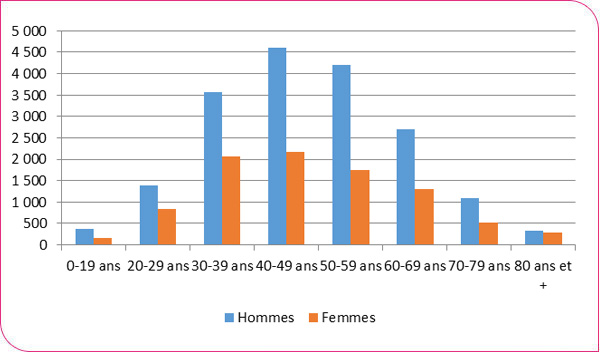
In 2016, 66.7% of people with ALD for chronic hepatitis B were men.
The most represented age groups for men were those aged 40–49 (25.2%) and 50–59 (23.0%). For women, they were those aged 40–49 (24.8%) followed by those aged 50–59 (21.7%) (Figure 1).
Relative to the population, the number of people with chronic hepatitis B under the ALD program is 41 per 100,000 inhabitants in France, 40 per 100,000 inhabitants in metropolitan France, and 52 per 100,000 inhabitants in the DROM (including Saint Martin and Saint Barthélemy).
Figure 1 - Distribution by sex and age group of people with long-term chronic disease (ALD) for chronic hepatitis B as of December 31, 2016, France as a whole (SNIIRAM SNDS, all health insurance schemes)
Source: SNIIRAM SNDS, all insurance schemes, all of France (Data extracted in April 2018). Analysis: Santé publique France
Figure 2 - Number of people with a long-term condition as of December 31, 2016, for chronic hepatitis, for chronic hepatitis C and chronic hepatitis B, general scheme, local mutual insurance sections, BDF, CAMIEG, CAVIMAC, CNMSS, CRPCEN, RG, SLM, all of France
Sources: SNIIRAM SNDS, Insurance schemes: general scheme, local mutual insurance sections, BDF, CAMIEG, CAVIMAC, CNMSS, CRPCEN, RG, SLM, all of France (Extracted April 2018). Analysis: Santé publique France
The ICD-10 codes used are:
- Chronic hepatitis C: B182
- Chronic hepatitis B: B180, B181
- Total chronic hepatitis: B18, B180, B181, B182, B188, B189
Data by region are presented in the section "Regional Hepatitis B Surveillance Indicators."
Mortality
A national survey on mortality related to hepatitis B and C, conducted in 2004–2005 among certifying physicians, estimated that 1,507 deaths (95% CI: 640–2,373) were associated with HBV (positive HBsAg), corresponding to a mortality rate of 2.6 per 100,000 (95% CI: 1.4–4.5), of which 1,327 (88%) were assessed as attributable to HBV, representing a mortality rate of 2.2 per 100,000 (95% CI: 0.8–3.7). The death rate is 2.5 times higher among men than among women, with a median age at death of 65 years. The stage of the disease at the time of death is at least cirrhosis in 93% of cases and hepatocellular carcinoma on cirrhosis in 35% of cases.
An analysis of data from the Program for the Medicalization of Information Systems in Medicine, Surgery, Obstetrics, and Home Hospitalization (PMSI MCO-HAD) enabled the estimation of in-hospital mortality associated with hepatitis B and C over the 2004–2011 period.
Septfons A, Gautier A, Brouard C, Bernillon P, Nicolau J, Larsen C. Prevalence, morbidity, and mortality associated with chronic hepatitis B and C in the hospitalized population in France, 2004–2011. Bull Epidemiol Hebd 2014,12:202–9.
Vaccination Coverage
The most recent data on vaccination coverage are available in the vaccination coverage section.
14 regional bulletins were published in 2017 (Hauts-de-France, Île-de-France, Normandy, Brittany, Pays de la Loire, Centre/Val-de-Loire, Grand Est, Burgundy/Franche-Comté, Auvergne/Rhône-Alpes, Nouvelle-Aquitaine, Provence-Alpes-Côte d'Azur-Corsica, Occitanie, Réunion-Mayotte, French West Indies-French Guiana)












