


Hepatitis A Outbreak in France - Update as of March 1, 2010
The French Institute for Public Health Surveillance is currently investigating an outbreak of hepatitis A in collaboration with the relevant partners and agencies: the National Reference Center for Enteric Viruses (Hepatitis A), the Laboratory for Studies and Research on Food Quality and Agri-Food Processes of the French Agency for Food Safety, the Directorate General for Health, the Departmental Directorates for Health and Social Affairs, the Directorate General for Competition, Consumer Affairs, and Fraud Control, the Directorate General for Food, and the Departmental Directorates for Social Cohesion and Population Protection.
Hepatitis A is a viral disease that is most often asymptomatic in young children but can cause febrile asthenia, gastroenteritis, and jaundice in adults. Severe forms, which are very rare, are most commonly identified in adults with underlying chronic liver disease. Approximately 1,500 cases are reported each year under the mandatory reporting system established in 2005. As of March 1, 2010, 55 cases linked to this outbreak had been identified, including 26 women and 29 men, aged 7 to 52 years (average age 31). Twenty-seven patients were hospitalized. The clinical course was favorable for all.
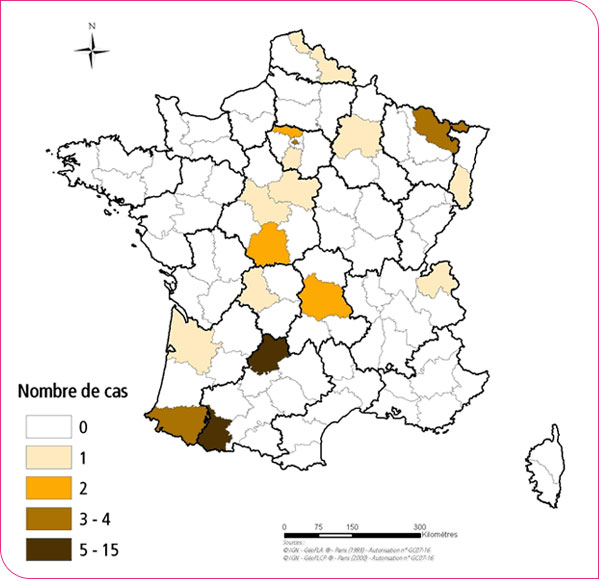
Symptoms appeared between November 20, 2009, and February 5, 2010 (Figure 1). The cases are located in 18 metropolitan departments, with two major clusters in the Hautes-Pyrénées and Pyrénées-Atlantiques (19 cases) and in the Lot (15 cases) (Figure 2).
Figure 1
Weekly distribution of cases by date of symptom onset - Hepatitis A outbreak, France, November 2009–February 2010
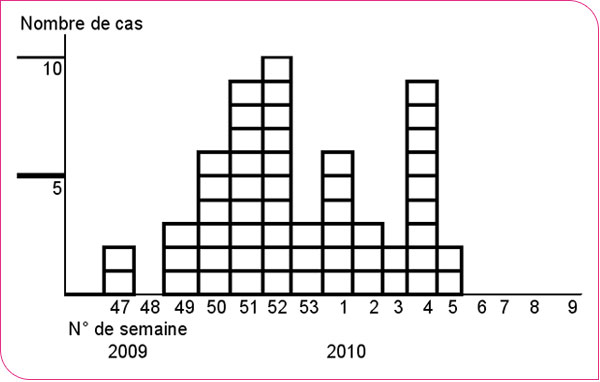
Figure 2
Geographic distribution of cases by department of residence - Hepatitis A outbreak, France, November 2009–February 2010
Interviews with patients regarding their food consumption during the 2 to 6 weeks preceding the onset of illness (incubation period for hepatitis A) revealed an unusually high frequency of dried tomato consumption. These dried tomatoes had been consumed in sandwiches or salads purchased at sandwich shops. The traceability investigation indicated that these tomatoes likely came from a single batch of frozen tomatoes imported from Turkey and distributed between early October 2009 and late January 2010. If this hypothesis is confirmed, there would currently be no further risk, as this batch is no longer being distributed. However, other cases of hepatitis A could occur due to person-to-person transmission. Prevention of hepatitis A relies on personal and public hygiene, particularly hand hygiene.
This hepatitis A outbreak linked to the consumption of dried tomatoes is the second such outbreak reported worldwide. In Australia, investigations conducted during a major outbreak in 2009 (240 cases from May 2009 to January 2010) also attributed that outbreak to the consumption of dried tomatoes.












