


CoVaPred: How can the public protect themselves, and what are the vaccination plans for COVID-19 once the vaccine becomes available?
Santé publique France is launching the CoVaPred survey in collaboration with Inserm and the CNRS to understand the adoption of protective measures against the coronavirus and assess vaccination intentions once new COVID-19 vaccines become available.
Take part in the CoVaPred study

While the French public has generally accepted the lockdowns imposed due to the SARS-CoV-2 pandemic and continues to follow preventive measures, only mass vaccination can help contain this pandemic and restore normal life. However, vaccination is a personal choice. This is why it is essential for health authorities to anticipate the French public’s intentions regarding COVID-19 vaccination. With this in mind, Santé publique France and its partners have launched a survey aimed at better understanding the adoption of protective measures and gauging vaccination intentions against COVID-19 among the adult population aged 18 to 64.
Objectives
The “CoVaPred” study has two objectives:
to better understand the protective measures adopted by the population against COVID-19
to assess vaccination intentions once new COVID-19 vaccines become available
Survey Procedure
This study is open to all individuals aged 18 to 64 residing in mainland France. The study is based on two representative samples surveyed in late June and December 2020, as well as voluntary participation in the survey via official information sites (Santé publique France, Ameli) and social media (CoVaPred on Facebook, Twitter, and Instagram). All you need to do is complete an online questionnaire.
Questionnaire Content
The questionnaire, accessible via a computer or smartphone, consists of checkboxes. It does not require written responses. There are no “right” or “wrong” answers: the goal is simply to gather the respondent’s opinion on the day they participate in the survey. Completing the questionnaire takes about 15 minutes. Participation in the survey is anonymous.
The more participants there are, the more meaningful the study’s results will be.
Results of the first survey wave (Summer 2020)
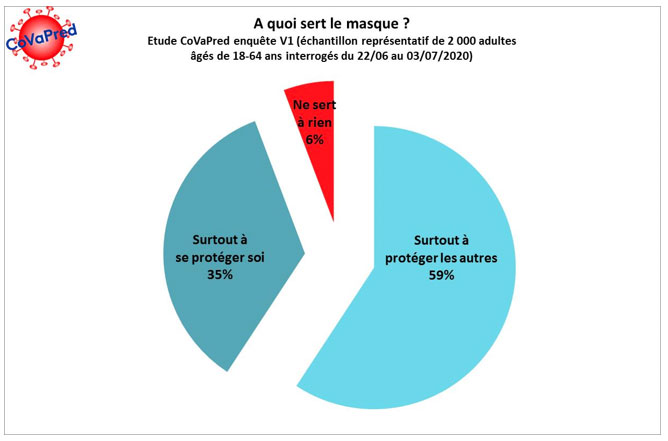
What is the purpose of wearing a mask against COVID-19?
Wearing a mask helps reduce the risk of transmission of respiratory viruses, including SARS-CoV-2. According to scientific literature, its effectiveness is greatest when the mask is worn by anyone who is sick and experiencing symptoms (especially a cough). Its effectiveness is maximized when masks are worn by everyone, whether sick or not.
In the specific context of the SARS-CoV-2 pandemic, anyone with COVID-19 must self-isolate for at least 8 days and until symptoms have completely disappeared. Consequently, the risk of SARS-CoV-2 transmission is greatly reduced (all COVID-19 patients, who pose a high risk of transmission, are isolated from the general population), but it persists insidiously (people who are “asymptomatic” or “presymptomatic”—and pose a low risk of transmission—remain in the general population). In this specific context, what is the purpose of wearing a mask?
59% of people aged 18 to 64 believe that wearing a mask is primarily intended to protect others (by preventing the spread of infection to others in the event of an “asymptomatic” or “presymptomatic” infection),
35% believe that wearing a mask is primarily to protect oneself (by preventing infection from others, whether they are symptomatic, presymptomatic, or asymptomatic),
6% of respondents believe that wearing a mask serves no purpose (as the risk of infection and/or the effectiveness of wearing a mask are considered too low),
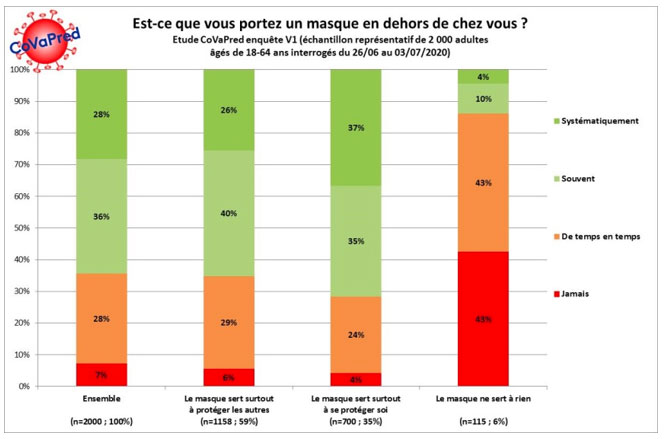
The diversity of opinions expressed regarding mask-wearing (and the underlying factors) has a significant impact on compliance with mask-wearing: People who perceive that wearing a mask “is mainly to protect oneself” wear masks more consistently than those who perceive that wearing a mask “is mainly to protect others,” and far more so than those who perceive that wearing a mask “is pointless.”
A closer look at the opinions expressed reveals that:
Men are more likely than women to believe that wearing a mask “serves no purpose”
People with an education, particularly those with a college degree, are more likely to perceive that wearing a mask “is mainly to protect others”
People who sometimes, or even never, follow vaccination recommendations believe that wearing a mask “is pointless”
People who perceive COVID-19 as “not serious at all” are more likely to believe that wearing a mask “is pointless”; conversely, people who perceive COVID-19 as “very serious” are more likely to believe that wearing a mask “is mainly to protect oneself”
People “at risk” of severe COVID-19 (smoking, obesity, hypertension, diabetes, chronic illness) and older adults (ages 50–64) do not more often perceive that wearing a mask “is mainly to protect oneself”
Note that these results are identical if the analysis is conducted without taking into account perceptions of the severity of COVID-19.
| Determinant | Distribution | What is the purpose of the mask? (reference: mainly to protect others) | |||
|---|---|---|---|---|---|
| Mainly to protect oneself | Serves no purpose | ||||
| OR (95% CI) | Test | OR (95% CI) | Test | ||
| Gender | |||||
| Female (reference) | 1022 (51.1%) | 1 | 1 | ||
| Male | 978 (48.9%) | 0.87 (0.72–1.07) | 0.184 | 1.57 (1.02–2.41) | 0.041 |
| Highest degree obtained | |||||
| Less than a bachelor’s degree (reference) | 874 (43.7) | 1 | |||
| High school diploma | 428 (21.4%) | 0.59 (0.45–0.77) | <0.001 | 0.65 (0.38–1.11) | 0.113 |
| After high school | 698 (34.9%) | 0.40 (0.32–0.51) | <0.001 | 0.32 (0.18–0.56) | <0.001 |
| Adherence to vaccination recommendations | |||||
| Always (reference) | 1,018 (50.9%) | 1 | 1 | ||
| Sometimes | 733 (36.6%) | 0.95 (0.76–1.17) | 0.604 | 3.41 (2.00–5.83) | <0.001 |
| Never | 249 (12.5%) | 1.11 (0.80–1.53) | 0.527 | 6.40 (3.52–11.64) | <0.001 |
| Perception of the severity of COVID-19 if infected | |||||
| Not serious at all (reference) | 108 (5.4%) | 1 | 1 | ||
| Not very serious | 639 (31.9%) | 1.06 (0.64–1.77) | 0.816 | 0.20 (0.11–0.37) | <0.001 |
| Moderately severe | 717 (35.9%) | 1.39 (0.83–2.32) | 0.212 | 0.07 (0.03–0.15) | <0.001 |
| Very severe | 252 (12.6%) | 2.02 (1.15–3.54) | 0.014 | 0.12 (0.04–0.32) | <0.001 |
| No opinion | 284 (14.2%) | 1.10 (0.63–1.91) | 0.734 | 0.29 (0.15–0.58) | <0.001 |
Source: CoVaPred Study, Survey V1 (representative sample of 2,000 adults aged 18–64 interviewed from June 26 to July 3).
Note: Odds ratios (OR) and 95% confidence intervals (95% CI) estimated using a multinomial logistic model after adjusting for stratification variables in the survey (sex, age, highest level of education attained, household size, size of residential urban area, region of residence in metropolitan France) and the risk factors for severe COVID-19 reported in the survey (smoking, obesity, hypertension, diabetes, chronic disease, pregnancy).
Conclusion
Wearing a mask is becoming mandatory in many cities (August 2020) and workplaces (September 2020). The results of this study conducted in early July suggest that compliance with this new public health measure will be higher among people who perceive that wearing a mask “is mainly to protect oneself.” The results also suggest that people under 65 do not correctly identify when they are “at risk” of severe COVID-19 and, if so, the need to consistently wear a mask to “protect oneself.”
Do "young people" protect "older people" from COVID-19?
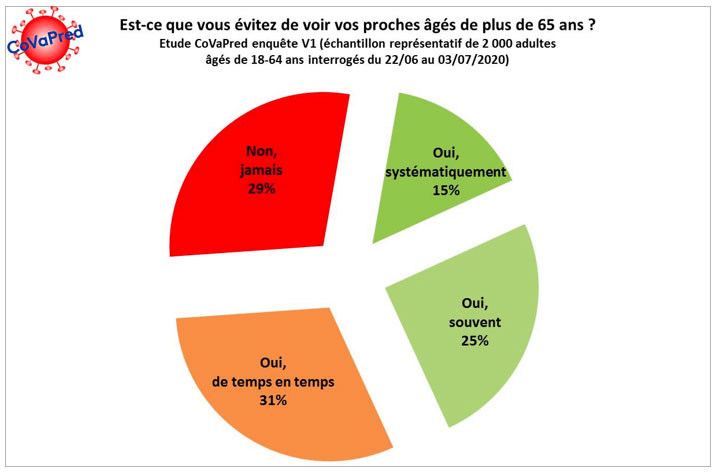
SARS-CoV-2 infection is highly contagious (R0 ≥ 3) and more contagious than seasonal flu (R0 ≈ 2). The COVID-19 disease it can cause is usually mild but can be severe, particularly in older adults: more than 9 out of 10 deaths attributed to COVID-19 occur in people aged 65 or older. Consequently, older adults have been advised to limit visits to essential ones since the start of the SARS-CoV-2 epidemic. In this specific context, to what extent is the population aged 18 to 64 avoiding contact with their relatives aged 65 or older?
After excluding 294 (15%) respondents who reported having no relatives over the age of 65, an analysis of the responses from the remaining 1,706 (85%) respondents shows that a majority (71%) of people aged 18 to 64 avoid seeing their relatives over the age of 65. However, only 15% systematically avoid seeing them.
A more in-depth study of avoidance behavior reveals that:
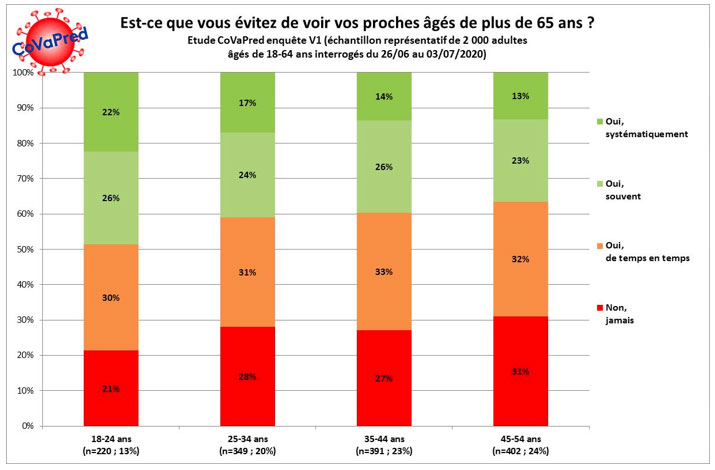
Differences in avoidance behavior among young adults are even more pronounced: adults aged 18 to 24 are three times more likely to report “systematically avoiding seeing their relatives over 65” compared to adults aged 55–64. Note that the results presented would not change if the analysis included people who reported having no relatives over 65
The younger the adults, the more they avoid seeing their relatives over 65
Compared to single people, those in a relationship are more likely to avoid seeing relatives over 65
People who never follow vaccination recommendations are also less likely to protect their relatives over 65
The tendency to avoid relatives over 65 is all the more pronounced the more people perceive that COVID-19 can be serious
It should also be noted that gender, education level, the size of the residential area, or the region of residence are not independently associated with the behavior of avoiding relatives over 65.
| Determinant | Distribution | Avoidance behavior toward relatives over 65 (yes vs. no) | |
|---|---|---|---|
| OR (95% CI) | Test | ||
| Age group | |||
| 18–24 years | 220 (12.9%) | 2.21 (1.45–3.38) | <0.001 |
| 25–34 | 349 (20.5%) | 1.52 (1.06–2.18) | 0.022 |
| 35–44 years | 391 (22.9%) | 1.45 (1.02–2.07) | 0.039 |
| 45–54 years | 402 (23.6%) | 1.18 (0.86–1.64) | 0.305 |
| 55–64 years (reference) | 344 (20.2%) | 1 | |
| Household | |||
| Single (reference) | 365 (21.4%) | 1 | |
| In a relationship | 1,341 (78.6%) | 1.48 (1.14–1.92) | 0.003 |
| Compliance with vaccination recommendations | |||
| Always (reference) | 884 (51.8%) | 1 | |
| Sometimes | 628 (36.8%) | 0.88 (0.70–1.12) | 0.299 |
| Never | 194 (11.4%) | 0.59 (0.42–0.83) | 0.003 |
| Perception of the severity of COVID-19 if infected | |||
| Not serious at all (reference) | 93 (5.5%) | 1 | |
| Not very serious | 553 (32.4%) | 1.90 (1.19–3.03) | 0.007 |
| Quite serious | 613 (35.9%) | 2.64 (1.64–4.26) | <0.001 |
| Very severe | 212 (12.4%) | 3.03 (1.75–5.25) | <0.001 |
| No opinion | 235 (13.8%) | 2.12 (1.26–3.56) | 0.005 |
Source: CoVaPred Study, Survey V1 (representative sample of 2,000 adults aged 18–64 interviewed from June 26 to July 3).
Note: Odds ratios (OR) and 95% confidence intervals (95% CI) estimated using a logistic model and adjusted for stratification variables in the survey (sex, age, highest level of education attained, household size, urban area size, region of residence in metropolitan France) and knowledge of infected individuals in the social circle.
Conclusion
People aged 65 or older are particularly at risk of severe COVID-19. Monitoring of the SARS-CoV-2 epidemic shows a resurgence of infections among young adults during the summer. However, the results of this study show that in early July, the young adult population with the highest infection rates is also the one that most avoids contact with people aged 65 and older to protect them.
For or against chloroquine for COVID-19?
In its opinion dated May 24, 2020, the High Committee on Public Health concluded that the risk-benefit balance of chloroquine or its derivative hydroxychloroquine is not favorable as a treatment for COVID-19. (Hydroxy)chloroquine has not shown any improvement in survival rates in severe cases of COVID-19 but, on the contrary, has been associated with an increased risk of serious side effects (ventricular arrhythmia). This assessment would remain unchanged today even if the most recent medical data were taken into account.
The use of (hydroxy)chloroquine for COVID-19 has sparked numerous expert debates since the start of the pandemic and remains controversial. From the perspective of health authorities, (hydroxy)chloroquine should no longer be prescribed for COVID-19 as of May 27, in both outpatient and inpatient settings. One month later, the CoVaPred study sheds light on the general public’s perspective.
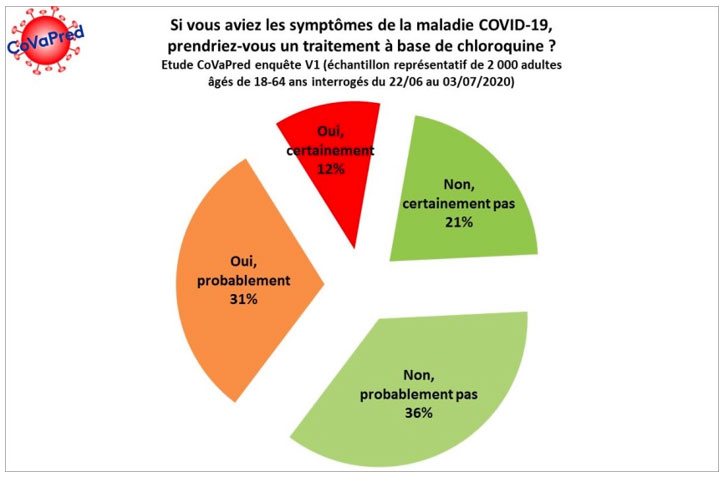
After excluding 58 (3%) people who had already had COVID-19 and 245 (12%) people who reported not knowing what a chloroquine-based treatment is, an analysis of the responses from the remaining 1,697 (85%) people shows that:
57% of people aged 18 to 64 would not take (hydroxy)chloroquine for COVID-19,
43% of people remain convinced of the individual benefits of (hydroxy)chloroquine in the event of COVID-19 symptoms.
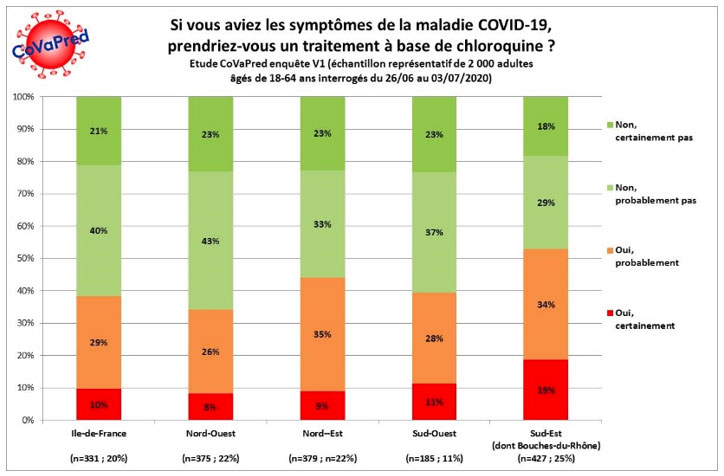
A more in-depth analysis of attitudes for or against (hydroxy)chloroquine reveals that:
Pro-chloroquine attitudes are even more pronounced in the Southeast region, where respondents are twice as likely to say they are “certain they would take a chloroquine-based treatment if infected” than in the Île-de-France region. It should be noted that the results presented would not change if the analysis included people who stated they did not know what a chloroquine-based treatment is.
A pro-chloroquine attitude is more common among those with no formal education.
Smokers are more likely to adopt a pro-chloroquine attitude than non-smokers.
People who do not always follow vaccination recommendations also adopt a pro-chloroquine attitude more often.
In the context of the SARS-CoV-2 pandemic, a pro-chloroquine attitude is associated with the perception that masks are primarily useful for protecting oneself, or even useless.
Compared to the rest of France, people living in the Southeast (including the Bouches-du-Rhône department) are more likely to hold a pro-chloroquine attitude.
It is also worth noting that gender, household size, risk factors for severe COVID-19, or the perception of the severity of COVID-19 are not associated as such with attitudes for or against chloroquine in the context of COVID-19.
It is also worth noting that gender, education level, the size of the residential urban area, or the region of residence are not independently associated with the behavior of avoiding close contacts over the age of 65.
| Determinant | Distribution | Chloroquine-based treatment for COVID-19 (yes vs. no) | |
|---|---|---|---|
| OR (95% CI) | Test | ||
| Highest level of education attained | |||
| Before high school | 718 (42.3%) | 1.84 (1.43–2.37) | <0.001 |
| High school diploma | 363 (21.4%) | 1.64 (1.23–2.17) | <0.001 |
| Post-baccalaureate (reference) | 616 (36.3%) | 1 | |
| Smoking status | |||
| Never smoked | 728 (42.9%) | 1 | |
| Former smoker or current smoker | 969 (57.1%) | 1.27 (1.02–1.57) | 0.029 |
| Compliance with vaccination recommendations | |||
| Always (reference) | 866 (51.0%) | 1 | |
| Sometimes | 618 (36.4%) | 1.49 (1.19–1.87) | <0.001 |
| Never | 213 (12.6%) | 1.30 (0.93–1.82) | 0.12 |
| What is the purpose of wearing a mask? (against SARS-CoV-2 infection) | |||
| Mainly to protect others (reference) | 1,019 (60.1%) | 1 | |
| Mainly to protect oneself | 581 (34.2%) | 1.35 (1.09–1.68) | 0.007 |
| It’s pointless | 97 (5.7%) | 1.70 (1.08–2.69) | 0.023 |
| Region of residence | |||
| Ile-de-France (reference) | 331 (19.5%) | 1 | |
| Northwest | 375 (22.1%) | 0.79 (0.55–1.12) | 0.18 |
| Northeast | 379 (22.3%) | 1.13 (0.81–1.58) | 0.47 |
| Southwest | 185 (10.9%) | 0.94 (0.63–1.41) | 0.78 |
| Southeast (including Bouches-du-Rhône) | 427 (25.2%) | 1.70 (1.24–2.34) | <0.001 |
Source: CoVaPred Study, Survey V1 (representative sample of 2,000 adults aged 18–64 interviewed from June 26 to July 3).
Note: Odds ratios (OR) and 95% confidence intervals (95% CI) estimated using a logistic model and adjusted for stratification variables in the survey (gender, age, highest level of education attained, household size, urban area size, region of residence in metropolitan France), healthcare worker status, risk factors for severe COVID-19 reported in the survey (smoking, obesity, hypertension, diabetes, chronic disease, pregnancy), history of symptoms suggestive of COVID-19 or a COVID-19 test without medical confirmation of infection, knowledge of infected individuals in one’s social circle, and perception of the severity of COVID-19 in the event of infection.
Conclusion
In late May, health authorities decided to suspend the exceptional prescription of (hydroxy)chloroquine as a treatment for COVID-19. One month later, the results of this study suggest mixed support for this decision: 43% of people aged 18 to 64 remain convinced of the individual benefits of this treatment. The results of this study also suggest that a pro-chloroquine stance indicates a general opposition to public health recommendations (quitting smoking, vaccination, mask-wearing), exacerbated by educational level and societal controversy.
Stay informed about the COVID-19 pandemic in France and around the world
Updates, Q&As, expert interviews... everything you need to know about the novel coronavirus (SARS-CoV-2) and COVID-19 in France and around the world












